The heat pump is running and the oil burner is gone, but a 275-gallon tank still fills a corner of the basement and its fill pipe still opens on the side of the house. Clement Boston Heat Pumps handles oil tank removal in Boston and the surrounding towns as the last step of an oil-to-heat-pump conversion.
Our typical range to remove an accessible basement tank is $600 to $1,500, plus the fire department’s permit. In Boston that permit is $110.
Do you have to remove the oil tank?
Not for the rebate. Mass Save’s whole-home rebate asks for the old system removed or disconnected, and a disconnected, capped fuel line is one way to meet it. The tank can stay.
There are good reasons to take it out anyway. A tank with oil in the bottom can still rust through, and the corner it fills is often the best spot in the basement for storage or the new air handler. Our Mass Save rebate guide covers the rest of the whole-home rules.
Keeping oil as backup
If you’re keeping the oil furnace as backup in a dual-fuel system, the tank stays in service and none of this applies.
The delivery risk
If the oil account stays open, or a driver goes to the wrong address, oil pumped into a fill pipe with no working tank behind it ends up on the basement floor. We take the fill and vent pipes out at the foundation and seal the holes. Close the oil account too.
What happens on the first look
We look at the tank, the pipes and the way out. Those three set the price, and they go on the written estimate with the permit.
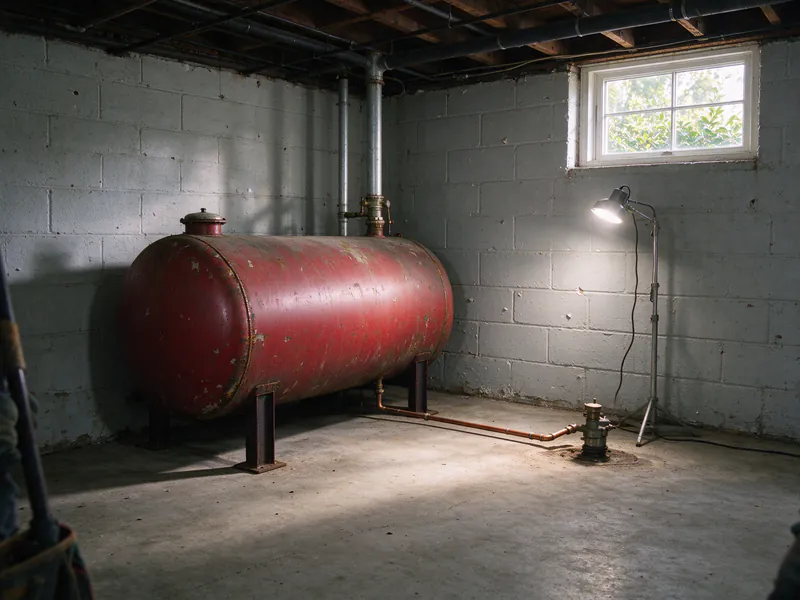
- The tank. Its size (275 gallons is the common basement tank), how much oil is left, any weeping at the seams or bottom, and staining on the floor underneath.
- The pipes. Where the fill and vent leave the house, and the supply line to where the burner stood.
- The route out. Stair width and turns, a bulkhead if there is one, and the doors to the driveway. A 275-gallon tank is about 27 inches wide and 5 feet long: a straight stair or a bulkhead takes it whole, a turning stair doesn’t.
- Timing. The tank comes out after the heat pump is heating, so the house is never without heat.
How the tank comes out
Pump it, clean it, cut it if it has to be, carry it out, seal the pipes, haul it to the tank yard. On an accessible basement tank that’s one day on site.
Emptying and cleaning
The oil and the sludge at the bottom are pumped into a truck or drums. The inside is wiped down and vented, because a tank is never cut while oil vapor is still in it.
Cutting and carrying
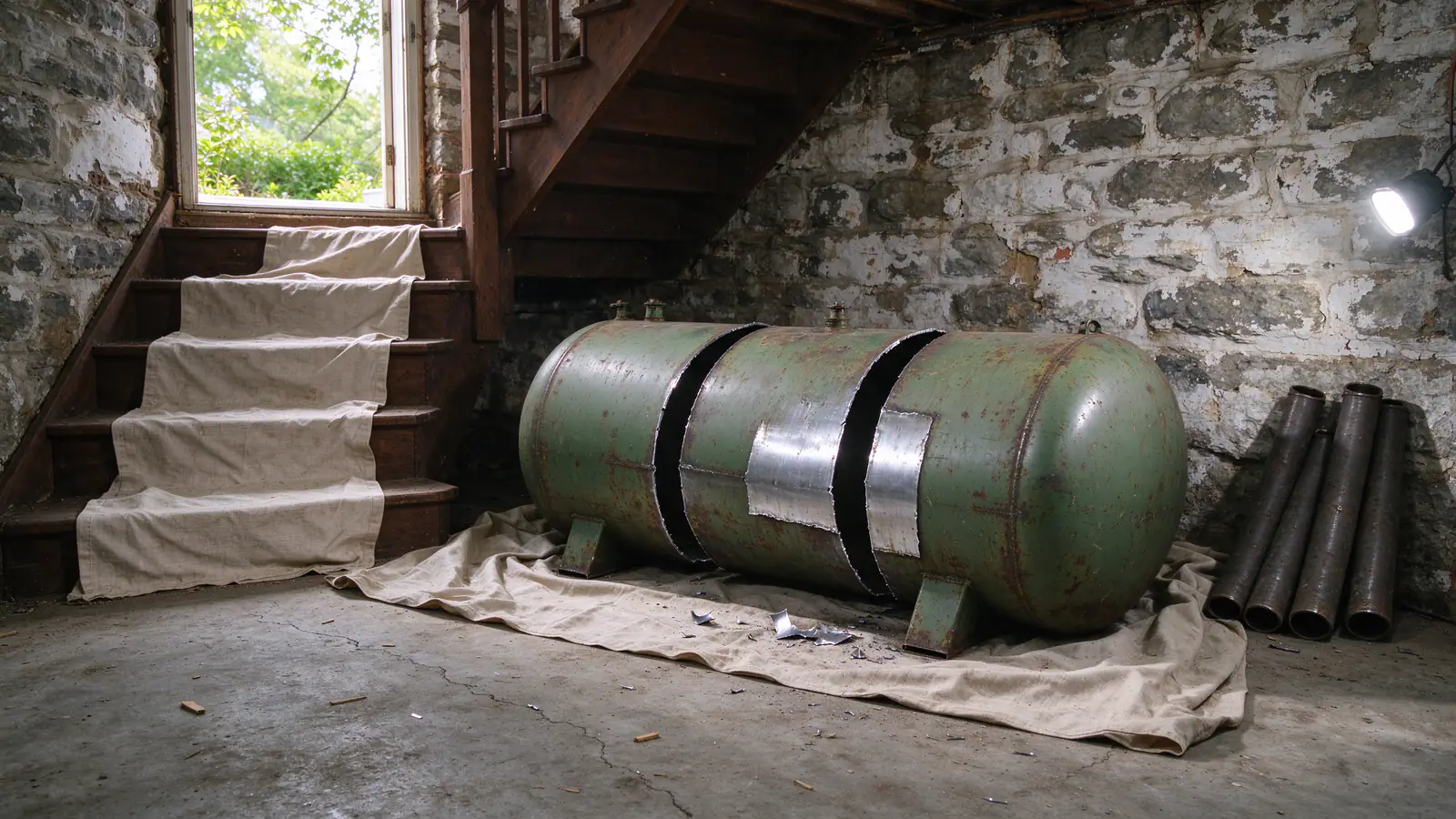
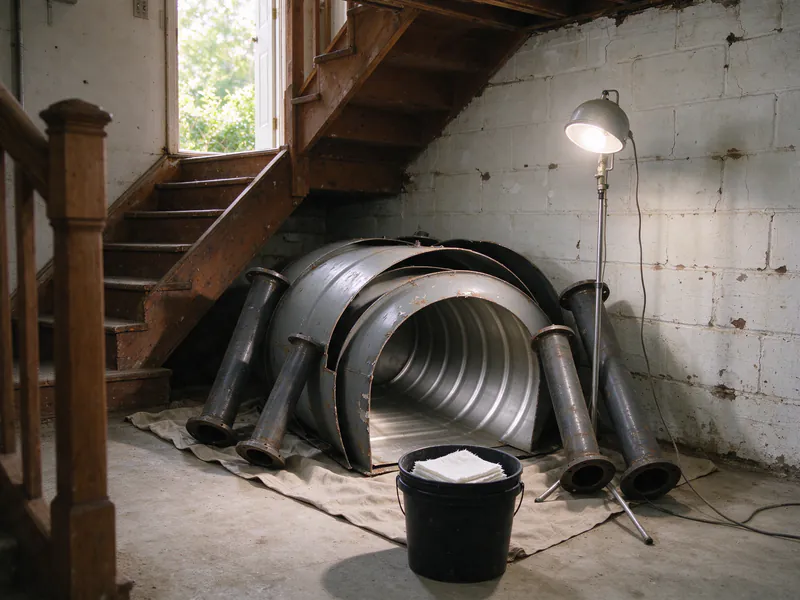
A tank that fits through the doors leaves whole. One that doesn’t is cut into sections with cold-cutting tools that don’t throw sparks, and the pieces go up the stairs over drop cloths.
Pipes and floor
Outside, the fill and vent pipes come out and the foundation openings are sealed. Inside, the supply line comes out back to where the burner stood. We check the floor under the tank for staining and sweep the area.
The permit and the paperwork
Massachusetts law requires a fire department permit to remove a tank and carry it away. In Boston it’s $110 from the Boston Fire Department; other towns set their own fee.
| Step | Who handles it | What it means for you |
|---|---|---|
| Permit before work | Your fire department; in Boston, its Fire Prevention Division | We arrange it; $110 in Boston |
| Inspection | The fire department, by appointment | An inspector may look at the tank and the floor |
| Disposal | An approved tank yard | The tank is cleaned and scrapped there |
| Receipt | Back to the fire department | In Boston, within 72 hours of delivery to the yard |
Cambridge, Somerville, Quincy and the other towns we serve work under the same state fire code, 527 CMR 9.00, through their own fire departments. The steps match; the fee and the inspection booking differ.
Buried tanks are a different job
An underground tank means digging, and the soil around it has to be checked. We price those after a look, and they’re scoped separately from the heat pump.
Removing a buried tank means locating it, excavating, opening and cleaning it in the hole, lifting it out and testing the soil. If the soil shows oil, the cleanup falls under the state’s contamination rules (Chapter 21E) with a licensed site professional overseeing it, and that’s scoped separately before anyone commits to a price.
Signs you have one
A fill pipe in the lawn or beside the foundation with no tank in the basement, a vent pipe on an outside wall, or an old burner supply line that runs into the floor. A house converted to gas decades ago can still have a tank in the yard.
How tank removal fits the conversion
The tank is the last piece of an oil conversion. The heat pump goes in, the burner comes out, the line is capped, and the tank follows once the new system is heating.
Done in that order, the house always has heat, and the capped line meets the whole-home rebate’s removal rule before the tank leaves. The heat pump vs oil heat guide covers running costs, and the cost guide shows the tank line beside our heat pump ranges.
Planning the last oil delivery
Once the install date is set, stop ordering oil and let the tank run low. Whatever is left at the end gets pumped out with the tank, so a full tank in October is money you won’t get back. If the whole-home heat pump goes in midwinter, we talk through how much oil the last weeks need.