If your Quincy condo or apartment heats with electric baseboard, you’re paying full price for every unit of heat. Replacing it is the first thing Clement Boston Heat Pumps looks at for heat pump installation in Quincy, MA, because a ducted system cuts that cost the most.
Close to three in ten Quincy homes heat with electricity, one of the highest shares near Boston. Four in ten sit in buildings of five or more units, so many of those conversions start with an association, not a basement.
Why baseboard homes come first in Quincy
A heat pump moves heat instead of making it, which matters most where the current heat is resistance. That describes a large part of Quincy’s condo and apartment stock.
What baseboard costs you
Baseboard and wall heaters turn one kilowatt-hour into one unit of heat. A cold-climate heat pump moves two to three units for the same kilowatt-hour on a typical winter day, and it cools in summer through the same ducts.
Mass Save counts electric resistance as an eligible system to replace, so the whole-home rebate applies once the baseboard is retired. Our baseboard conversion page walks through the layout options.
No ducts, no basement
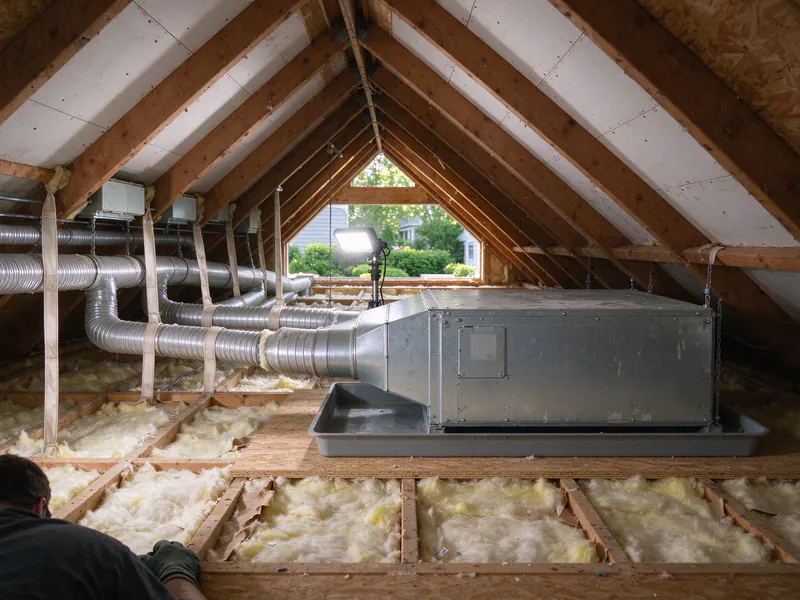
A condo unit on an upper floor rarely has a basement to work from. The top floor can use the attic; a middle unit uses a closet air handler and short runs above a dropped hallway ceiling. See attic air handlers and heat pump ductwork.
Where a ducted plan can’t reach every room without major demolition, we say so in the estimate. The ducted vs ductless guide sets out that comparison.
Living with the bay
Quincy is one of the state’s coastal communities, with miles of shoreline from Squantum to Houghs Neck. Salt air and storm water change where an outdoor unit should sit.
Salt and spray
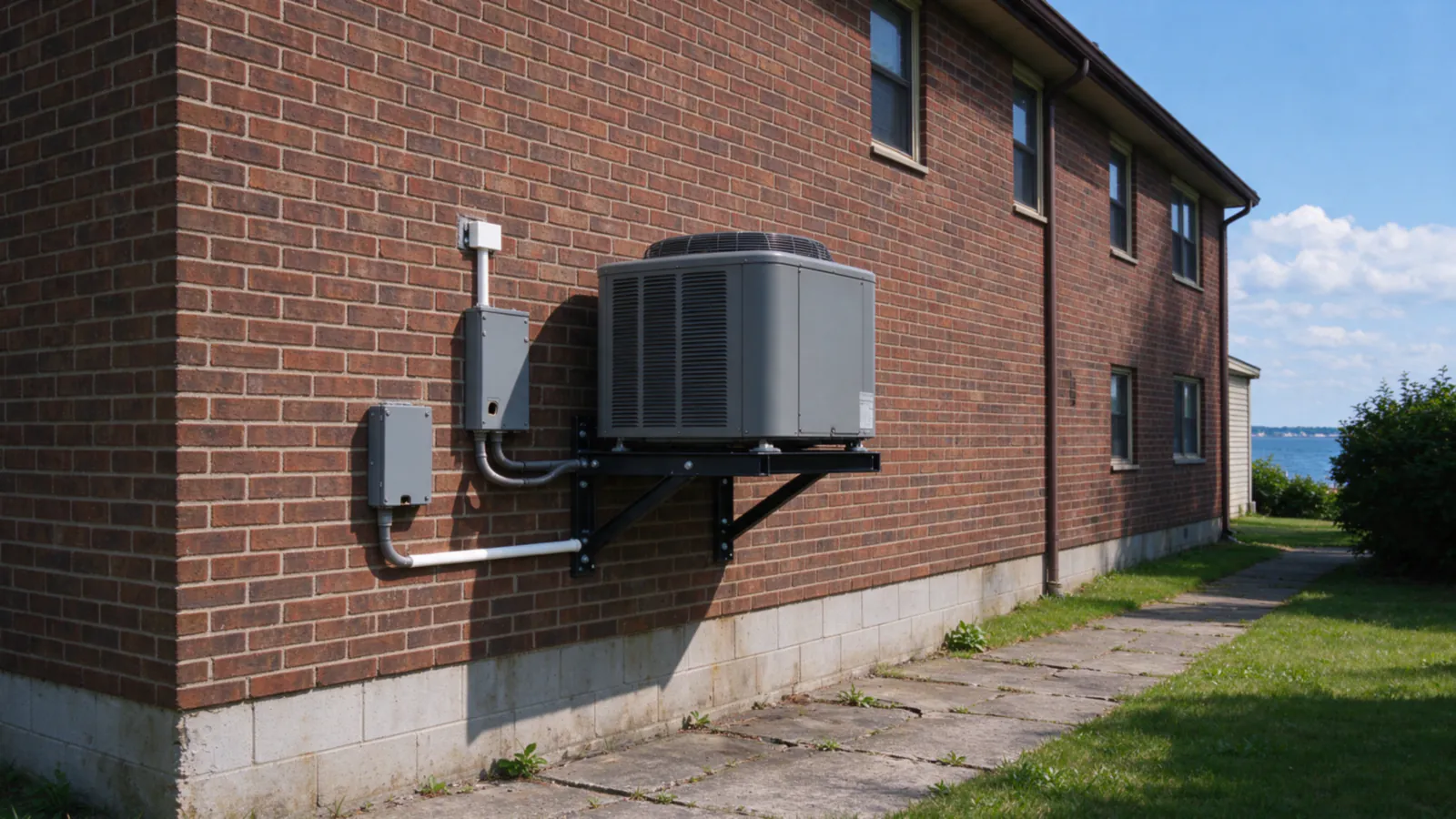
Massachusetts has no siting rule for heat pumps near salt water, so we follow the makers’ guidance. Keep the unit out of direct spray, let rain rinse the coil rather than tucking it under an eave, and choose a coastal-protected model when one is offered.
Close to Wollaston Beach or Marina Bay, we favor the side of the building away from the onshore wind. A yearly fresh-water rinse helps; see heat pump maintenance.
Flood zones and snow
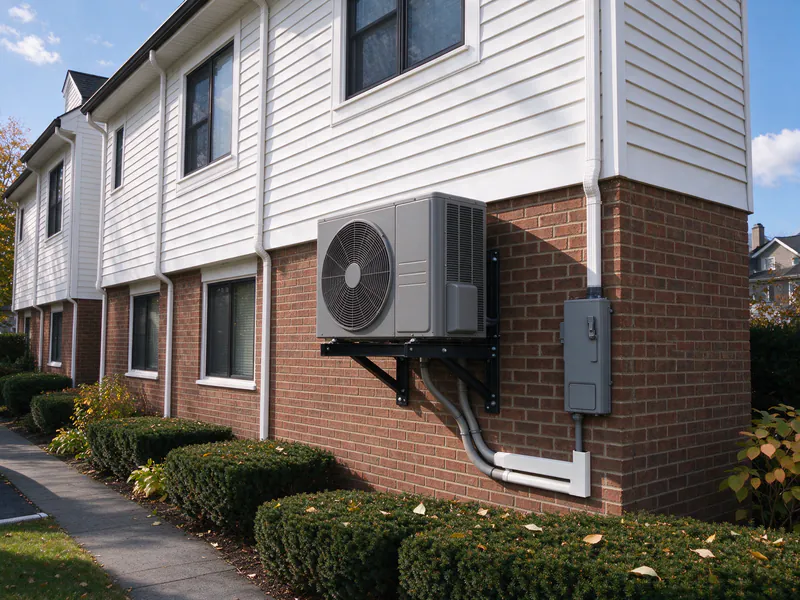
Some low-lying parcels near the shore sit in a mapped flood zone, which is checked per address. Where it applies, the state building code’s flood provisions push equipment above the design flood level, often on a wall bracket or a raised platform.
Away from the water, the concern is snow and drifting. Our snow stand guide covers heights and clearances.
Condos, houses and who signs off
Quincy splits roughly a third detached houses, a tenth two-families and four in ten units in larger buildings. Each needs a different conversation before the install.
| Quincy home type | Share of homes | Who decides placement |
|---|---|---|
| Detached house | 32.7% | You |
| Two-family | 10.8% | You, with the other owner if it’s a condo |
| Three or four units | 10.5% | The association or the owners together |
| Five or more units | 40.5% | The board, under the master deed |
State condo law binds each owner to the master deed, by-laws and rules, and those usually govern roofs and common land. Our condo guide lists what boards ask for. For houses in West Quincy or Merrymount with a furnace, see furnace to heat pump.
Gas, oil and the electric panel
Outside the condo stock, Quincy houses split between gas furnaces and boilers, with about one in eight homes still on oil. The case for a heat pump, and the wiring it needs, depends on which you have.
If you heat with oil or gas
Oil costs more per unit of heat than a heat pump on National Grid’s winter rate, so an oil house in Quincy Point or Houghs Neck has a clear running-cost case. The tank comes out once the heat pump carries the house; see oil to heat pump.
Gas is cheaper per unit of heat than either. Gas owners tend to switch when the furnace or the central air is near the end, and we put the running cost on your own rates in the estimate.
The panel in a condo building
A condo unit’s panel is fed from a meter bank the association controls, and older buildings can have small unit services. We do a load calculation on your panel at the first visit, counting the baseboard circuits that come out.
Baseboard removal often frees enough capacity for the heat pump. Where it doesn’t, our typical range for a service upgrade is $3,000 to $6,500, and National Grid and the association both have a say in the timing. See panel upgrades.
Mass Save money and Quincy paperwork
Quincy’s Inspectional Services Department takes permit applications through its online portal: electrical and sheet metal for a ducted job, gas where a line is capped. Fees are confirmed per address.
| What | The Quincy picture |
|---|---|
| Electric and gas utility | National Grid for both |
| Energy code | Stretch code since July 1, 2011; not the specialized code |
| Heating fuel mix | Gas 54.4%, electricity 29.6%, oil 12.0% |
| Homes built before 1940 | 37.1% |
| Coastal community | Yes, Boston Harbor region |
National Grid customers who heat with a heat pump get a lower winter distribution charge from November through April; the electric rate guide explains it. Rebate conditions are in our Mass Save guide.
Visit, estimate, install: the Quincy sequence
The first visit measures the unit’s heat loss room by room at the design temperature, maps duct routes, checks the panel and finds an outdoor spot the board and the weather will both accept.
- Board package: spec sheet, sound rating, a placement drawing and the mounting detail, ready before the board meets.
- Written estimate: equipment with capacity at 5°F, ducts, electrical, permits, rebate path and price.
- Install, usually three to seven working days for a condo unit, with baseboard removed once the heat pump carries the rooms.
- Commissioning: pressure test, deep vacuum, charge by weight, airflow and static measured, controls set.
Milton borders Quincy to the west on Eversource; Braintree to the south runs its own light plant.