(857) 837-1475Get an Estimate

Where a ducted heat pump goes in a Boston house

Every ducted system has the same four parts: an outdoor unit, a copper line set, an indoor air handler and the ducts. What changes from house to house is where each one can go. The drawing is a typical three-decker; the numbers match the work described beside it.

Cutaway of a Boston three-decker: an air handler in the attic and one in the basement, supply trunks up stacked closets, outdoor units on the flat roof and the rear porch, with the line set in red, numbered 1 to 6 for the work described beside it AtticThird floorSecond floorFirst floorBasement air handler air handler stacked closets 123456 roof unitporch unitline set
A typical three-decker. Numbers match the work beside the drawing.

One system that heats the whole house on the coldest night and cools it in August, with nothing else running beside it.

What we size it from

We don't copy the tonnage off the old furnace or AC. We run a room-by-room load calculation (ACCA Manual J) for your walls, windows and air leaks at Boston's design temperature, then pick a cold-climate unit that still puts out enough heat on that night. A house that had a 4-ton AC often needs 3.

What the job includes

The outdoor unit on a stand above the snow line, a matched air handler or coil, the line set, the electrical circuit and disconnect, new controls, permits, and taking the old equipment out. Mass Save's whole-home rebate needs the old system removed or disconnected, so we plan for that from the first visit.

What decides the price

Whether the ducts can be reused, how far the line set runs, and whether the panel has room. Our typical range for a whole-home system on ducts we can reuse is $15,000 to $28,000 and up, before rebates.

How we know it worked

After the install we measure what the plan promised: airflow at the air handler, static pressure in the ducts, temperature split across the coil, and the refrigerant charge by weight. Those readings go in your closeout papers, along with the aux heat lockout setting.

If your oil furnace already pushes warm air through ducts, the hard part of a heat pump is already in the house.

Why oil homes switch first

Heating oil is the most expensive way to heat most Boston houses, and a cold-climate heat pump on the utility's winter heat pump rate usually costs much less to run. The comparison against oil isn't close; against gas, it is, and we show you the numbers for your rate.

What happens to the tank

Once the heat pump carries the house, the burner comes out, the fuel line is capped, and the tank can be emptied and removed. In Boston, removing a tank needs a Fire Department permit, and we arrange it as part of the job.

Keeping the furnace as backup

Some owners keep the oil furnace for the deepest cold. That's a dual-fuel setup, and it changes which Mass Save rebate applies, so we lay out both paths in your estimate.

The paperwork that comes with it

An oil conversion often brings a Mass Save whole-home rebate, a HEAT Loan, a heat pump electric rate and a Fire Department permit for the tank. We keep the sequence straight: the rebate forms need the right equipment list and proof that the old system is out, and the rate switch is a call to the utility once the heat pump is running. Most oil homes in our area already have ducts, which keeps the job to a few days.

No ducts doesn't mean no ducted heat pump. It means we have to find room for them. It's the biggest job on this page, and the one where planning matters most.

Where the ducts can go

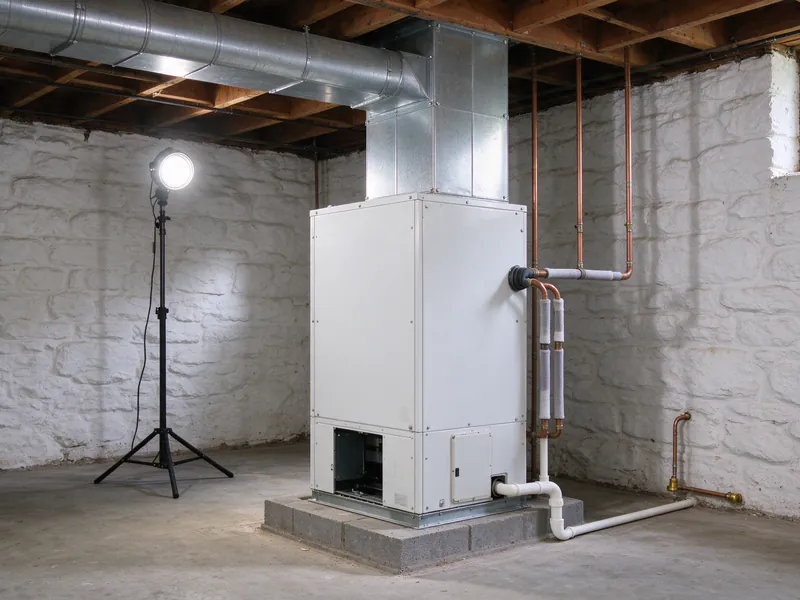
In a three-decker or a two-family, the attic over the top floor and the basement under the first usually hold an air handler each. Closets stacked floor over floor carry the trunk. Where there's no clean path, we say so, and point you to the options that fit.

Small-duct systems

High-velocity systems run 2-inch flexible tubes that slip through walls and closets where a 10-inch duct never could. They cost more per ton, but they keep the plaster mostly intact.

Keeping the radiators

Many owners keep the boiler for the first floor and put the heat pump upstairs, where it's hotter in summer and the radiators were never balanced. Our typical range for a heat pump with new ductwork, including small-duct systems, is $20,000 to $40,000 and up.

What we look at on the first visit

Attic height and access, the closets that stack from floor to floor, the basement ceiling, where the radiators are falling short, and the electrical panel. We sketch the duct routes on the floor plan before we price anything, so you can see which walls, if any, get opened, and where the registers land in each room.

A heat pump moves more air at a lower temperature than a furnace, so ducts that got by for 30 years can suddenly be the problem.

What we measure

Static pressure across the air handler, the size of the return, and leakage at the joints in the basement trunk. These readings decide whether the ducts can carry the new system or need work first.

The usual fixes

A bigger return, sealed seams with mastic, a new trunk section, or a few branches resized for rooms that never got enough air. We price duct work from what we find, because two houses with the same footprint can need very different fixes.

Why it's worth doing first

A heat pump starved of airflow runs louder, freezes its coil in summer and leans on backup heat in winter. Fixing the ducts usually costs less than oversizing the equipment to cover for them.

What it costs

Duct work is priced from what we find, not from a per-room number. A larger return and sealed seams in an open basement is a modest add to the job; rebuilding a trunk or adding branches through finished ceilings is more. Your estimate lists each change and why it's there, so you can see what the airflow readings asked for and what they didn't.

The second floor of a cape or colonial is where comfort breaks down: an oven in July, the coldest rooms in January, and the farthest from the basement furnace.

Why the attic

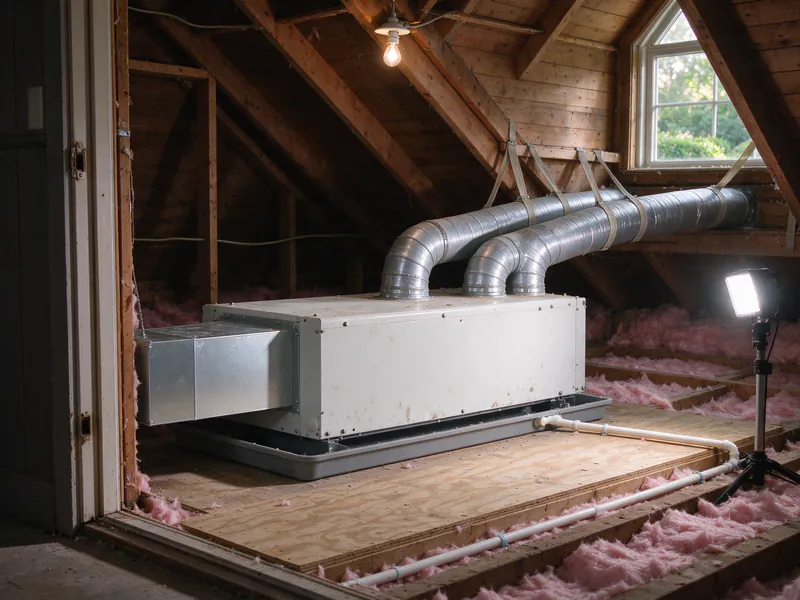
An air handler above the bedrooms puts short, straight duct runs into each room through the ceiling. It's the most common way we add a ducted zone to a house whose only ducts are in the basement, or that has none at all.

What it takes up there

A platform and a clear path to service it, ducts sealed and insulated for an unheated attic, a condensate line with a float switch and a secondary pan, because a leak up there lands on a ceiling. Old attic AC units often had none of that.

What it pairs with

Most attic jobs are one zone of a bigger plan: the attic unit for upstairs, the existing furnace or a second heat pump for downstairs. We price the attic work from the access, the insulation and the run lengths we measure.

Who it fits

Capes with kneewall attics, colonials whose basement furnace can't push enough air upstairs, and ranches with a walkable attic. It doesn't fit a flat roof or an attic you can't stand in, and where it doesn't, we say so on the first visit rather than squeezing in a unit nobody can service.

If your gas or oil furnace is young and sound, you don't have to throw it out to get a heat pump.

How it works

The heat pump replaces your AC and does the heating most of the winter. Below a switchover temperature you choose, the controls hand the job to the furnace. The two never fight, because one thermostat runs both.

Picking the switchover

Set it from what each fuel costs you, not from a rule of thumb. On National Grid's winter rate the math lands differently than on Eversource's, and oil and gas aren't the same either. We work out the number for your house and leave it written on the estimate.

Rebates and town rules

Mass Save treats dual fuel as a partial-home system with integrated controls, which has its own per-ton rebate. Cambridge, Arlington, Brookline, Newton and Lexington limit new fossil equipment in major renovations, so check the town before you plan around a furnace.

Who it suits

Owners with a gas furnace less than about ten years old, houses with high heat loss that a heat pump alone would need to oversize for, and anyone who wants a second source of heat. If the furnace is near the end, whole-home usually makes more sense, and we price both so you can compare.

Old houses with plaster walls

Old houses with plaster walls

Many Boston houses were built before 1940, with balloon framing, plaster and lath walls, and little insulation. That doesn't rule out ducts. It changes where they go: stacked closets, attic kneewalls and the basement ceiling, routes that avoid opening finished walls. Air sealing the attic floor first can cut the heating load enough to drop a size of equipment, which saves money twice: on the system and on every winter after. We look at the attic and basement first. Knob-and-tube wiring or a full panel can change the order of the work.

Heat pumps in older Boston houses
Three-deckers, floor by floor

Three-deckers, floor by floor

A three-decker has three separate units and, usually, three separate heating systems. Each floor gets its own air handler and outdoor unit, sized for that floor, because the top floor loses far more heat through the roof than the middle one does through its floor and ceiling. Units can sit on the back porches or the flat roof. Mass Save counts rebates per meter, so a three-unit building can qualify for three. Each unit's residents keep their own thermostat and their own bill.

Heat pumps for three-deckers
Condos and roof decks

Condos and roof decks

In a condo, the board decides where an outdoor unit can sit, and in Back Bay, Beacon Hill and the South End the historic district commissions have a say too: rooftop units centered on the upper roof in Back Bay, nothing visible from the street on Beacon Hill. We bring the unit spec, its sound rating and a placement drawing to the board early, so approval isn't the step that holds up the job. Older condo systems often need a new air handler too. We also check the condo's master deed for rules on rooftop equipment.

Replacing a condo heat pump
Snow, ice and the outdoor unit

Snow, ice and the outdoor unit

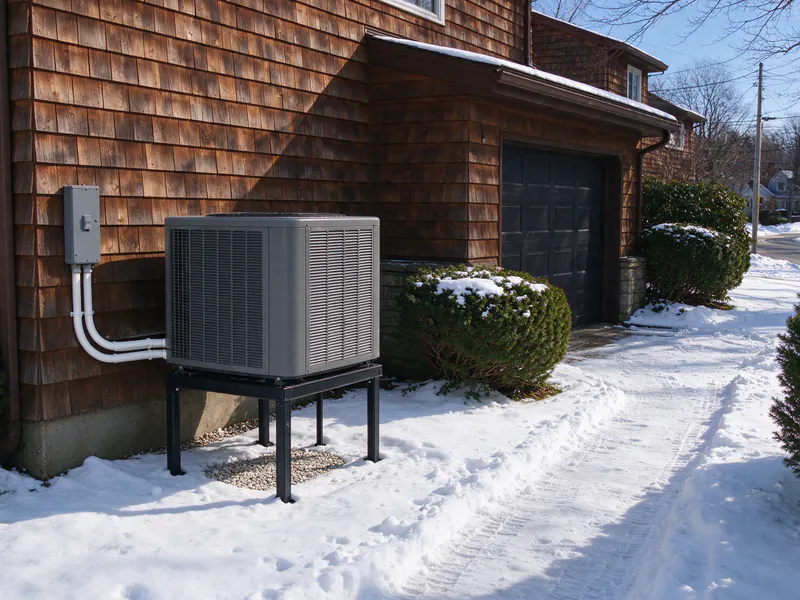
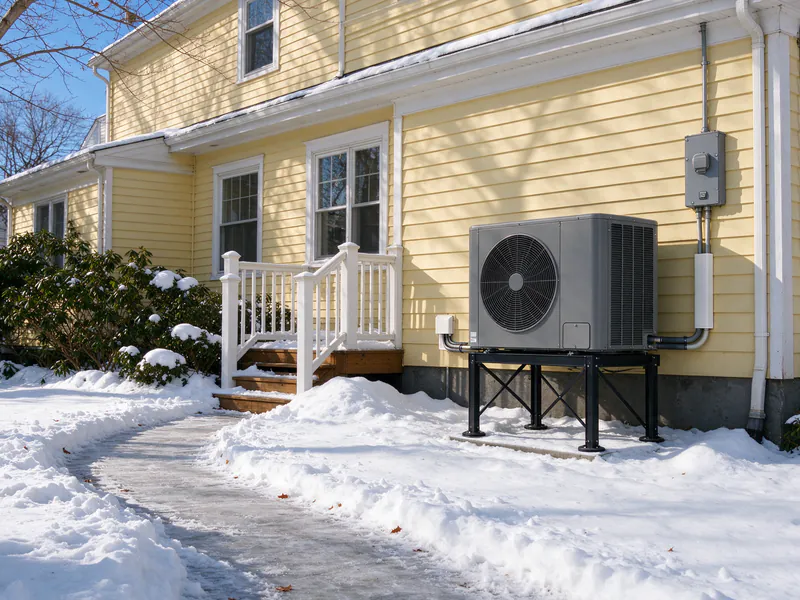
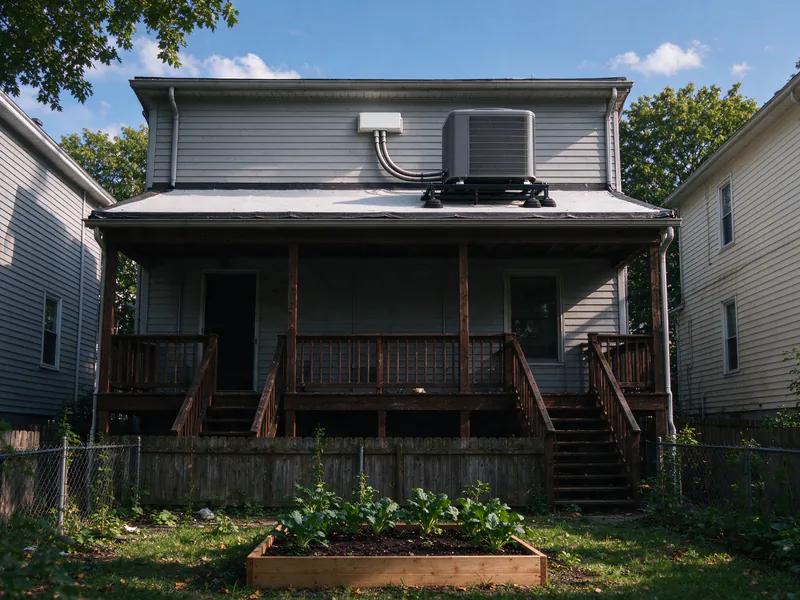
Defrost cycles shed water that freezes under the unit, and a plow pile can bury the coil overnight. We set outdoor units on a stand high enough to clear drifting snow, out from under roof drip lines and away from the path you shovel, with room for meltwater to drain. Near the harbor, we also look at salt spray and the manufacturer's coastal guidance before picking the spot. A good stand is cheap; a buried coil in February isn't. Wall brackets work where there's no ground space, if the wall can take the weight.

Snow stands and outdoor unit placement

The numbers behind a Boston install

  • 7°FThe design night we size heating for at Logan; inland towns run colder
  • 50 dBABoston's nighttime limit at your lot line, which steers where the outdoor unit goes
  • Per tonHow Mass Save pays its whole-home rebate, through a network installer
  • 0%Mass Save HEAT Loan financing for eligible heat pump work

Other heat pump work we do

Not every job is a full conversion. These are the projects that start from a system you already have, plus the work that keeps one running.

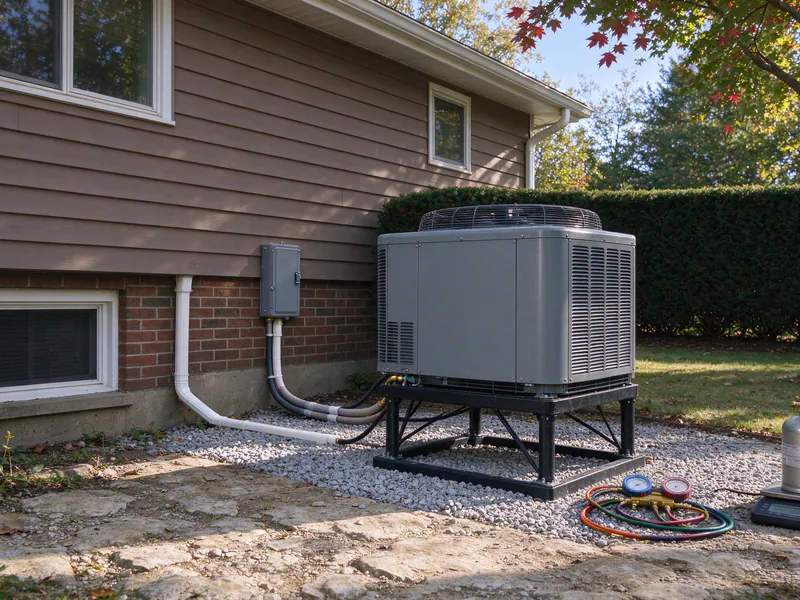
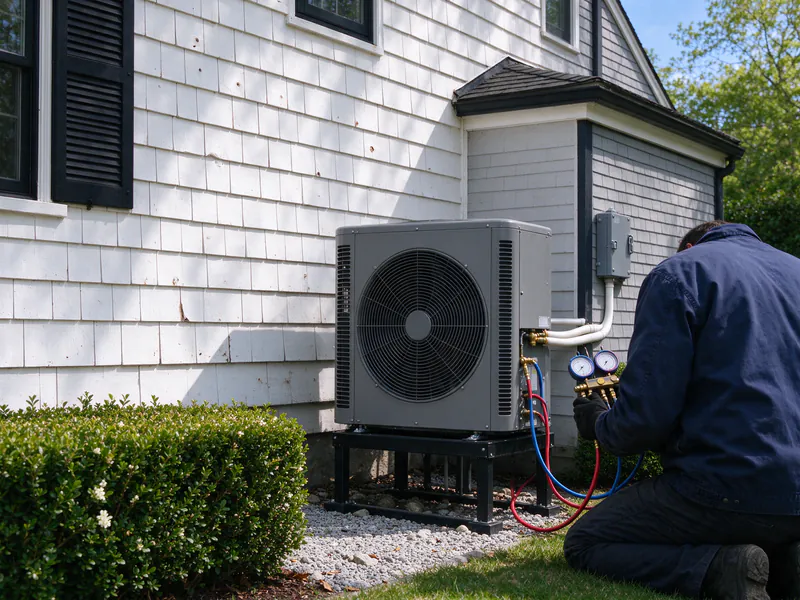
Refrigerant gauges and a digital scale beside a new heat pump outdoor unit on a raised stand next to a split-level house in autumn

Heat pump replacement

Your heat pump is 12 or 15 years old, the repairs are getting bigger, and it never kept up in January. Before we quote a swap, we find out why the old one struggled, so the new one doesn't repeat it.

Same size isn't automatic

Old systems were often sized by rule of thumb. We recheck the load and the ducts before we price a like-for-like swap, and newer variable-speed units often do better at a smaller size.

What changes in a replacement

The line set may be reusable if it's the right size and passes a pressure test; the outdoor pad usually moves up onto a snow stand. Mass Save's whole-home rebate doesn't cover replacing an existing heat pump, though its basic rebate may. Our typical replacement range is $12,000 to $24,000.

Before you replace like for like

Ask what the old unit did on the coldest nights. If it ran aux heat constantly, it may have been undersized, or the ducts starved it. If it cycled on and off, it may have been oversized. A replacement is the chance to fix that, instead of copying the old model number onto a new box. We also check the condensate line, the float switch, the thermostat and the electrical disconnect, which are often older than the outdoor unit and fail just as quietly.

New heat pump air handler on the supply plenum where a gas furnace stood in a Boston-area basement, with the capped gas stub beside it

Gas furnace to heat pump

A gas furnace with central air is the easiest house in Boston to convert, because the ducts are already there. Most of the work happens in the basement, and the heat is usually off for only a day or two.

The swap

The AC condenser gives way to a heat pump, the coil on top of the furnace becomes a heat pump coil or a new air handler, and the thermostat changes. If the furnace goes, the air handler carries backup heat strips sized for the coldest hours.

Gas or no gas

Gas is cheaper than oil, so the running-cost case is closer. Most owners switch because the furnace and AC are both near the end, and one system replaces two. We show the running cost on your gas and electric rates before you decide.

Keep the furnace, or take it out

If the furnace is young, dual fuel keeps it as backup and lets the heat pump do most of the work. If it's near the end, an all-electric air handler with backup heat replaces it, and the gas line to the basement can be capped. Mass Save's rebate differs between the two, and we show both on the estimate. Either way, the ducts get measured first, because furnace ducts were sized for hot air at low volume and a heat pump moves more.

Cold-climate heat pump on a raised stand where an old central AC condenser sat, beside a two-story Boston-area house in early fall

Replace central AC with a heat pump

If your central AC just died, the replacement that costs a little more can also heat the house. It's the cheapest moment to add heat to an AC system you already have.

Why now is the moment

A heat pump uses the same ducts, line set path and air handler location as the AC it replaces. Doing it when the AC fails costs much less than adding heat later, and it can carry the shoulder seasons so the boiler or furnace runs less.

What we check first

Whether the line set can be reused, whether the attic or basement air handler can be matched to a heat pump, and whether the circuit is big enough. An air handler that came with the old AC often has to be replaced too, because the coil and blower were sized for cooling only.

What it costs over the AC

A heat pump costs more than a straight AC replacement of the same size, mostly in the outdoor unit and the controls. What you get for the difference is heat in spring and fall, a backup for the boiler or furnace, and a step toward a full conversion later without redoing the job. If the AC failed in July, we can usually quote the heat pump and the AC side by side so you can weigh them.

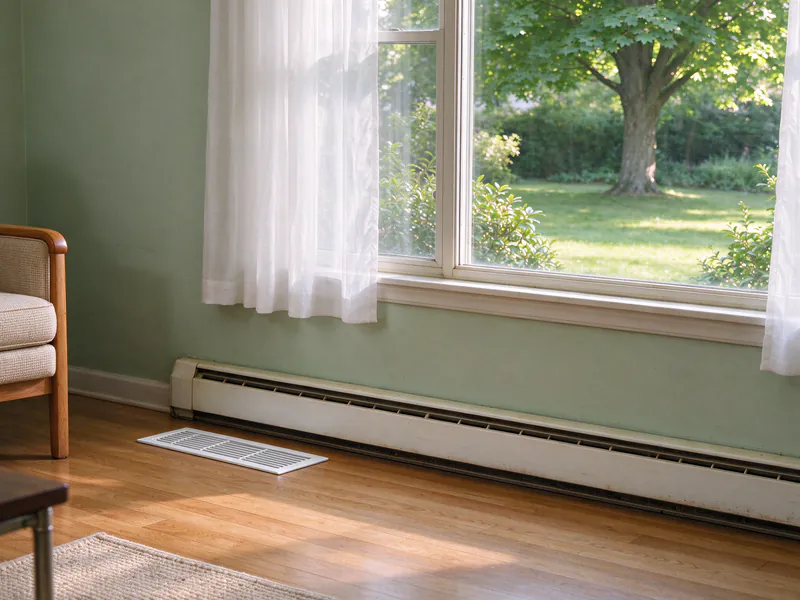
Electric baseboard heater under a living room window in a 1960s ranch, with a new floor register cut in beside it

Electric baseboard to heat pump

Electric baseboard turns every kilowatt-hour into one unit of heat. A heat pump moves two to three units of heat for the same kilowatt-hour on a typical winter day. That gap is the whole case for switching, and it shows up on the first winter bill.

The house you have

Baseboard homes have no ducts, so the plan is an attic air handler for the upper floor and a basement or closet unit for the lower one, or ducts in a crawlspace for a ranch. The baseboards can stay as backup in rooms you rarely use.

What it saves

This is the conversion with the clearest savings, because you stay on electricity and use far less of it. Mass Save counts electric resistance heat as an eligible system to replace.

What changes in the house

New ducts mean an air handler in the attic, a closet or the basement, registers in the ceilings or floors, and a return path in each zone. In a ranch, a crawlspace or attic often holds the whole system. We plan the routes first, so the estimate shows where every register goes and which, if any, walls are opened. Electrical panels in baseboard homes are often already sized for the load, which keeps the electrical side simple.

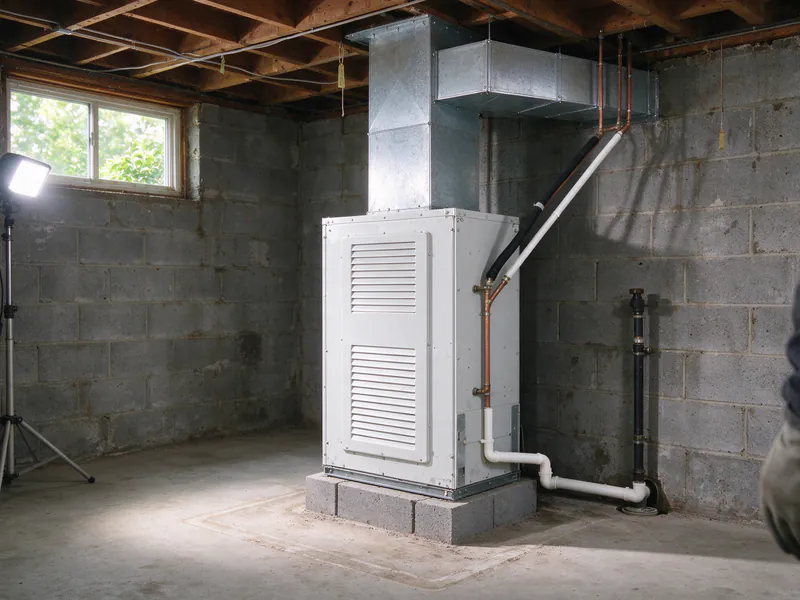
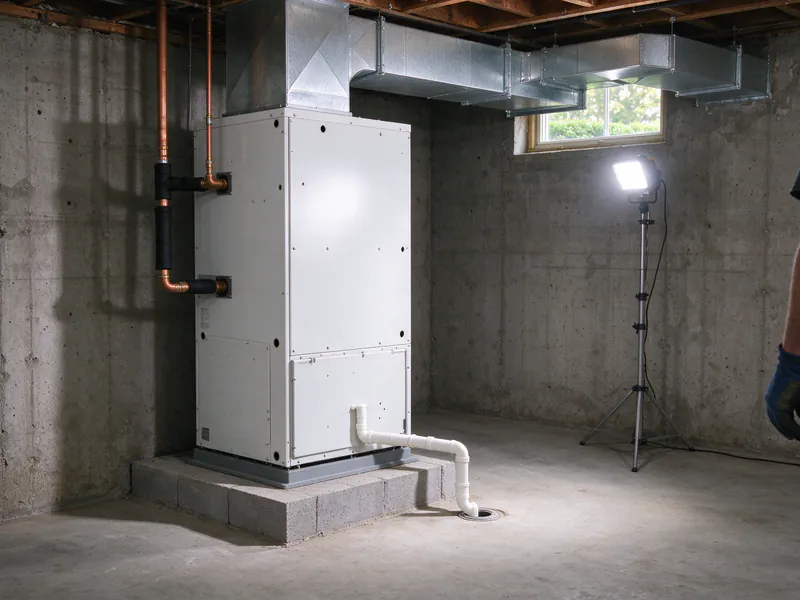
New upright heat pump air handler on a raised block in an unfinished basement, with a fresh condensate trap and brazed copper lines

Air handler replacement

Rusted cabinet, a coil that leaks refrigerant, a blower that hums: sometimes the indoor half fails before the outdoor half. The fix is often the indoor unit alone, but only when the outdoor unit still has years left in it and the two are a listed match.

Matching it right

A new air handler has to be listed as a match for your outdoor unit, or the capacity and the warranty both suffer. We check the outdoor model and refrigerant before quoting, and charge the system by weight after.

When it's the wrong fix

If the outdoor unit is old or runs an older refrigerant, a new air handler can strand you with a mismatched pair. Our typical range for an air handler alone is $1,500 to $4,200 and up; where the outdoor unit is near the end, we price the whole system beside it.

What we check first

The outdoor unit's model and age, its refrigerant, the condition of the line set, and whether the old air handler's location has room for a modern cabinet, its condensate pan and service access. Attic air handlers get a float switch and a secondary pan, because a failed drain up there ends up in a bedroom ceiling. We weigh in the charge after the swap and confirm airflow before we leave.

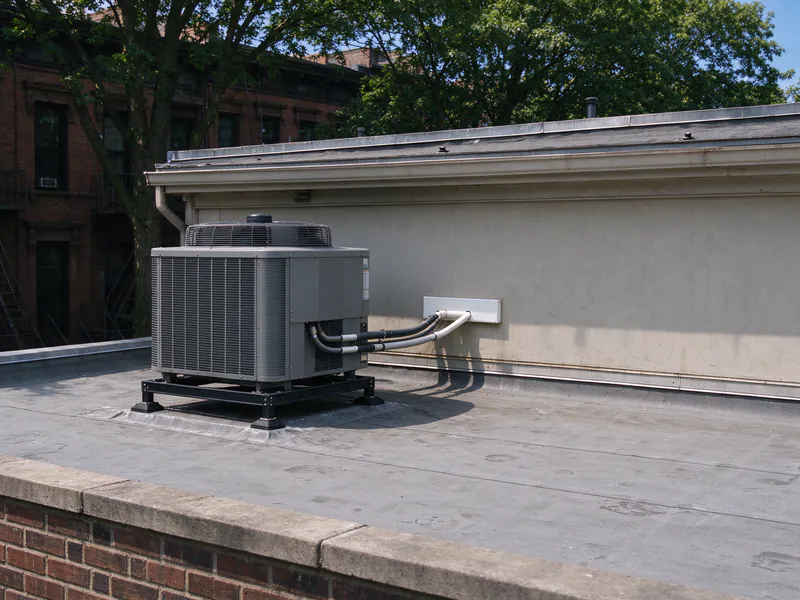
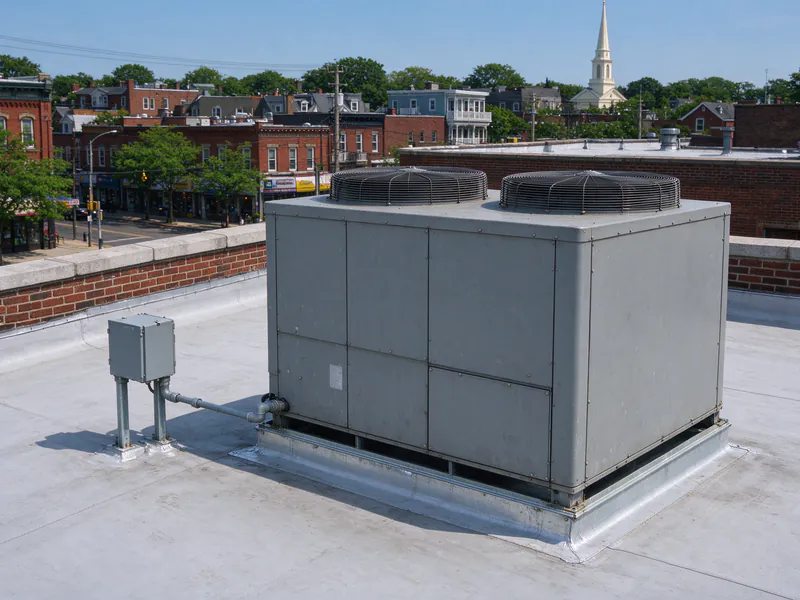
Packaged rooftop heat pump on a flat commercial roof in Boston, set on a curb adapter with its electrical disconnect beside it

Commercial heat pump installation

Small offices, storefronts and multifamily buildings run on the same equipment at a larger scale. The decisions are the same as in a house: size from the load, check the ducts and the power, and plan where the outdoor equipment can go without disturbing the neighbors.

What we take on

Light-commercial split systems, rooftop packaged heat pumps and apartment buildings with a system per unit. Rooftop jobs add a crane day, curb adapters and a structural check of the roof.

How it's scoped

We measure the load, review the electrical service and plan around your hours, so the space stays open. Mass Save has a separate commercial heat pump rebate per ton, which needs pre-approval before the work starts.

What changes from a house

Bigger equipment, three-phase power in many buildings, building-department plan review for larger jobs, and work scheduled around occupants and business hours. In a multifamily building, each unit usually gets its own system and meter, so each household's comfort and bill stay its own. Rooftop units need a curb or adapter, roof penetrations that stay watertight and a crane booked weeks ahead. We walk the building first, then come back with a scope and a schedule you can plan around, and we coordinate the electrical, structural and roofing trades the job needs.

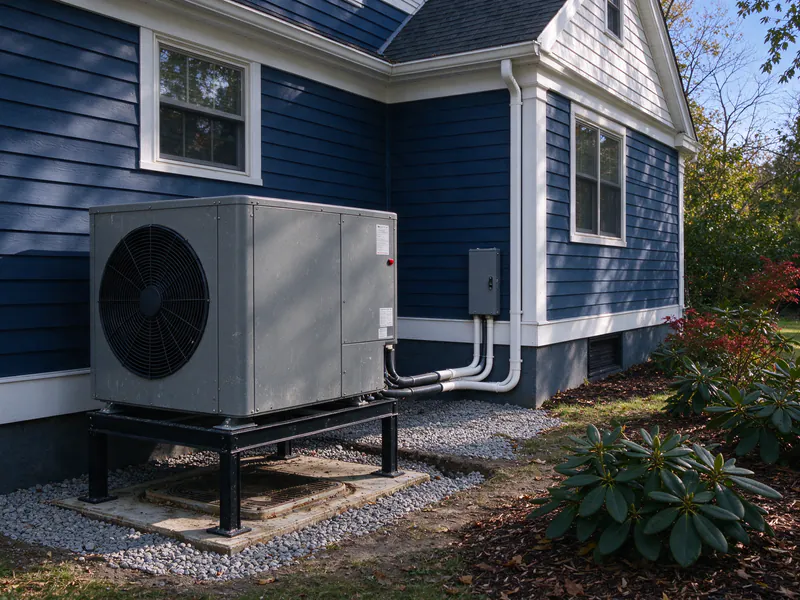
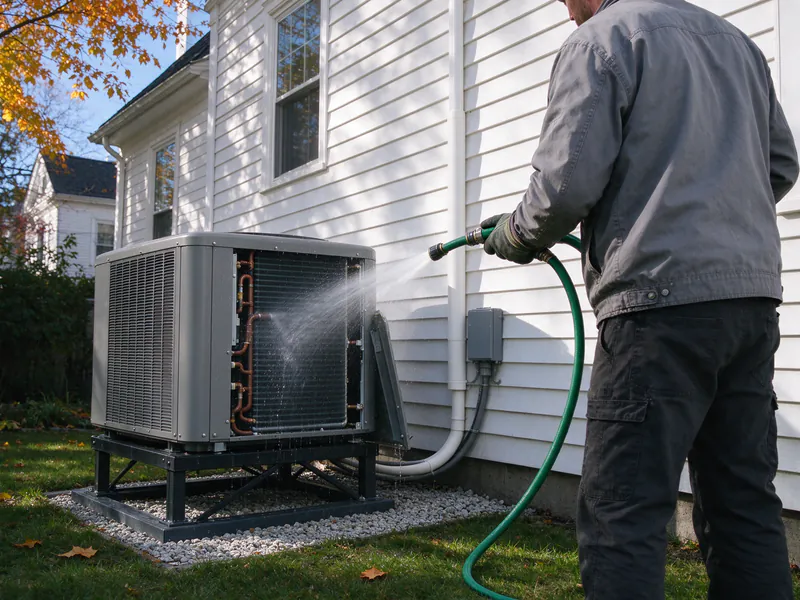
Ducted heat pump outdoor unit on a raised stand in the side yard of a Boston house in autumn, its side panel off and the coil being rinsed with a low-pressure hose

Heat pump maintenance

A ducted heat pump runs all year, so it needs more attention than a furnace that rests all summer. A yearly visit costs far less than the January repair it prevents.

What a visit covers

Filters, the outdoor coil, the condensate line and float switch, a check of the defrost cycle, refrigerant pressures and the backup heat staging. In fall we confirm the aux heat comes on only when it should. We also test the float switch by tripping it.

What it prevents

Most heat pump service calls in January trace back to a clogged filter, a blocked drain or a coil packed with leaves. A yearly visit catches them in October instead.

How often

Once a year for most houses, ideally in fall, plus filter changes every one to three months depending on the filter and the dust. Houses near the water benefit from an extra coil rinse, because salt shortens the life of the outdoor coil and fins. We leave a record of the readings, so the next visit can compare and catch a slow leak or a failing fan motor before it fails on a cold night. We can also show you the few checks you can do yourself, like keeping the outdoor unit clear of snow and leaves.

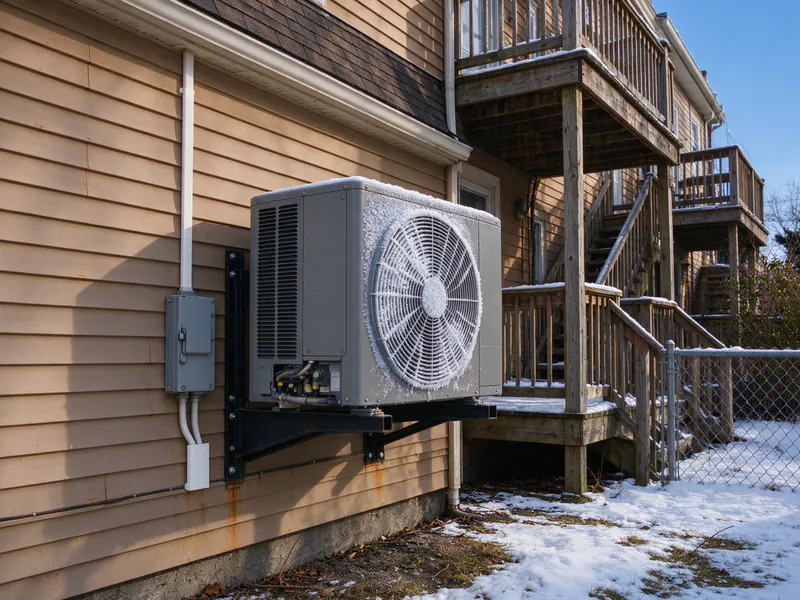
Ducted heat pump outdoor unit on a wall bracket behind an East Boston three-family in January, its coil iced over

Heat pump repair

Ice that won't clear, heat that blows cool, an outdoor fan that won't start: these are heat pump problems, and they're what we fix. When you call, tell us what the outdoor unit is doing and what the thermostat says.

How we diagnose

Light frost that melts every hour or so is normal defrost. Ice that builds into a block is not, and the cause is usually airflow, a sensor or the refrigerant charge. We find which before replacing parts.

Repair or replace

We give you the repair price and, if the system is old enough to ask the question, the replacement range beside it, so the decision is yours. We work on ducted heat pumps only, not general furnace or boiler repair.

What to try before you call

Check the filter, make sure the outdoor unit isn't buried in snow, and look at the thermostat mode: a thermostat left on emergency heat runs only the backup strips, which feels like the heat pump failed and costs a lot to run. If the breaker for the outdoor unit has tripped, reset it once; if it trips again, leave it off and call. If those don't fix it, write down what you see and when, and send a photo of the outdoor unit and the thermostat screen. It saves a trip.

What a ducted heat pump costs with us

These are our typical ranges for the most common jobs, before rebates. Your price comes from the home visit and a written estimate built from the measurements.

Whole-home heat pump, ducts reusedCold-climate outdoor unit on a snow stand, matched air handler or coil, line set, circuit, controls, permits, old system out
$15,000 to $28,000 and up
Heat pump replacementSwap of an existing ducted heat pump, line set reused where it tests sound
$12,000 to $24,000
Heat pump with new ductworkAttic or basement air handlers with new duct runs, or a small-duct high-velocity system
$20,000 to $40,000 and up
Electrical service upgradeTypically 100 to 200 amps, customer side, with utility coordination
$3,000 to $6,500
Oil tank removalAccessible basement tank, emptied and removed, plus the Boston Fire Department permit
$600 to $1,500
Air handler replacementAir handler matched to an existing outdoor unit
$1,500 to $4,200 and up

What moves the price

  • How many tons the load calculation calls for
  • Whether the ducts can be reused or need work
  • Line set length and the route through the house
  • Panel capacity and the electrical service
  • Where the outdoor unit can go: ground stand, porch, roof
  • Permits, and historic or condo review

Will it keep this house warm? What decides the answer

Nine questions that decide whether a ducted heat pump keeps your house comfortable all winter, grouped from the big picture down to the thermostat on the wall.

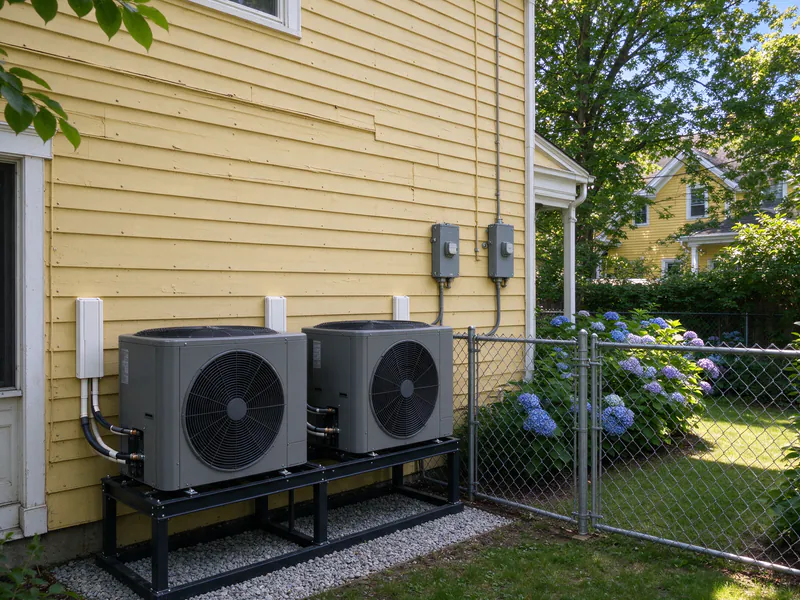
Two outdoor units on an 18-inch stand, Roslindale, near Roslindale Village
A

Start with the whole picture

Our guide to ducted heat pumps in Boston walks one path from the system you have now to the one that gets installed: oil, gas, boiler or baseboard; whole-home or dual fuel; reuse the ducts or add them; and the rebate rules that come with each choice. If you read one page before calling anyone, make it this one. It also covers what we check at commissioning, and how to read a quote line by line. Each section links to the deeper guide on that question.

The Boston homeowner's guide to ducted heat pumps
B

Do they work in a Massachusetts winter?

Cold-climate heat pumps keep producing heat well below zero, and Mass Save's rebates require equipment on the ENERGY STAR cold-climate list. What matters is how much heat the unit puts out at 5°F compared with what your house loses on a 7°F night at Logan, or colder inland. Lexington's nearby Hanscom field logs about five nights a year at or below zero. We size so the heat pump covers the design night with little or no backup. Inland, we size to that colder night.

Do heat pumps work in Massachusetts?
C

Sizing from the house, not the old unit

A ton is 12,000 BTU an hour of capacity, and the right number comes from a load calculation: walls, windows, insulation, air leaks and the design temperature, room by room. An oversized heat pump short-cycles and leaves summer air clammy; an undersized one leans on backup heat. Mass Save pays a sizing bonus for systems backed by a proper calculation. We give you the calculation with the estimate, so you can see the numbers behind the size. A proper calculation often lands smaller than the old furnace.

How a heat pump is sized
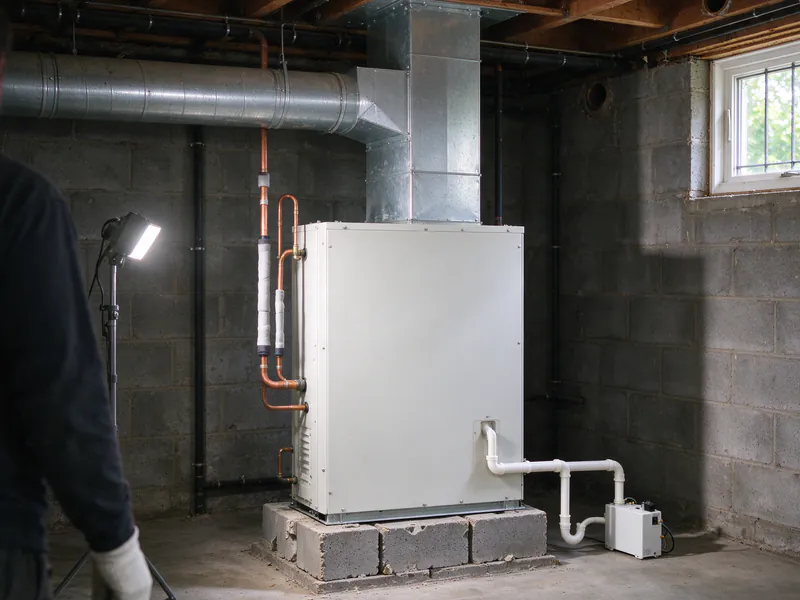
Basement air handler and trunk below the first floor of the cape, Maplewood, Malden
D

Variable speed, and why it matters here

A variable-speed compressor runs slow and steady most of the winter and ramps up on the coldest nights, instead of slamming on and off. That's what keeps supply air warm and the house even. Most cold-climate ducted units are variable speed; the trade-off is cost, and a duct system that has to handle a wider range of airflow. Single-stage units still exist, but they struggle here. They cycle more, run colder supply air on mild days and lean on backup heat sooner when it gets truly cold. For most Boston houses, the variable-speed premium pays for itself in comfort alone.

Variable-speed heat pumps
E

Which ratings to read

SEER2 measures cooling over a season and HSPF2 heating over a season, both under federal test procedures. For a Boston house, the number we look at hardest is capacity at 5°F and how much of it the unit keeps as the temperature drops. A high HSPF2 with weak low-temperature capacity can still leave you on backup heat in January. We list the 5°F capacity on every estimate we write. The ENERGY STAR cold-climate list publishes those low-temperature figures for each listed system, so you can compare models side by side.

SEER2 and HSPF2, explained
F

Aux heat, and when it should run

Most all-electric systems carry electric heat strips in the air handler for the coldest hours and for defrost. They cost two to three times as much to run as the heat pump, so the controls should lock them out above a set outdoor temperature. A heat pump that runs aux heat in October is badly set up, not undersized. We set and record the lockout at startup. If you see the aux heat light on a mild day, call us.

Heat pump aux heat
Horizontal heat pump air handler on a raised platform in a kneewall attic, with a secondary drain pan, insulated ducts and a service light
G

The thermostat that runs it

A heat pump needs a thermostat that knows it's a heat pump: one that stages the compressor, holds back the aux heat, and on dual-fuel systems hands off to the furnace at the right temperature. Communicating systems use the maker's own control. We set the lockouts during commissioning and show you which settings to leave alone. Old thermostats rarely work with new systems, so we plan the control as part of the job. A wrong setting can double the winter bill.

Heat pump thermostats and settings
H

When the power goes out

A heat pump needs electricity, and so does a gas or oil furnace's blower and controls. For a long outage, a standby generator has to be sized for the heat pump's running load, not just its nameplate. Many owners keep a fireplace insert or one room on a small generator as their plan instead. We can plan the circuit for a generator inlet when the panel is being worked on anyway. A dual-fuel furnace still needs power for its blower and controls.

Heat pumps and power outages
I

Ducted or ductless?

Ducted systems hide the equipment and treat the whole house through registers; ductless heads go on the wall of each room and need no ducts at all. Where a house has ducts, or room for them, we install ducted. Where it doesn't, ductless is often the better fit, and we'll tell you so even though it's work we don't do. Some houses use both: ducted for the main floors, a ductless head for an addition. We'll point you to what fits.

Ducted vs ductless heat pumps

Oil, gas, or a heat pump: what each costs to run

Cost to deliver a million BTU of heat, worked out from the state's average oil, propane and gas prices and the utilities' winter heat pump rates. Your bill depends on your house and your rate, but the order rarely changes.

  • Heating oil furnace or boiler$52
  • Propane furnace$44
  • Heat pump, National Grid winter rate$42
  • Heat pump, Eversource winter rate$33
  • Natural gas furnace$25
Derived from U.S. Energy Information Administration Massachusetts residential prices for oil ($6.18/gal), propane ($3.81/gal) and natural gas ($25.06/Mcf, annual), and the Eversource and National Grid winter heat pump rates, assuming 85% efficiency for oil, 95% for propane and gas, and a seasonal heat pump efficiency (COP) of 2.5. Prices change; we rerun this for your rate in the estimate.
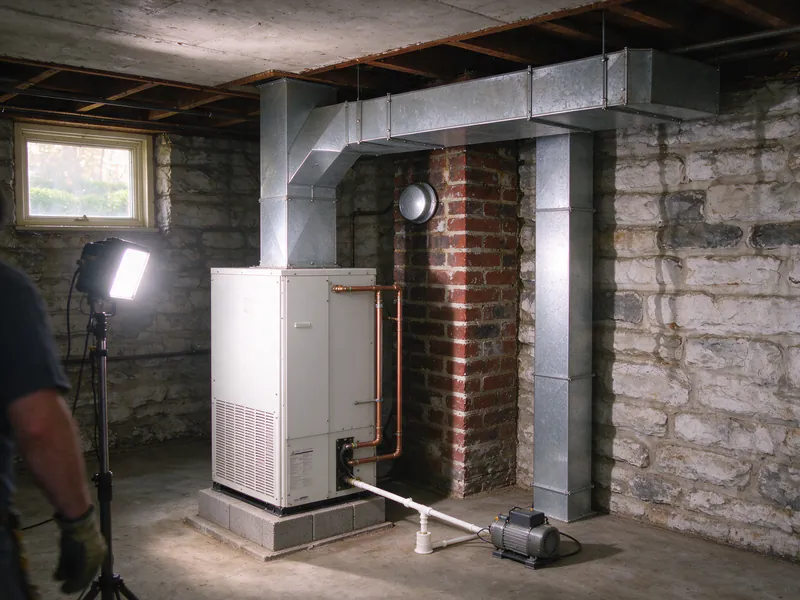
Cold-climate heat pump air handler in a fieldstone basement where an oil furnace stood, with the capped oil line at the wall

Switching from oil

Against heating oil, a cold-climate heat pump costs less to run on either utility's winter rate, by roughly a fifth to a third, and it adds central air you may not have had. Oil heats about 7% of Boston homes but far more in the suburbs: close to a third in Lexington. Those are the houses where a conversion pays back fastest. The tank comes out, and so does the yearly oil delivery and burner tune-up. Most oil homes in our area already have ducts or room for them.

Heat pump vs oil heat

Against a gas furnace

Gas is the cheapest fuel per BTU in Massachusetts, so on running cost alone a heat pump roughly breaks even or costs a little more. Owners switch anyway when the furnace and AC both need replacing, to drop a gas bill's fixed charges, or to meet a town rule. Dual fuel keeps the furnace for the coldest hours if the math says so. We put both running costs on your estimate. Gas prices swing month to month, so we use your actual bills.

Heat pump vs gas furnace in Massachusetts

Against a boiler

A boiler with radiators heats beautifully and quietly, and nothing about a heat pump makes it obsolete. The case for adding ducts is cooling, a cheaper fuel than oil, and rooms the radiators never balanced. Many owners keep the boiler downstairs and put the heat pump where the radiators fall short. A boiler and a heat pump can share a house for years. We size the heat pump for the rooms it serves, not the whole house. Cooling is often what tips it.

Heat pump vs boiler
Central AC or a heat pump?

A heat pump is a central air conditioner that can run in reverse. It costs more than an AC of the same size, but less than an AC plus a later heating upgrade, and it can carry spring and fall on its own. If your AC is failing, the heat pump is almost always the better replacement. The ducts, line set path and air handler location usually carry straight over. The air handler may need replacing if it was sized for cooling only.

Heat pump vs central AC
The heat pump electric rate

Eversource, National Grid and Unitil customers who heat with a heat pump can switch to a seasonal rate that lowers part of the delivery charge from November through April, on every kilowatt-hour the house uses. If you got a Mass Save heat pump rebate, you're usually enrolled automatically; otherwise you ask the utility to switch you. Municipal light plants set their own rates, so check with yours. The rate applies to the whole house's usage in winter, not only the heat pump.

The Massachusetts heat pump rate
Ducted cold-climate heat pump outdoor unit on a raised stand behind a two-story Boston colonial in winter, with snow on the lawn

What a full install costs

Our typical range for a whole-home system on existing ducts is $15,000 to $28,000 and up before rebates; with new ductwork, $20,000 to $40,000 and up. What moves your number is the tonnage the load calculation calls for, how much duct work the house needs, the length of the line set, whether the panel has room, and where the outdoor unit can go. Rebates come after the job, so we show the price before and after them. The cost guide breaks down each of those drivers with examples.

Heat pump installation cost in Massachusetts

Mass Save rebates, and who can claim them

Mass Save pays its whole-home rebate per ton of installed capacity, at $2,650 a ton up to $8,500 for systems installed through 2026; from January 1, 2027 it drops to $2,350 a ton, capped at $7,500. The equipment has to be on the cold-climate list and the installer has to be in Mass Save's Heat Pump Installer Network. Towns with their own light plant, like Belmont, Reading and Braintree, run their own programs instead. We check which program your address falls under before we write the estimate. Income-eligible households can qualify for larger amounts.

Mass Save heat pump rebates

Paying for it over time

Mass Save's HEAT Loan offers 0% financing up to $25,000 for eligible heat pump work through participating lenders. It pairs with the rebate, which comes after the job. The federal heat pump tax credit ended for systems placed in service after December 31, 2025, so it's no longer part of the math. Apply for the loan before the work starts, not after. Light plant towns have their own financing, so check yours first. We can point you to the participating lenders.

The Mass Save HEAT Loan

A typical Jamaica Plain oil-to-heat-pump conversion

An oil-heated single-family in Jamaica Plain near Jamaica Pond, warm-air furnace in the basement, AC never installed. Here's where each decision and each dollar comes from.

New air handler on the old plenum, with the second return beside it, Jamaica Plain, near Jamaica Pond
Where
Jamaica Plain, near Jamaica Pond
House
1920s single-family, two floors, about 1,900 sq ft
Before
Oil warm-air furnace, 275-gallon basement tank, 100-amp service
After
3-ton cold-climate ducted heat pump, new 200-amp service, tank removed
Price
$28,300 before rebates
Time on site
Five working days
  1. 1

    First visit: measure before pricing

    The load calculation came in at about 31,000 BTU an hour on a 7°F night, so a 3-ton cold-climate unit covers it without backup. The old furnace was rated far higher. Static pressure across the furnace read high because the single return was undersized for heat pump airflow.

  2. 2

    The estimate: two paths, in writing

    Path one: whole-home, old furnace out, which qualifies for Mass Save's whole-home rebate. Path two: dual fuel, keeping the furnace. The owners chose whole-home. The estimate listed the return enlargement, the service upgrade, the tank removal and the permits as separate lines.

  3. 3

    Permits and the utility

    Electrical and sheet metal permits through Boston's Inspectional Services, the Fire Department permit for the tank, and a service upgrade booked with Eversource so the meter swap and the new panel happened on the same day.

  4. 4

    Install and commissioning

    Return enlarged, outdoor unit on a stand clear of the drift line, line set pressure-tested with nitrogen and pulled to a deep vacuum before the charge was weighed in. Airflow and static pressure were measured again, and the aux heat lockout set before anyone called it done.

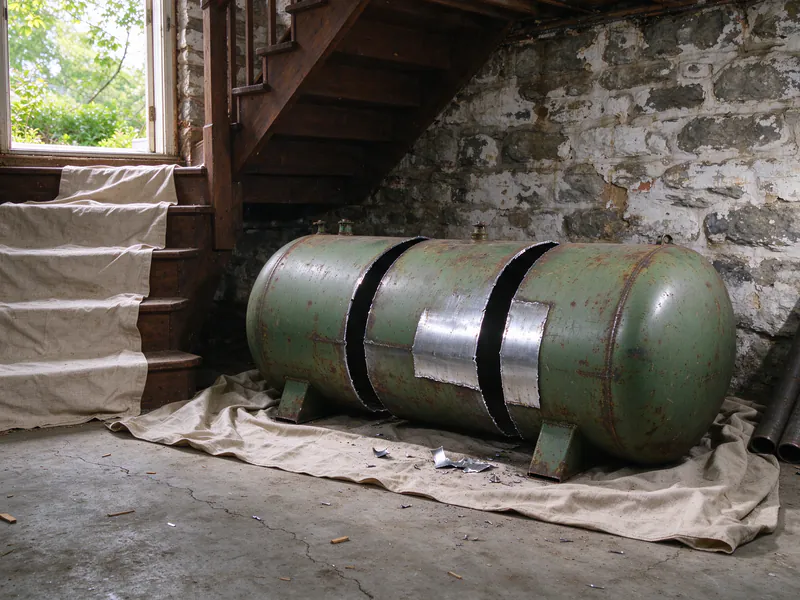
Empty 275-gallon steel oil tank cut into sections at the foot of basement stairs, with drop cloths laid up the steps

Oil tank removal

Once the heat pump carries the house, the oil tank is dead weight in the basement, and a liability when you sell. Most removals take a few hours once the permit is in hand, and the basement gets back the space the tank took.

What removal involves

Pumping out the remaining oil, cleaning and cutting the tank, removing it and the fill and vent pipes, and capping the lines at the outside wall so nobody pumps oil into a pipe that goes nowhere. Boston requires a Fire Department permit, and we file it.

Basement tank or buried tank

An accessible basement tank is a short job: our typical range is $600 to $1,500 plus the permit. A buried tank is a different project, with soil checks and possibly a licensed site professional, so we scope it separately after a look.

When to do it

During the conversion, so the burner, the fuel line and the tank all go at once. Mass Save's whole-home rebate asks for the old system removed or its fuel line capped, and the tank removal completes that.

Selling the house

Buyers' inspectors and insurers ask about oil tanks, and an abandoned tank still in the basement raises questions you'd rather answer with a permit and a receipt. Removing it during the conversion closes the question for good.

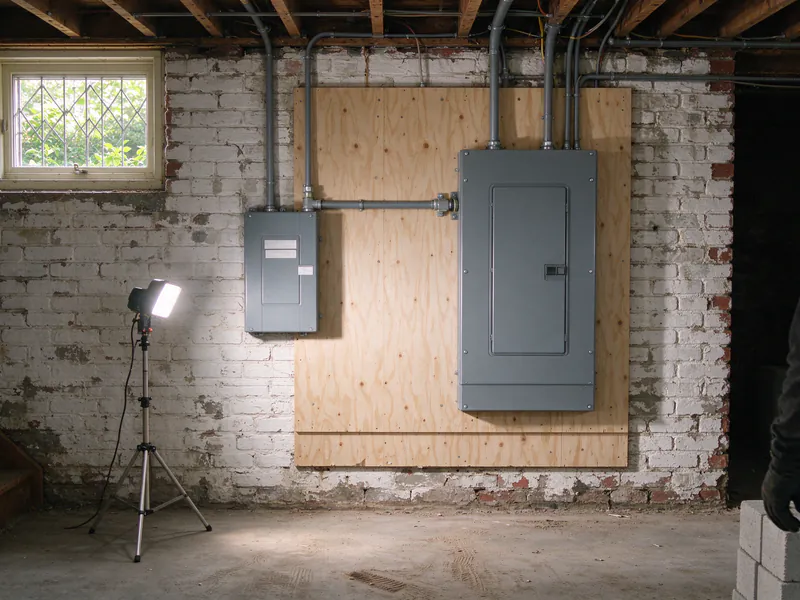
New 200-amp electrical panel with its door closed on a plywood backboard in a Boston basement, with a disconnect beside it

Electrical service upgrade for a heat pump

A lot of older Boston houses still run on 100-amp service, and a whole-home heat pump with backup heat strips can push it past what's safe. Finding out early keeps it from being a surprise on install day.

How we check

A load calculation of the electrical service, the same way we size the heat pump: what's on the panel now, what the heat pump and its aux heat draw, and what you plan to add, like an EV charger or an induction range.

When it's needed

Not always. Many houses carry a heat pump on 100 amps with a load-managed setup or smaller aux heat. Where they can't, the upgrade to 200 amps means a new panel, a new meter socket and a day coordinated with Eversource or National Grid. Our typical range is $3,000 to $6,500.

Permits

An electrical permit through the town or city, and an inspection before the utility reconnects. We schedule it so you're without power for one day, not several.

Why it's part of our job

Because the heat pump and the electrical service are planned together. Sizing the backup heat, choosing a load-managed setup or upgrading the service are trade-offs we make with the heat pump plan in hand, so you don't pay for an upgrade the system doesn't need.

The install, day by day

Most ducted installs take two to five working days on site, after a permit wait. Day one is usually removal and the pad; the middle days are the air handler, ducts and line set; the last is wiring, the pressure test, vacuum, charge and airflow. The heat is off for part of the job, so in winter we plan around a backup. You'll get a schedule with the estimate. Permit timing varies by town, and Boston's backlog differs from Belmont's.

The heat pump installation process

Comparing quotes

A quote worth comparing names the equipment model and its capacity at 5°F, says whether a load calculation was done, lists duct changes and the electrical work, states who pulls which permits, and says whether the installer is in Mass Save's network. If a quote leaves any of those blank, ask before you compare prices. Ours answers each of those in writing. A low price with blank lines usually grows later, once the work starts and the missing items turn into change orders.

Questions to ask a heat pump installer
Technician kneeling beside a new heat pump outdoor unit on a raised stand in the side yard of a Boston-area colonial, with gauge hoses connected to the unit's service ports

New refrigerants

New heat pumps have moved to lower-impact refrigerants such as R-454B, under federal rules phasing down the older R-410A. They need matched equipment, refrigerant detectors in some air handlers and line sets checked for compatibility. It's one more reason an old outdoor unit and a new air handler don't mix. We note the refrigerant on every estimate. Older R-410A systems can still be serviced, but parts and charge are getting harder to source. Ask any installer which refrigerant they're quoting.

R-454B and the refrigerant change

How long it lasts

A ducted heat pump runs in summer and winter, so it piles up hours faster than an AC. How long it lasts depends on installation quality, coastal exposure and maintenance more than the brand. The parts that wear first are usually the outdoor fan motor, capacitors and sensors, not the compressor. Yearly service and a clean outdoor coil do more for its life than anything else. We note the age and condition of each part at every service visit. Coastal units age faster.

How long heat pumps last

Where we work

All of Boston, with pages for five of its neighborhoods, and every town of 10,000 or more people within about 20 miles. The utility and the rebate program are what change most from place to place.

TownElectric utilityHeat pump rebates
Allston-Brighton, BostonEversourceMass Save
Dorchester, BostonEversourceMass Save
Jamaica Plain, BostonEversourceMass Save
Roslindale, BostonEversourceMass Save
West Roxbury, BostonEversourceMass Save
AbingtonNational GridMass Save
ArlingtonEversourceMass Save
BedfordEversourceMass Save
BelmontBelmont LightBelmont Light heat pump rebate for oil, propane and electric homes; Mass Save for gas-heated homes
BeverlyNational GridMass Save
BillericaNational GridMass Save
BraintreeBraintree Electric Light DepartmentBELD heat pump rebate (gas-heated homes may add Mass Save)
BrocktonNational GridMass Save
BrooklineEversourceMass Save
BurlingtonEversourceMass Save
CambridgeEversourceMass Save
CantonEversourceMass Save
ChelseaEversourceMass Save
ConcordConcord Municipal Light PlantConcord Municipal Light Plant (gas-heated homes use Mass Save)
DanversDanvers ElectricDanvers Electric rebate up to $4,000, plus Mass Save for homes leaving natural gas
DedhamEversourceMass Save
EverettNational GridMass Save
FraminghamEversourceMass Save
HanoverNational GridMass Save
HinghamHingham Municipal Light PlantHMLP heat pump rebate (gas-heated homes use Mass Save)
HolbrookNational GridMass Save
HullHull Municipal Light PlantMass Save for gas-heated homes; Hull Municipal Light Plant lists no heat pump rebate
LexingtonEversourceMass Save
LynnNational GridMass Save
LynnfieldReading Municipal Light DepartmentRMLD rebates in Lynnfield Center, PMLP rebates in South Lynnfield; Mass Save gas side for National Grid gas homes
MaldenNational GridMass Save
MarbleheadMarblehead Municipal Light DepartmentMarblehead Municipal Light Department heat pump rebate ($500 a ton, three tons a year)
MedfieldEversourceMass Save
MedfordNational GridMass Save
MelroseNational GridMass Save
MiltonEversourceMass Save
NatickEversourceMass Save
NeedhamEversourceMass Save
NewtonEversourceMass Save
North ReadingReading Municipal Light DepartmentReading Municipal Light Department rebate and 0% loan
NorwellNational GridMass Save
NorwoodNorwood LightNorwood Light rebates (gas-heated homes: Mass Save)
PeabodyPeabody Municipal Light PlantPeabody Municipal Light Plant heat pump rebate
QuincyNational GridMass Save
RandolphNational GridMass Save
ReadingReading Municipal Light DepartmentRMLD heat pump rebate or 0% loan (gas-heated homes may also look at Mass Save)
RevereNational GridMass Save
RocklandNational GridMass Save
SalemNational GridMass Save
SaugusNational GridMass Save
ScituateNational GridMass Save
SharonEversourceMass Save
SomervilleEversourceMass Save
StonehamEversourceMass Save
StoughtonNational GridMass Save
SudburyEversourceMass Save
SwampscottNational GridMass Save
TewksburyNational GridMass Save
WakefieldWakefield Municipal Gas & Light DepartmentWakefield Municipal Gas & Light (WMGLD) heat pump rebates
WalpoleEversourceMass Save
WalthamEversourceMass Save
WatertownEversourceMass Save
WaylandEversourceMass Save
WellesleyWellesley Municipal Light PlantWellesley Municipal Light Plant heat pump program (gas-heated homes: Mass Save)
WestonEversourceMass Save
WestwoodEversourceMass Save
WeymouthNational GridMass Save
WilmingtonReading Municipal Light DepartmentRMLD heat pump rebate or 0% loan (gas-heated homes may also look at Mass Save)
WinchesterEversourceMass Save
WinthropNational GridMass Save
WoburnEversourceMass Save

All service areas, with energy codes and permit offices

Questions we hear most

  1. Will a heat pump really heat my house in January?
  2. Can I keep my furnace?
  3. Do I need new ducts?
  4. Do I need a bigger electrical panel?
  5. How much is the Mass Save rebate?
  6. Will my electric bill go up?
  7. How loud is the outdoor unit?
  8. How long does an install take?
  9. Do you service mini splits?
  10. What should I have ready for the first visit?

Will a heat pump really heat my house in January?

Yes, if it's a cold-climate unit sized for your house's heat loss at Boston's design temperature. Those units keep producing heat below zero. What leaves people cold is a unit sized off the old furnace or AC, or ducts that can't move enough air, so we measure both before we pick equipment.

Can I keep my furnace?

You can. A dual-fuel setup lets the heat pump do most of the heating and hands off to the furnace below a temperature you choose. It changes which Mass Save rebate applies, and a few towns limit new fossil equipment in major renovations, so we show both paths in the estimate.

Do I need new ducts?

Not always. Many furnace ducts can carry a heat pump with a larger return or some sealing. We measure static pressure and look at the return before deciding. Houses with radiators or baseboard need new ducts, or a small-duct system.

Do I need a bigger electrical panel?

Sometimes. We do a load check of the service. Many houses carry a heat pump on 100 amps; others need an upgrade to 200 amps, which takes a permit and a day coordinated with the utility.

How much is the Mass Save rebate?

For a whole-home system it's paid per ton: $2,650 a ton up to $8,500 for installs through 2026, and $2,350 a ton up to $7,500 from January 1, 2027. You need cold-climate equipment and an installer in Mass Save's Heat Pump Installer Network. Light plant towns run their own programs.

Will my electric bill go up?

Yes, and your oil or gas bill goes down or away. Whether the total drops depends on what you heat with now and your rate. Against oil, it usually drops; against gas, it's closer. The utility's winter heat pump rate helps, and we work out the numbers for your house.

How loud is the outdoor unit?

Modern variable-speed units are quiet at most speeds, but placement still matters: Boston limits nighttime noise to 50 dBA at the lot line. We keep units off shared walls and away from bedroom windows, and use a pad or stand that doesn't carry vibration into the house.

How long does an install take?

Two to five working days on site for most homes, after the permits come through. Conversions with new ductwork, an electrical upgrade or tank removal take longer. Your estimate lists the schedule.

Do you service mini splits?

We install and service ducted heat pumps, including ducted and small-duct air handlers. For wall-mounted ductless heads we're not the right call, and we'll tell you so.

What should I have ready for the first visit?

Your recent oil, gas and electric bills, the model plates on the furnace, AC or heat pump, which rooms are uncomfortable and when, and a photo of the electrical panel. None of it is required, but it makes the estimate sharper.

A street of Boston-area houses: a Dorchester three-decker, a South End rowhouse, a West Roxbury colonial, a Quincy cape, a Somerville two-family and a Lexington ranchDorchesterSouth EndWest RoxburyQuincySomervilleLexington
Dorchester · South End · West Roxbury · Quincy · Somerville · Lexington

Start with your house.

Tell us what heats it now and which rooms aren't working. We'll measure, lay out the system and the ducts, and put the plan and the price in writing.

(857) 837-1475

Send the basics and we'll set up a visit.

Step 1 of 2

The house and the work