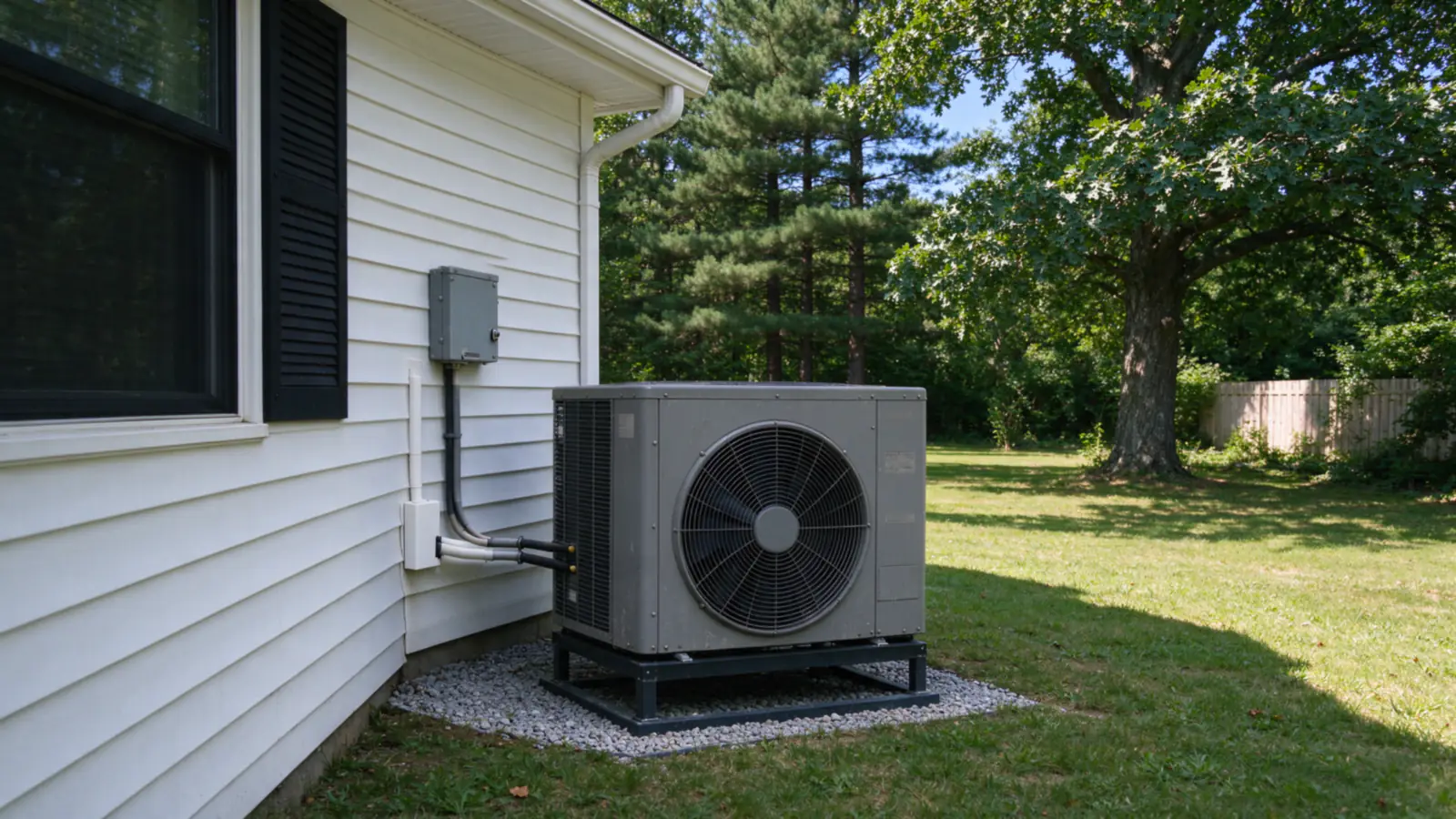
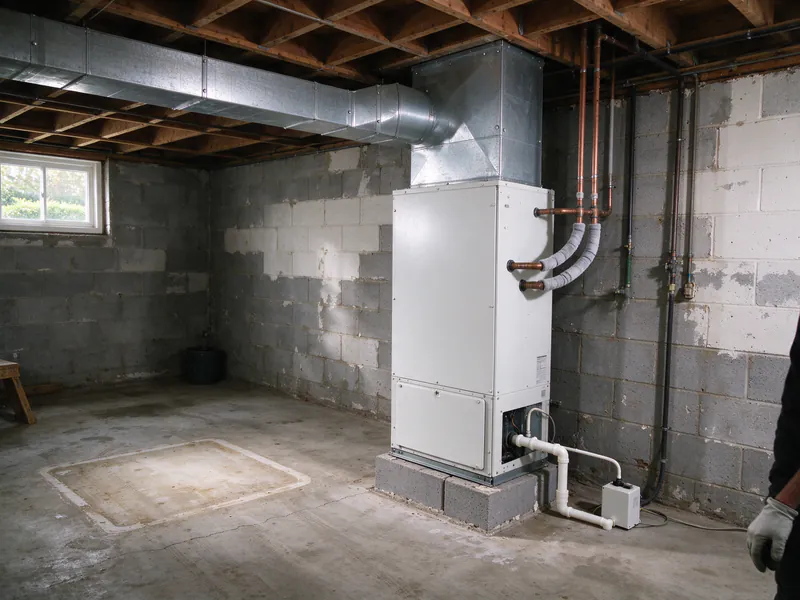
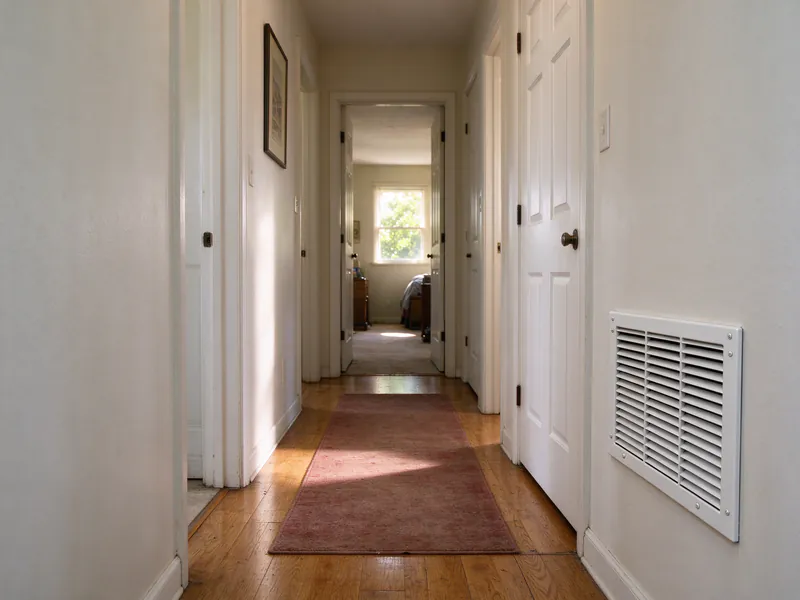
The easiest heat pump job in Saugus is a house that already has ducts. Clement Boston Heat Pumps handles heat pump installation in Saugus, MA for oil and gas furnace homes, where the air handler takes the furnace’s place and the existing ducts carry the new heat and cooling.
Two in three Saugus homes are detached, and more than one in five burns oil. For a forced-air house heated with oil, that pairing is the strongest case for a cold-climate heat pump.
When a Saugus house already has ducts
A forced-air house keeps its ducts, its registers and most of its layout. What changes is the air handler, the outdoor unit and a few duct fixes we find on the first visit.
Measuring before reusing
Compared with an oil furnace, a heat pump pushes more air at a cooler supply temperature. So we measure static pressure across the system, size the return, and check for leaks at every joint. Where the return is undersized, a second return grille or a larger one solves it. See furnace to heat pump conversion.
One-level and split-level houses
Where a house is on one floor over a basement, the duct runs are short and even, and one system usually covers it. A split-level or a house with a finished upper floor may need its ducts balanced, or a second air handler for the top level.
Rooms on baseboard
Where an addition or finished basement runs on electric baseboard, it can join the system. The new system can reach those rooms with a short branch, so the baseboard can stay as backup or come out. See baseboard to heat pump.
Leaving oil behind in Saugus
Oil costs more per unit of heat delivered than a heat pump on National Grid’s winter rate, and Mass Save treats oil as an eligible system to replace. The switch has three parts.
The heat pump
A cold-climate unit sized to the house’s load at the design temperature carries the whole winter without the oil furnace. The estimate shows its capacity at 5°F. Our Massachusetts climate guide explains why that number matters.
The rebate
Taking the oil furnace out, or disconnecting it, opens Mass Save’s whole-home rebate, which pays by the ton with a cap of $8,500 on systems installed by the end of December 2026. The per-ton amount and the cap both step down on January 1, 2027. Equipment must be on the cold-climate list. See our rebate guide.
The tank
Once the heat pump carries the house, the tank comes out. Our typical range for an accessible basement tank is $600 to $1,500, under the local fire department’s permit. See oil tank removal and our heat pump vs oil guide.
Gas and electric homes in Saugus
About 55% of Saugus homes heat with gas and 19% with electricity. Both have a clear path through Mass Save, because National Grid sponsors both sides.
Electric heat
Baseboard turns one kilowatt-hour into one unit of heat; a heat pump moves two to three on a typical winter day. That gap shows up on the first bill. From November to April, National Grid’s heat pump rate cuts the distribution part of your bill.
Gas
Gas costs the least per BTU, which narrows the savings. The switch usually follows a failing furnace or a wish for central cooling, and the whole-home rebate applies when the gas furnace comes out.
The marsh, the river and the outdoor unit
The state lists Saugus as a North Shore coastal town, with the Saugus River and Rumney Marsh along its southern edge. That affects where the outdoor unit can sit on some lots.
Flood elevation
Lots close to the marsh can fall inside a FEMA flood zone. If yours does, state code fixes a minimum height for the equipment, and that can push the air handler out of a low basement. We pull up your parcel’s flood map before drawing the plan.
Snow and clearance
Inland lots near Breakheart deal with snow more than salt. A stand keeps the coil above drifts and lets defrost water drain away from the foundation, not into a basement window well.
Salt on the eastern side
Homes in East Saugus sit closer to the marsh and the coast than the rest of town. Where an outdoor unit takes wind off the water, we tuck it behind the house and can price a coastal coating on the coil as an option. Our placement guide covers spacing from walls and fences.
Noise next door
On a ranch lot, the outdoor unit often ends up along a side yard near the neighbor’s bedrooms. Saugus noise limits for HVAC equipment are confirmed per address, and a variable-speed unit runs quietly at low speed most of the winter. See variable-speed heat pumps.
Permits, code and rebates in Saugus
Permits go through the town’s building department; the filing route is confirmed per address. A ducted job needs electrical and sheet metal permits, a gas permit where a line gets capped, and a fire department permit for tank removal.
| What | Saugus |
|---|---|
| Who supplies power and gas | National Grid, on both |
| Building energy code | Stretch, since January 1, 2016 (no specialized code) |
| Coast | Listed coastal town, North Shore |
| Where rebates come from | Mass Save, with National Grid as sponsor |
| Financing | Mass Save HEAT Loan, 0% up to $25,000; apply before work |
The HEAT Loan guide walks through applying, and our installation cost guide breaks down each price range.
An Saugus job, week by week
The first visit measures the ducts and return, runs a room-by-room load calculation, checks the panel, and picks the outdoor spot with the flood map in hand.
- Estimate in writing: the unit and what it puts out at 5°F, each duct fix, wiring, the tank, permit fees, which rebate fits, and one price.
- Install: two to four working days on existing ducts.
- Before we leave: a nitrogen hold test, a deep vacuum checked on a micron gauge, refrigerant weighed in, supply airflow and static readings, and the strip-heat lockout temperature noted.
Next door, Lynn shares National Grid with older, denser housing, and Lynnfield gets its power from municipal light plants instead.