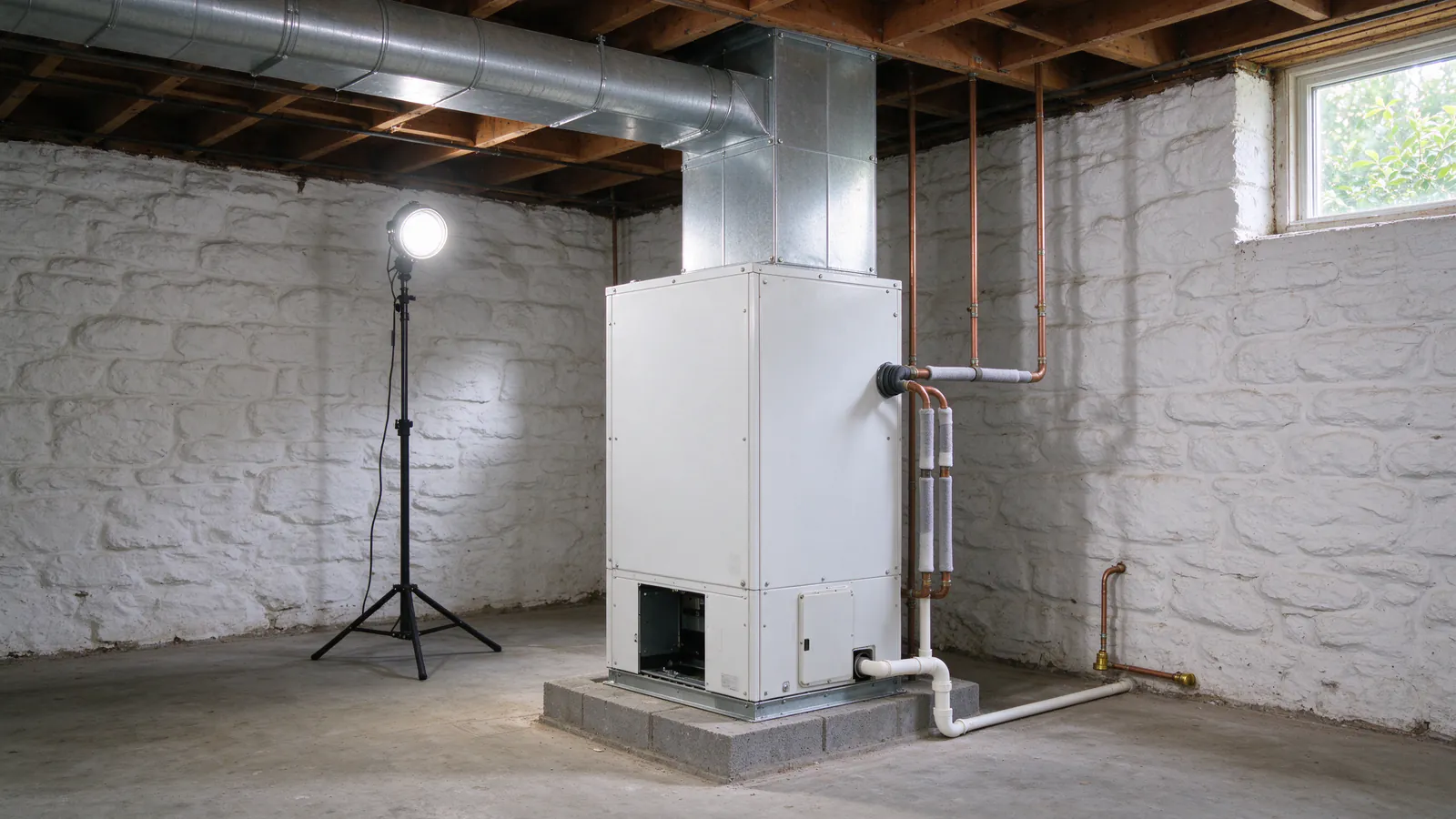
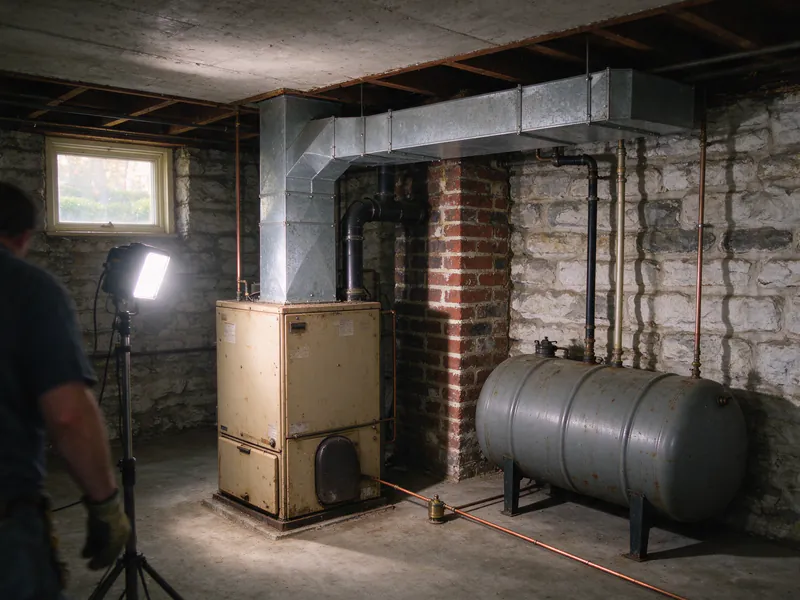
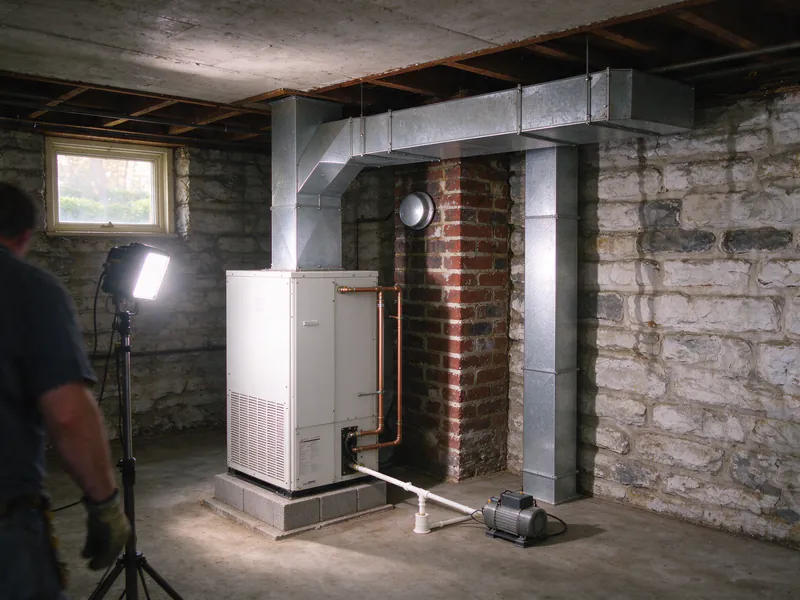
The oil truck comes all January, the tank fills a corner of the basement, and there’s no central air. Clement Boston Heat Pumps handles the oil to heat pump conversion in houses that already have ducts: we retire the oil furnace or hydro-air boiler, cap the oil line and put a cold-climate heat pump on the ductwork you have.
Our typical range for a whole-home heat pump on ducts we can reuse is $15,000 to $28,000 and up, before rebates. Tank removal and any service upgrade are separate lines on the written estimate, so you see what each piece costs.
Is your oil house a ducted one?
This page is for oil homes with ductwork: an oil warm-air furnace, or an oil boiler feeding a hot-water coil in an air handler. If your oil boiler heats radiators or baseboard, the job is building ducts; see boiler to heat pump conversion.
Oil warm-air furnace
The burner fires into a heat exchanger and a blower pushes the warmed air through your ducts. The heat pump’s air handler takes the furnace’s place on the same supply plenum, so the trunk and branches stay where they are.
Hydro-air
The oil boiler heats water, which runs to a coil inside an air handler, often in the attic. That air handler and coil are replaced with a heat pump unit, and the boiler leaves once nothing else depends on it. Settle that last part first: plenty of hydro-air boilers also heat the domestic water.
What we check that only oil houses raise
On top of the usual load calculation, an oil house adds three questions: what heats your water, what condition the tank is in, and whether the panel can carry heat that used to come from a burner.
- Hot water. A tankless coil inside the boiler, or an indirect tank fed by it, means your hot water needs a new source before the boiler goes. We flag it on the first visit so the timing works.
- The tank. Basement or buried, its age, and the fill and vent pipes outside. Our typical range for removing an accessible basement tank is $600 to $1,500, plus the Boston Fire Department permit ($110). A buried tank gets scoped separately after a look.
- The panel. Plenty of oil houses never had central air, so the original 100-amp service may still be in place. We run an electrical load calculation with the heat pump and its backup strips included. Our typical range for a service upgrade, usually 100 to 200 amps, is $3,000 to $6,500.
- The ducts. Static pressure across the furnace, the size of the return and leaks at the trunk joints, measured before anything gets priced.
Why oil furnace ducts often need a bigger return
An oil furnace sends out hot air, often 120°F or more, and moves little of it. A heat pump’s supply air runs cooler, roughly 90°F to 105°F, so it moves more air to heat the same room.
More air through the same ducts raises static pressure. Past the air handler’s limit, the blower gets loud, uses more electricity and the coil can’t deliver its rated heat. In an oil house the fix is usually on the return side, because most were built with one return grille in a hallway.
What the duct work adds
A second return, or a larger one, gets its own line in the estimate with the sheet metal permit. Our ductwork page covers sealing and the other changes a reading can call for.
Go oil-free, or keep the furnace as backup?
A reasonably tight house can usually be carried by a cold-climate heat pump alone, with electric strips for defrost and the odd deep-cold night, as long as the equipment’s output at 5°F covers the load calculation.
What going oil-free removes
No deliveries, no yearly burner cleaning, no tank to explain to a buyer’s inspector. Heating and cooling come from one system on one bill, and the whole-home rebate path opens.
When oil backup makes sense
A big, leaky house where a system sized for the 7°F night is oversized the rest of the winter, or an oil furnace young enough to keep. Dual fuel runs it only in the coldest hours.
The catch with oil: a burner that fires a few days a year still needs its tank filled, its nozzle and filter changed, and fuel that sits for months.
Rebates for leaving oil
Where Eversource or National Grid supplies your electricity, an oil to heat pump conversion can qualify for Mass Save’s whole-home rebate, paid per ton for qualifying equipment installed by a participating contractor.
| Your electric company | Rebate route for an oil house |
|---|---|
| Eversource or National Grid | Mass Save whole-home rebate per ton, through your electric sponsor; the per-ton rate drops on January 1, 2027 |
| A light plant town such as Belmont, Reading, Braintree or Peabody | The town utility’s own heat pump program; Mass Save’s electric rebates don’t cover oil switches there |
The whole-home path also asks for cold-climate listed equipment, proof of weatherization and the oil system removed or disconnected. Mass Save’s HEAT Loan offers 0% financing up to $25,000 through participating lenders if you apply before work starts. The rebate guide has the amounts.
What happens to your heating bills
Per unit of heat delivered, oil costs more than any other common heating fuel in Greater Boston. A cold-climate heat pump on a winter heat pump rate delivers the same heat for noticeably less, though the result depends on your house and the winter.
Once a heat pump heats the house, Eversource and National Grid customers can move to the seasonal heat pump rate, which lowers distribution charges on all household electricity from November through April. The electric rate guide explains it, and heat pump vs oil heat works through the running costs.
The part that can still run up a bill
Backup strips are plain resistance heat. We set a lockout so they stay off above a chosen outdoor temperature and record it at closeout. If they come on during a mild week, read heat pump aux heat.
The order the work goes in
Permits come first: electrical and sheet metal through the city or town, plus the Fire Department permit for the tank. Then the job runs in this order, so the house is without heat for as little time as possible.
- The utility books the meter work if the service is being upgraded, ideally the same day the new panel goes in.
- The burner and furnace come out, and the oil supply line is cut and capped.
- The air handler, return changes, outdoor unit and line set go in.
- Commissioning: nitrogen pressure test, vacuum below 500 microns, charge by weight, airflow measured and the backup lockout set.
- The tank comes out last, once the heat pump is carrying the house.