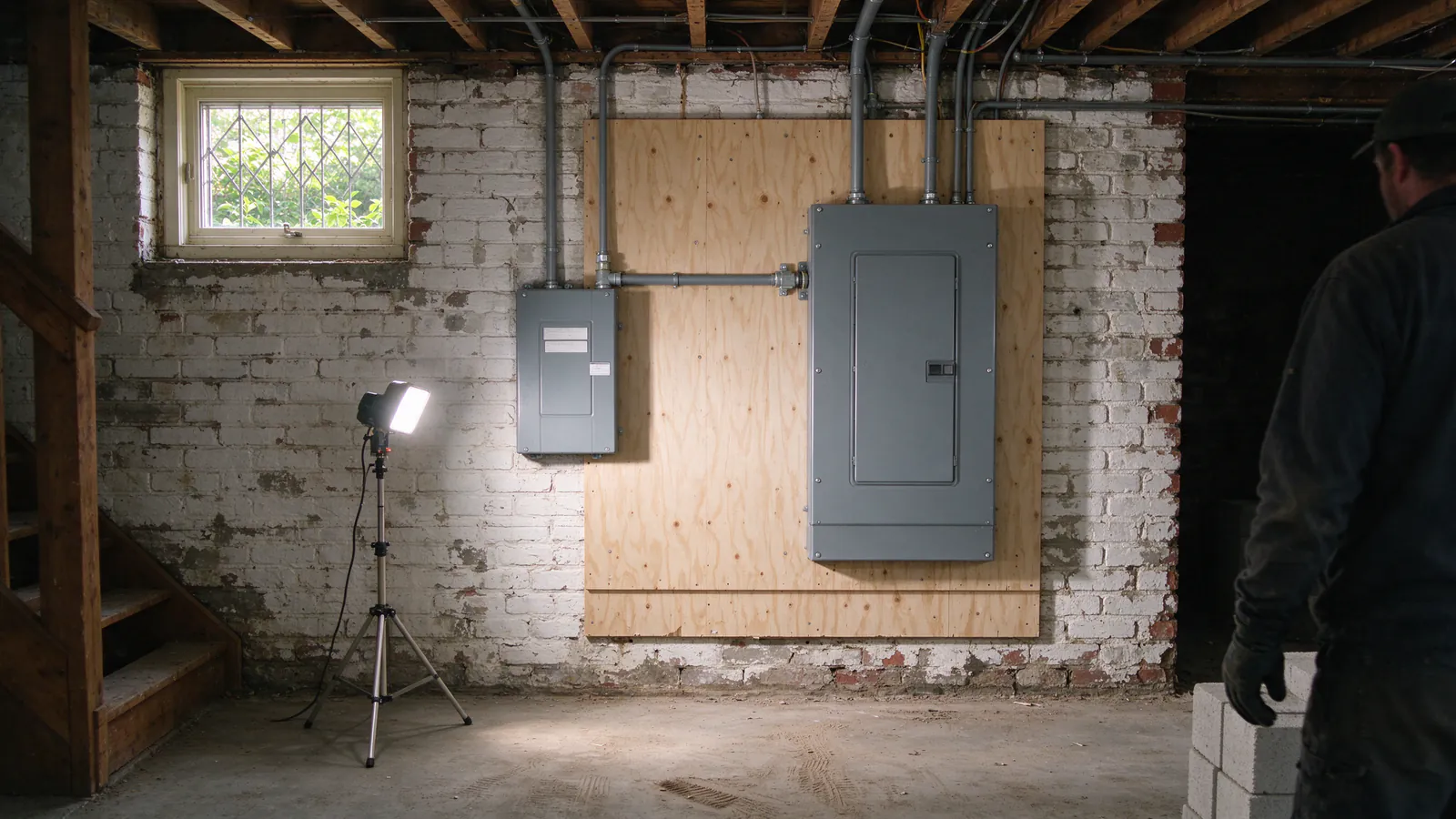
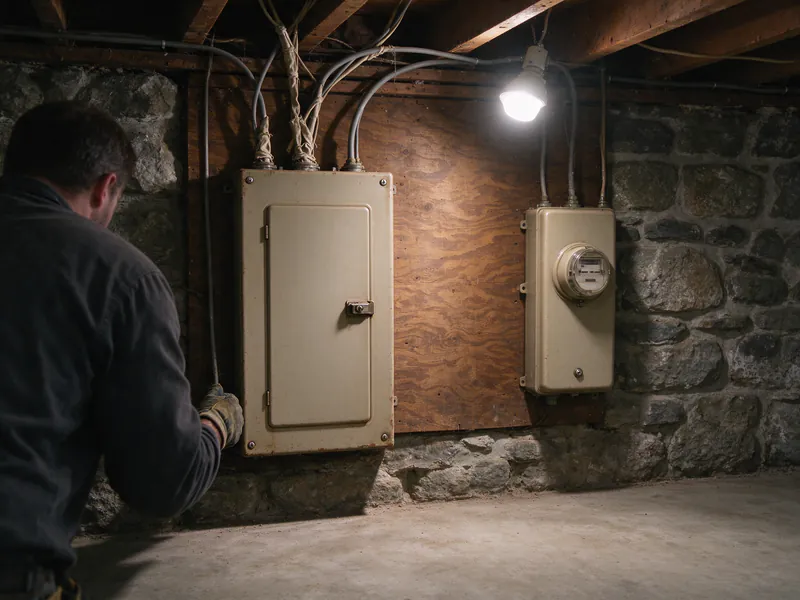
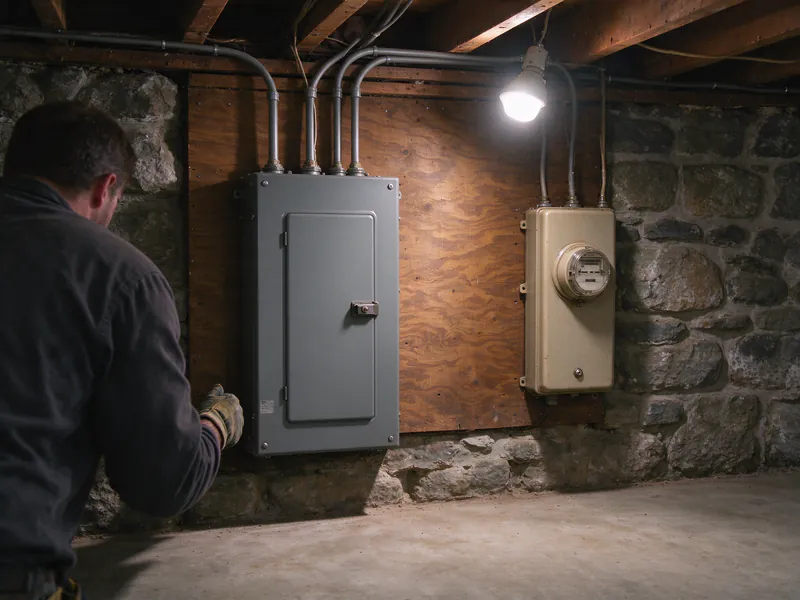
The heat pump needs two new 240-volt circuits, and the panel in the basement is a full 100-amp box with two breakers already sharing a slot. Clement Boston Heat Pumps handles the electrical panel upgrade for a heat pump as part of the install, but only after a load calculation shows the service is too small.
Plenty of 100-amp houses carry a heat pump without one. When an upgrade is needed, our typical range is $3,000 to $6,500 for the customer-side work; the utility’s part is separate.
Do you need 200-amp service for a heat pump?
Not always. The answer comes from adding up what the whole house draws, not from the heat pump alone, and the backup heat strips are what pushes most 100-amp services over.
What the calculation adds up
We run the service load calculation the electrical code lays out: lighting and outlets by floor area, kitchen and laundry circuits, the range, dryer and water heater, and the heat pump with its backup heat. Heating and cooling don’t both count, because they never run at the same time.
Why the backup strips matter
A 3-ton heat pump draws modestly. The electric strips in the air handler draw far more: 10 kW pulls about 42 amps at 240 volts. On a cold night they can run with the heat pump, oven and dryer: that’s the load the service carries. Our aux heat guide explains when the strips come on.
What happens on the first visit
The panel check is part of every heat pump visit. We open the cover, count spaces, read the main breaker and look at the grounding, then run the numbers with the system we’re proposing.
- Service size. The main breaker, the meter socket rating and the service conductors. A 100-amp breaker on wire rated for 60 amps is a 60-amp service.
- Space. A heat pump needs a two-pole breaker for the outdoor unit and another for the air handler. Tandem breakers and two wires under one screw mean the panel is already out of room.
- Condition. Scorched bus bars, breakers that don’t match the panel’s listing, and missing grounding all go on the estimate.
- What’s on the house. An electric range, dryer, water heater, EV charger or well pump, and anything you plan to add.
If the service has room, the estimate says so and the circuits are part of the heat pump price. If it’s close, we lay out the options side by side before recommending an upgrade.
Ways to keep the service you have
When the numbers are close, a smaller strip or a load-management device can keep the existing service. Both trade some backup capacity or convenience for a smaller bill up front.
Smaller backup heat
A cold-climate heat pump that carries the design-night load by itself needs far less strip heat. Dropping from 10 kW to 5 kW cuts about 21 amps from the calculation. Our sizing guide shows how the heat pump’s capacity at 5°F decides how much backup a house needs.
Load management
A load-management device watches the service and pauses a big load, such as an EV charger or a water heater, while the heat pump and strips run. Where the wiring inspector accepts it, the calculation counts that control, and a 100-amp service can stay.
What a service upgrade involves
The utility cuts power at the drop, the meter socket, service conductors and panel are replaced, the town’s wiring inspector signs off, and the utility reconnects. Plan on the power being off for most of one working day.
- Permit. An electrical permit from your city or town. In Boston a service upgrade costs $20 plus $0.25 per amp, so $70 for 200 amps. Cambridge charges $10 per 100 amps of service.
- Utility booking. Eversource or National Grid sets the disconnect and, after inspection, the reconnect.
- The swap. New meter socket, service entrance cable, a 200-amp panel, ground rods and the water pipe bond. Every existing circuit moves over with its own breaker and label.
- Inspection and reconnect. The municipal wiring inspector checks the work, then the utility reconnects and seals the meter.
Utility fees and any work on the utility’s side, such as a new overhead drop or a meter moved outdoors, sit outside our range and appear as their own lines on the estimate.
How often it comes up in Boston
From November 2021 through October 2026, Boston issued about 1,560 permits naming a heat pump for heating. 188 of them describe a service upgrade or change: roughly one in eight.
Circuits and the outdoor disconnect
Every heat pump gets its own circuits and a disconnect at the outdoor unit, upgrade or not. Their size comes from the nameplate, not the tonnage.
The nameplate lists a minimum circuit ampacity and a maximum fuse or breaker size; the wire and breaker are chosen between them. The disconnect sits within sight of the outdoor unit so a technician can kill the power while working on it, and the air handler gets its own circuit sized for its strips.
Where your town and utility change the steps
The work is the same everywhere; the permit office, the fee and the utility on the other end of the drop differ.
- Eversource towns such as Arlington, Newton and most of Boston: Eversource disconnects and reconnects after the town’s inspection.
- National Grid towns such as Quincy, Malden and Lynn: the same sequence through National Grid.
- Light plant towns such as Belmont, Braintree and Reading: the town utility handles the meter side.
What a panel upgrade doesn’t fix
A new panel and service change what comes into the house. They don’t change the wiring inside the walls.
If the house still has knob and tube or ungrounded two-wire circuits, those circuits move to the new panel as they are. The new panel doesn’t remove them, and it doesn’t decide what an insurer will accept. We note what we see on the estimate, and rewiring is its own job.
Pricing it with the heat pump
The cost guide shows how the electrical line sits beside the whole-home heat pump price.