(857) 837-1475Get an Estimate

Service area, Massachusetts

Ducted heat pumps for Cambridge, MA houses and condos

Ducted heat pumps for Cambridge houses and condos, planned around the fossil-fuel-free rule, HVAC noise limits and Mid-Cambridge and Old Cambridge review.

Last Updated:

Row of three-story wood-frame houses on a Mid-Cambridge side street with a ducted heat pump outdoor unit on a stand in a rear yard visible between two houses
ElectricEversource
RebatesMass Save
PermitsCambridge Inspectional Services Department
Energy codeSpecialized stretch code since July 1, 2023

What a boiler-to-heat-pump job in Mid-Cambridge looks like

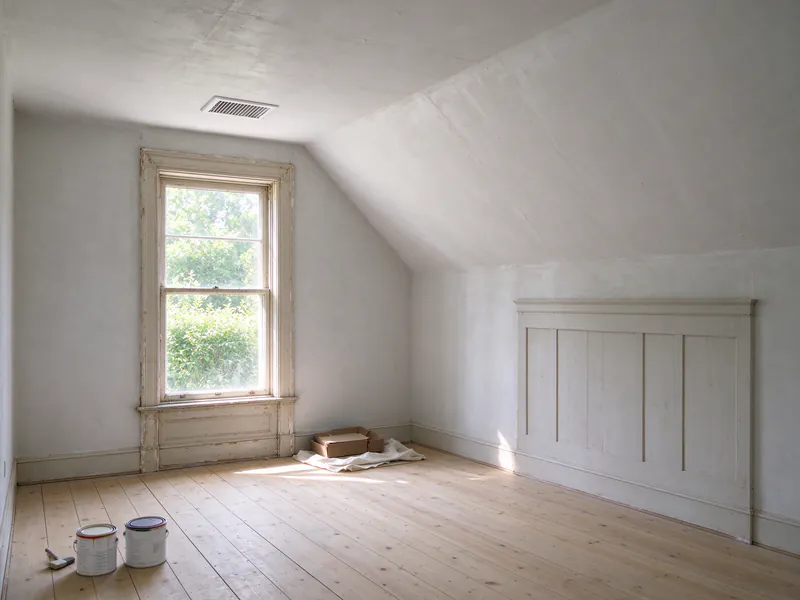
New ceiling register in a finished third-floor bedroom, Mid-Cambridge
New ceiling register in a finished third-floor bedroom
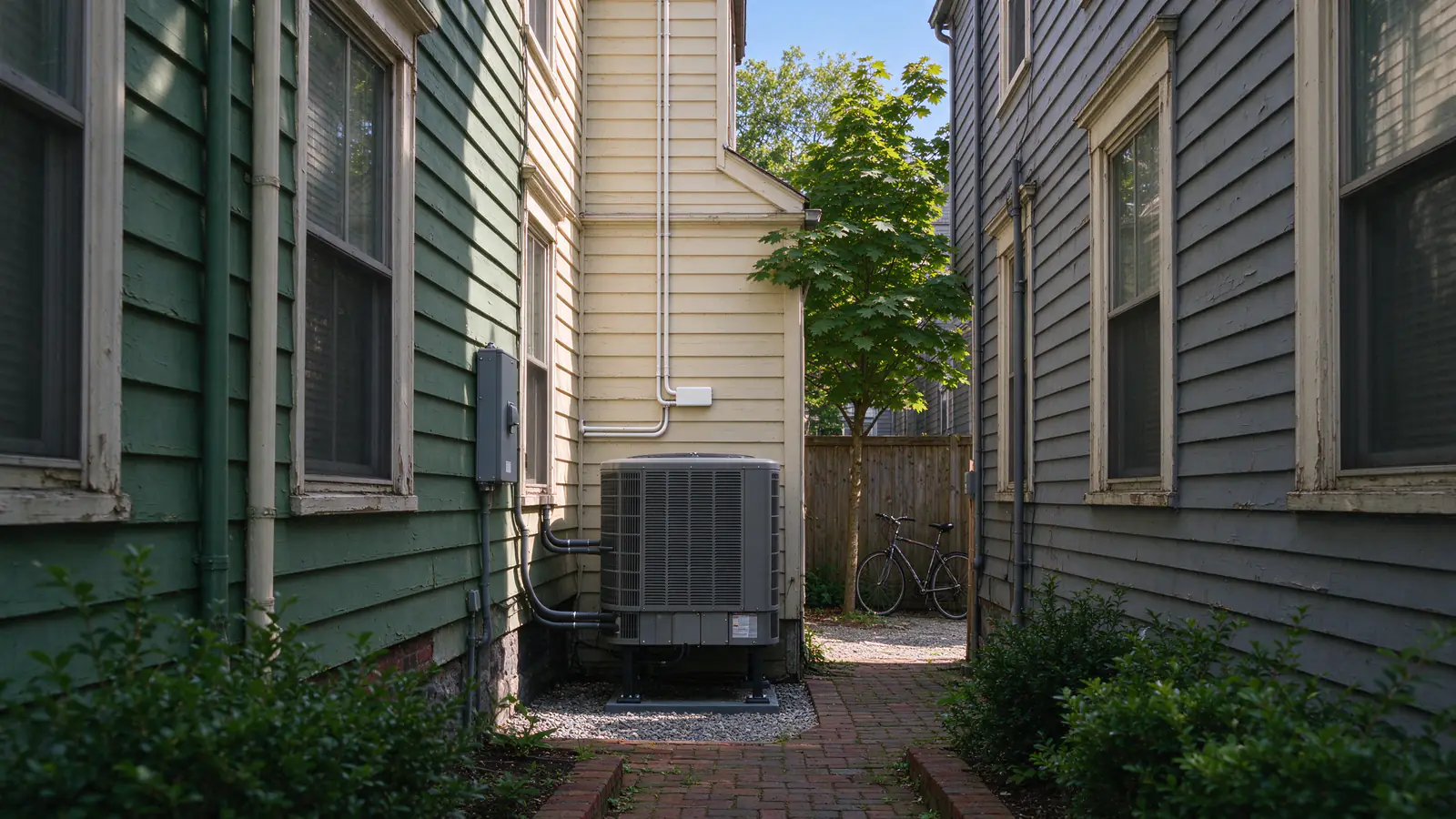
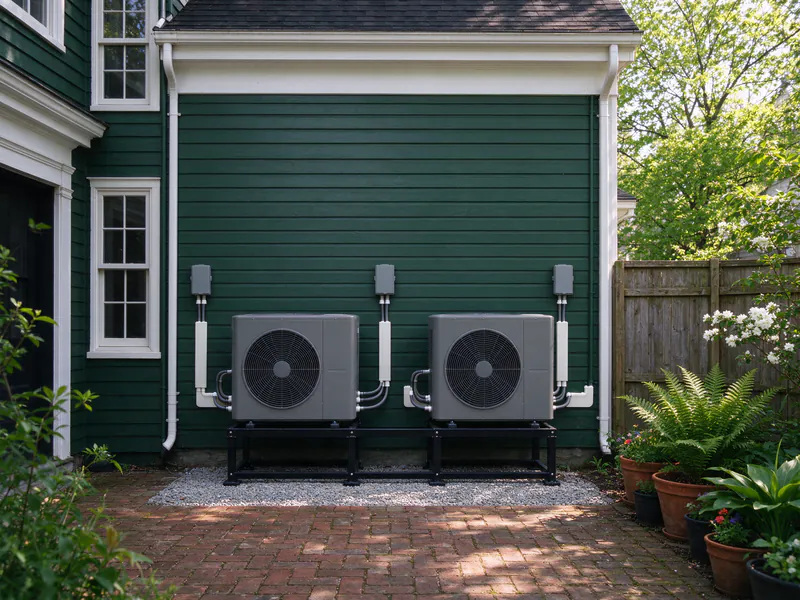
Outdoor units in the rear yard, out of the narrow side yard, Mid-Cambridge
Outdoor units in the rear yard, out of the narrow side yard

The house and the rule

An 1890s three-story house on a narrow lot, heated by a gas steam boiler, with the third floor and kitchen being gutted. Because it's a major renovation, Cambridge's fossil-fuel-free ordinance rules out a new gas boiler or furnace, so the heat has to be electric.

Using the renovation

With the third floor open, a 2-ton attic air handler feeds the top two floors through the new framing and two closets that stack between floors 2 and 3. A 1.5-ton basement unit reaches the first floor through floor registers, so the finished plaster downstairs stays closed.

Where the outdoor units go

The 9-foot side yard sits against the neighbor's bedroom windows, and Cambridge's guidance holds HVAC equipment to 50 dB(A) at night at the lot line. So both units go to the rear yard on a sound-rated stand, set to low-noise mode at night, with a sound reading at the line before we finish. Mid-Cambridge is a neighborhood conservation district, and a rear-yard unit not visible from the street is the kind of work the Historical Commission usually clears with a Certificate of Non-Applicability.

Sequence and permits

Ducts are roughed in before the drywall, the boiler comes out once the heat pumps carry the house, and permits go through Cambridge Inspectional Services. Twelve supply registers, two returns, line sets of 38 and 22 feet, all pressure-tested, evacuated and charged by weight.

Project facts
ServiceBoiler-to-heat-pump conversion with new ducts
WhereMid-Cambridge
House1890s three-story single-family, about 2,600 sq ft
BeforeGas steam boiler and radiators, window AC
After2-ton attic and 1.5-ton basement heat pumps
Price$36,800 before rebates
Time on siteNine working days, timed around a renovation

What brings people to us in Cambridge

A renovation that can't put gas back

Cambridge's fossil-fuel-free ordinance keeps new gas or oil equipment out of the work area of a major renovation, so the new heat is electric.

A three-decker or condo with window units

Each unit gets its own system sized for its own floor, with the board or the other owners signing off on where the outdoor units go.

A narrow side yard

The city holds HVAC equipment to 50 dB(A) at night at the neighbor's line, which usually moves the outdoor unit to the rear or the roof.

A steam or hot-water house with no ducts

Attic and basement air handlers, stacked closets or small-duct systems bring ducted heat and cooling without opening every wall.

Close to half of Cambridge’s homes were built before 1940, most for steam or hot-water radiators. Clement Boston Heat Pumps installs ducted heat pumps in Cambridge houses, two-families and condos, planned around three rules that make a Cambridge job different.

Those rules are the fossil-fuel-free ordinance, the city’s HVAC noise limits and historic review where it applies. Each one changes the plan before we choose any equipment.

Why Cambridge jobs start with the rules

Three Cambridge rules shape where the heat comes from, where the outdoor unit sits and who signs off. We check all three on the first visit.

Fossil-fuel-free renovations

Since March 22, 2024, Cambridge’s ordinance has kept new fossil-fuel equipment out of new buildings and out of the work area of major renovations. If you’re gutting a floor and replacing the heat at the same time, the new heat is electric.

A gas furnace kept as backup isn’t available for that work, so the ducted heat pump is the main system. We size it to carry the coldest night without leaning on backup strips; see whole-home heat pumps.

Noise at the lot line

The city’s HVAC noise handout sets 50 dB(A) from 6 p.m. to 7 a.m. and 60 dB(A) by day, measured from your neighbor’s property line. The handout itself warns that many units turn out to be in violation once running.

On lots where side yards are a few feet wide, that limit decides where the unit goes. We check the unit’s rated sound against the distance to the line, favor rear yards and roofs, and take a reading at the line before we finish. Our outdoor unit placement guide covers the rest.

Historic and conservation districts

Old Cambridge and Fort Washington are historic districts. Avon Hill, Half Crown-Marsh, Harvard Square and Mid-Cambridge are neighborhood conservation districts, where exterior work visible from a public way can need Cambridge Historical Commission review.

A unit in a rear yard or on a roof the street can’t see usually qualifies for a Certificate of Non-Applicability, often issued on the spot. We photograph the spot from the street on the first visit so the question is answered early.

The houses we see, and where the ducts go

Cambridge is mostly multi-family. More than half its homes sit in buildings of five or more units, and only about one in ten is a detached house. That shapes the job more than the equipment does.

Three-deckers and two-families

Each unit gets its own system sized for its own floor, because the top floor loses far more heat through the roof than the one below. The top unit’s air handler goes in the attic, the first floor’s in the basement, the middle one in a closet or on a small-duct system. Our three-decker guide walks through it.

Condos

The board and the master deed decide where outdoor units can sit. We bring the spec, the sound rating and a placement drawing to that conversation early; see condo heat pump replacement.

Single-family houses with radiators

In a Victorian or a Cambridgeport single-family, the usual plan is an attic air handler for the upper floors and a basement unit for the first, with stacked closets carrying the trunk. Renovations make it easier, because the ducts go in before the drywall. See boiler and radiator homes.

Electric heat, gas heat and what changes the savings

About 28% of Cambridge homes already heat with electricity, against roughly 64% on gas and under 4% on oil. Which group you’re in changes the case for a heat pump more than anything else.

If your condo heats with baseboard

In an older condo, electric heat usually means baseboard or wall heaters, which turn one kilowatt-hour into one unit of heat. A heat pump moves two to three units for the same kilowatt-hour on a typical winter day.

The savings show up on the first bill, and Mass Save counts electric resistance heat as an eligible system to replace. See electric baseboard to heat pump.

If you heat with gas

Gas is the cheapest fuel per BTU, so the running-cost case is closer. Most Cambridge owners on gas switch because the boiler is near the end, they want central cooling, or a renovation rules out new gas equipment. We put the running cost on your actual rates in the estimate; see heat pump vs gas furnace.

Code and rebate rules that apply in Cambridge

Cambridge’s Inspectional Services Department issues the electrical permit and a separate sheet metal permit, plus a building permit when the work is part of a renovation.

What The Cambridge figure
Sheet metal permit fee $50 plus $25 per 100 linear feet of duct
Work started before a permit Triple fees
Heat pump sheet metal permits, Nov 2021 to Oct 2026 294, about three in four for ducted systems
Energy code Specialized stretch code since July 1, 2023
Electric utility Eversource

Cambridge homes are on Eversource, so Mass Save’s rebates apply, along with the winter heat pump rate. Most Cambridge homes heat with gas, and Mass Save’s whole-home rebate covers replacing gas heat when the old system comes out.

That rebate also needs cold-climate equipment and an installer in Mass Save’s network; our rebate guide lists the conditions. The cost guide sets out our ranges.

From first call to commissioning in Cambridge

The first visit covers the load calculation, the ducts or routes for new ones, the panel and the outdoor spot, measured against every lot line. In a district, we photograph the spot from the street.

  • Written estimate: equipment, duct work, electrical, permits and the rebate path, line by line.
  • Renovation timing: we work to the general contractor’s framing and drywall schedule, so ducts are roughed in while the walls are open.
  • Permits first, then the install, usually two to nine working days depending on new ducts.
  • Commissioning: pressure test, vacuum, charge by weight, airflow, controls, and a sound reading at the lot line.

Neighboring Somerville runs its own permit office and allows dual fuel; Arlington shares Cambridge’s fossil-fuel-free approach.

Services in Cambridge

How a job usually runs in Cambridge

First call

You tell us what heats and cools the house now, which rooms aren't working, and roughly where the house is.

Home visit

We measure the house for a load calculation, test the ducts, check the panel and look for an outdoor spot.

Written estimate

Equipment, duct changes, electrical, permits and the rebate path, line by line, with our price.

Install

Permits first, then the work: usually two to five working days on site.

Commissioning

Pressure test, vacuum, charge by weight, airflow and controls set before we call it done.

Neighborhoods, landmarks and routes

  • Mid-Cambridge
  • Cambridgeport
  • Riverside
  • Agassiz
  • Neighborhood Nine
  • North Cambridge
  • East Cambridge
  • The Port
  • Wellington-Harrington
  • Strawberry Hill

Landmarks

  • Harvard Square
  • Central Square
  • Inman Square
  • Porter Square
  • Fresh Pond

Getting around

  • Massachusetts Avenue
  • Cambridge Street
  • Memorial Drive
  • Route 2 at Alewife
10 mi20 miBostonCambridge
Open Cambridge, MA in Google Maps

Planning a heat pump in Cambridge?

We start with what heats the house now, the ducts you have or could have, and where the outdoor unit can go.

Cambridge: questions

Can I replace my gas boiler with a new gas boiler during a Cambridge renovation?

Not inside the work area of a major renovation. Cambridge's fossil-fuel-free ordinance, in effect since March 22, 2024, keeps new fossil-fuel equipment out of new buildings and major renovations. A like-for-like boiler swap outside a major renovation is a different case; we check which one your project is.

How loud can my outdoor unit be in Cambridge?

The city's HVAC noise handout sets 50 dB(A) from 6 p.m. to 7 a.m. and 60 dB(A) during the day, measured from your neighbor's property line. We place and select the unit to meet that, and take a reading at the line before we finish.

Do I need Historical Commission approval for a heat pump in Mid-Cambridge?

Mid-Cambridge is a neighborhood conservation district, so exterior work visible from a public way can need review. An outdoor unit in a rear yard that the street can't see usually gets a Certificate of Non-Applicability, which the Commission often issues on the spot.

What does a ducted heat pump cost in a Cambridge house?

Our typical range for a whole-home system on ducts we can reuse is $15,000 to $28,000 and up before rebates. Most Cambridge houses heat with radiators and need new ducts, where our typical range is $20,000 to $40,000 and up. Your written estimate sets the price.

Which permits does a Cambridge heat pump job need?

Usually an electrical permit and a sheet metal permit from Inspectional Services, plus a building permit when the work is part of a renovation. Cambridge's sheet metal fee is $50 plus $25 per 100 linear feet of duct, and work started before a permit is issued pays triple fees.

Nearby service areas

Guides for houses in Cambridge

Get an estimate in Cambridge

Tell us what heats the house now and which rooms aren't working in Cambridge.

Step 1 of 2

The house and the work