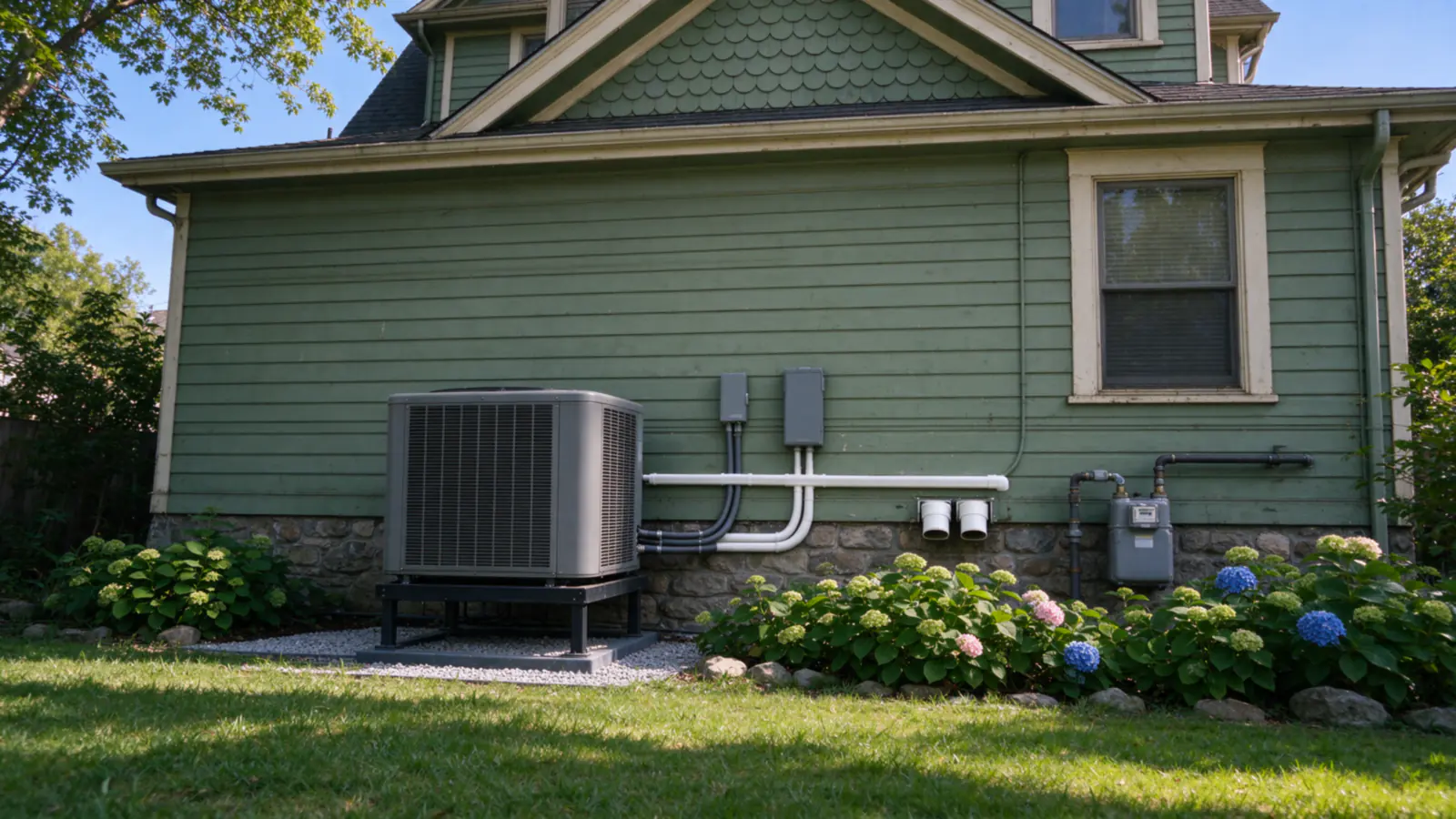
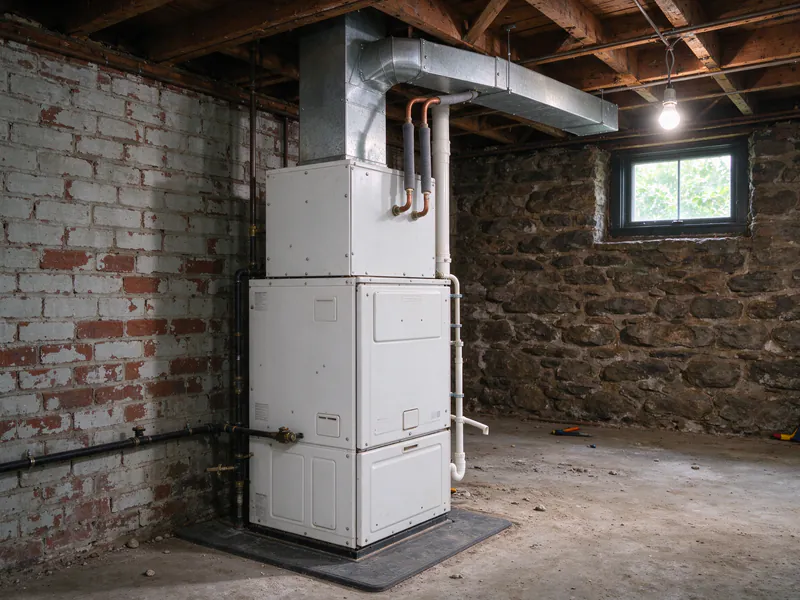
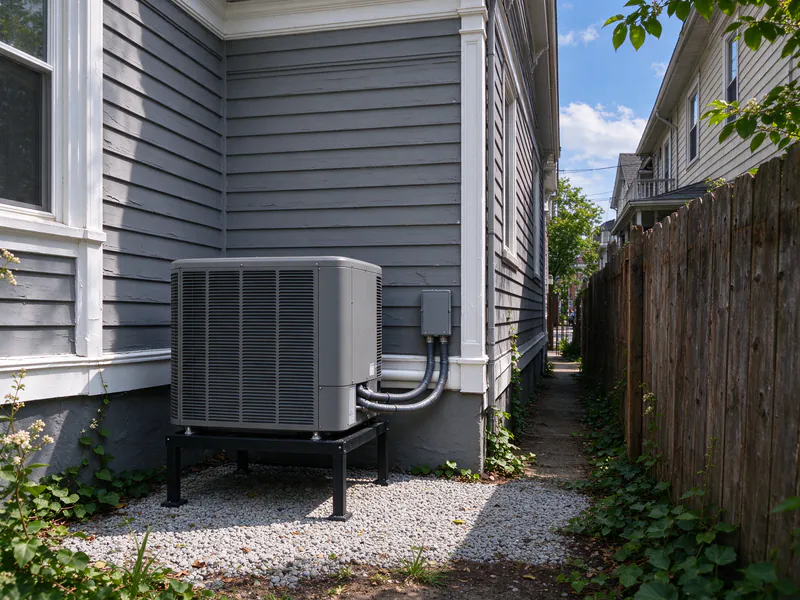
Your gas furnace is six years old and runs fine, the central AC just quit, and you’d like heat pump heating without scrapping a good furnace. A dual fuel heat pump does that. Clement Boston Heat Pumps adds a heat pump that heats most of the winter and hands the coldest hours to the furnace you already own.
We price dual fuel from what stays and what changes: the outdoor unit, a coil on the furnace, the controls and the line set. The written estimate after the home visit sets the number.
How the heat pump and furnace share the work
The heat pump heats the house until the outdoor temperature drops to a set point, then the furnace takes over. Both use one blower, one coil cabinet and one set of ducts, and in summer the heat pump cools.
The balance point
Every house has an outdoor temperature where the heat it loses equals what the heat pump can deliver. Above it, the heat pump carries the house alone. Below it, something has to add heat. The load calculation and the equipment’s published output at 17°F and 5°F tell us where that point falls.
The switchover temperature
The switchover is the setting where the control hands off to the furnace. It can sit at the balance point, below it or above it, depending on comfort, fuel prices and rebate rules. With the coil on top of the furnace, the two never heat at once, because furnace heat across that coil overloads the heat pump.
Keep the furnace or go all-electric?
Keep it when it’s young and the house is hard to heat with one heat pump. Retire it when it’s near the end, when your town limits fossil equipment in your renovation, or when you want a single electric bill.
- Dual fuel fits a furnace under about ten years old, a large or drafty house, a panel with little room for electric strips, or an owner who wants a gas or oil backup on hand.
- Whole-home fits an old furnace, a house weatherized enough for one heat pump, or an owner after the larger whole-home rebate.
What it costs to run
The fuel you keep decides how much dual fuel saves. Next to oil or propane, heat from a heat pump costs less through most of the winter. Next to gas at current Boston prices, the gap is narrow, and in deep cold gas heat can cost less. Our heat pump vs gas furnace guide runs the numbers.
Town rules
Arlington, Brookline, Cambridge, Newton, Lexington and Concord limit new fossil-fuel equipment in new buildings and major renovations. Keeping an existing furnace in an ordinary retrofit isn’t affected; putting in a new furnace during a gut renovation there is. Medford and Watertown still allow dual fuel with new equipment.
Gas, oil or a boiler as the backup
The backup can be a gas furnace, an oil furnace or a boiler feeding a hot-water coil. Each pairs with the heat pump a little differently.
- Gas furnace. The usual pairing. The heat pump’s coil sits on the furnace outlet, and the furnace blower moves air for both.
- Oil furnace. The same layout. Because oil heat costs more per unit, the switchover can sit low and the burner runs only on the coldest nights.
- Boiler with hydro-air. Some houses have an air handler with a hot-water coil fed by the boiler. A heat pump air handler takes its place, with a boiler-fed coil kept in the airstream as the backup. The boiler still serves radiator zones and, in many houses, the hot water.
Combustion safety stays its own check. When a coil goes on a furnace, the venting, draft and heat exchanger are looked at separately, and a licensed gas fitter handles anything on the gas side. Hydro-air houses also have a boiler conversion option if the boiler is due.
What the first visit checks for dual fuel
We size the heat pump from the house and design around the backup that’s already there. The visit covers the load, the furnace, the ducts, the panel and the outdoor spot.
- A room-by-room Manual J at your town’s design temperature, so the balance point is known before equipment is picked.
- The furnace’s age, input, blower type and cabinet width, which decide the coil and whether the blower can deliver heat pump airflow.
- Static pressure on the ducts; dual fuel doesn’t excuse a choked return, so fixes go on the estimate as ductwork lines.
- The panel. Without electric strips, a dual fuel heat pump adds less load, which can avoid a service upgrade.
- The outdoor spot, above drifting snow and inside your town’s noise limit.
Integrated controls and the partial-home rebate
Mass Save pays a partial-home rebate when a heat pump heats a home that keeps oil, propane or gas, provided an integrated control runs the two. The control has to be on the program’s list and set at or below its maximum switchover temperature.
Through 2026 the partial-home rebate is $1,125 per ton up to $8,500; from January 1, 2027 it steps down to $1,000 per ton up to $7,500. We install qualifying cold-climate equipment as a participating contractor in Mass Save’s Heat Pump Installer Network.
Why the control matters
Two separate thermostats, or a basic changeover, can let the furnace take over on mild days and erase the savings. An integrated control reads the outdoor sensor, keeps the heat pump primary and calls the furnace only below the setting. We record the switchover in your closeout papers so anyone servicing the system later can see it.
Gas-heated homes apply through the gas sponsor; oil and propane homes through the electric sponsor. Light plant towns run their own programs. Our rebate guide lays out each path, and aux heat explains what the thermostat display means.
When dual fuel is the wrong fit
When the furnace is near the end, dual fuel pairs a new heat pump with an old burner you’ll replace soon anyway. When the ducts can’t carry heat pump airflow, the ducts come first.
It’s also a poor match if you plan to drop gas service within a few years; a furnace-to-heat-pump conversion is cleaner then. And an aging oil furnace with an old tank often points to an oil-to-heat-pump conversion with the tank removed.