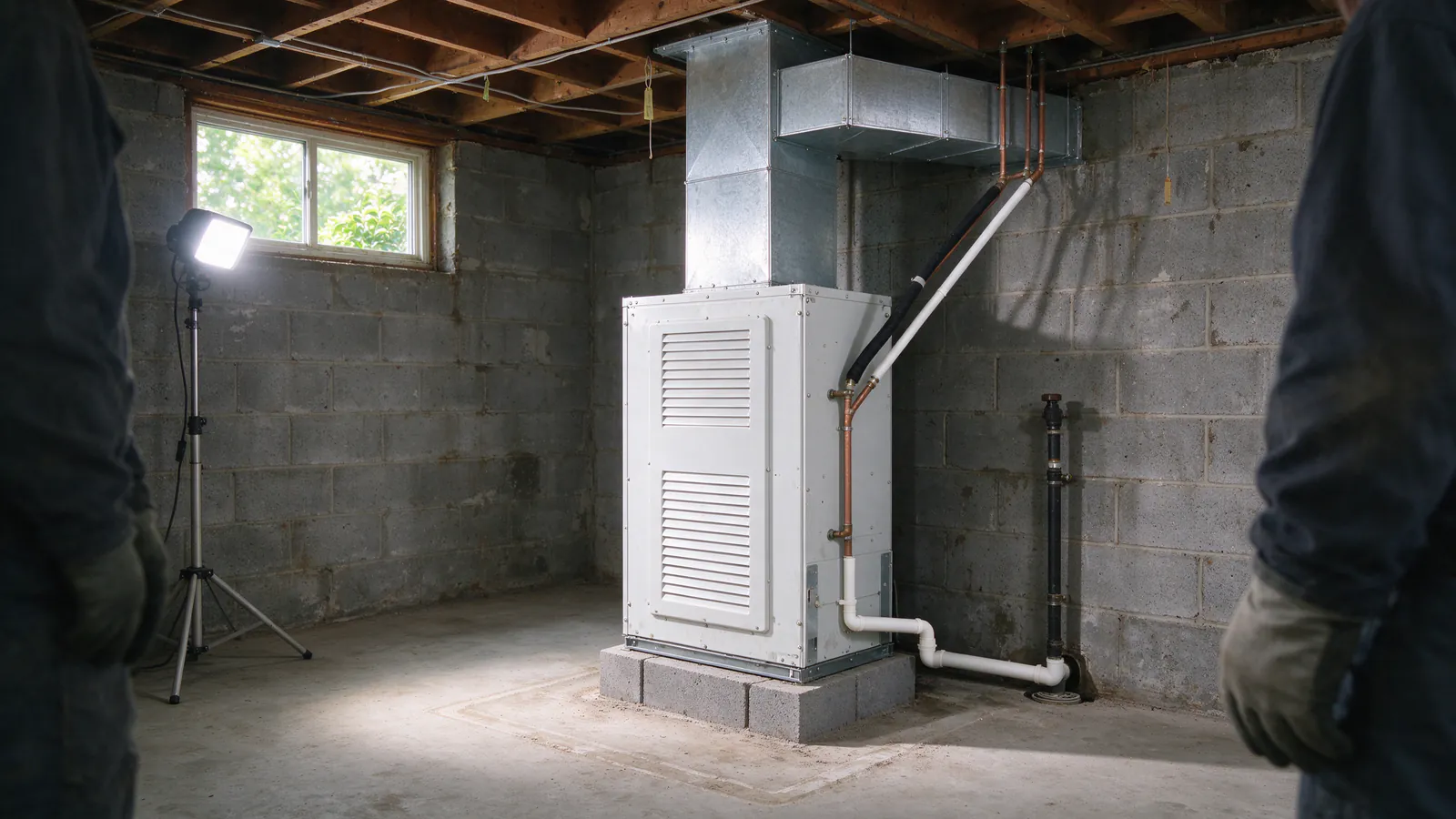
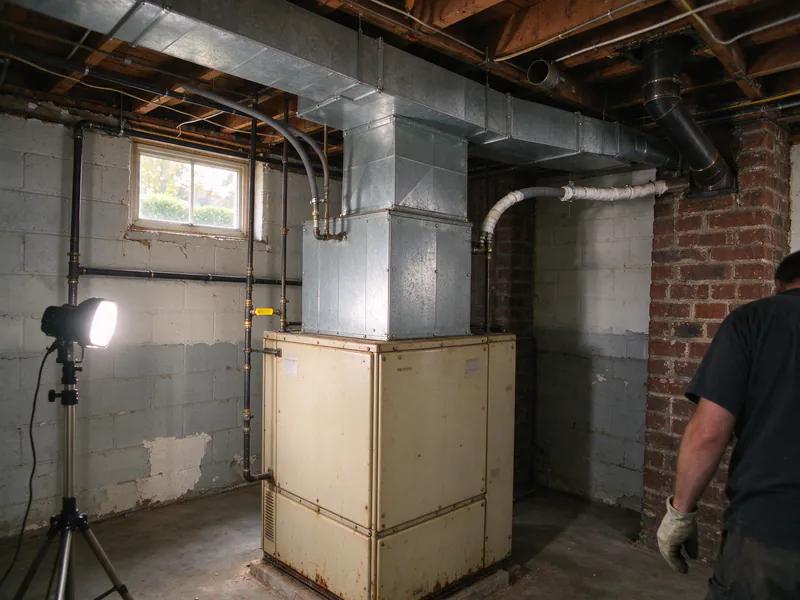
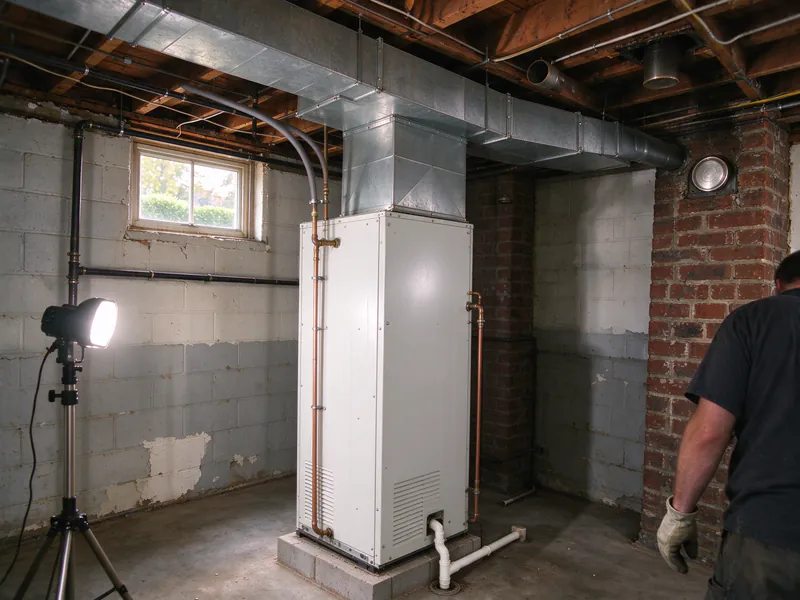
The furnace is past 20, a repair quote just landed, and you’re wondering whether that money belongs in a heat pump instead. Clement Boston Heat Pumps handles the furnace to heat pump conversion across Boston and nearby towns: the gas or propane furnace comes out, and a cold-climate heat pump heats and cools through the same ducts.
Our typical range on ducts we can reuse is $15,000 to $28,000 and up, before rebates. We’ll also tell you straight where a heat pump costs more to run than gas, because at today’s rates it usually does.
Repair the furnace, or convert now?
Convert when the furnace or the AC is near the end anyway, or a big repair is on the table. A young furnace with a working AC rarely justifies pulling it early.
Good times to switch
- The furnace is 20 or more years old and needs an inducer motor, a control board or a heat exchanger.
- The central AC is failing too, or the house never had one.
- You want off gas, or you’re renovating in a town that limits new fossil-fuel equipment.
When waiting makes sense
A furnace under ten years old with a sound AC. Then dual fuel when the AC fails, or a full conversion later, gets value from what you already paid for. If only the AC is failing now, read replacing AC with a heat pump.
What changes in the basement
The furnace and the AC coil sitting on it come out. A heat pump air handler of about the same footprint takes their place on the supply plenum, carrying its own coil, variable-speed blower and electric backup strips.
- Gas line. A licensed gas fitter caps the furnace branch under a gas permit. The meter stays if the range or water heater still burns gas.
- Venting. The furnace flue is abandoned. A gas water heater left on the same chimney gets checked for venting alone, and often needs a liner.
- Condensate. A high-efficiency furnace already drains to a pump or floor drain, which the air handler reuses with a float switch. An older 80% furnace never needed one, so a drain gets added.
- Electrical. The furnace ran on a 120-volt circuit. The air handler’s strips and the outdoor unit need 240-volt circuits, so we check panel space and the service size.
- Outdoor unit. Usually near where the AC condenser sat, raised on a stand above drifting snow.
Your ducts were built for hot air
A gas furnace delivers air somewhere around 120°F to 140°F. Heat pump air leaves the registers cooler, so the system moves more of it to deliver the same heat, and that’s where furnace ductwork shows its limits.
We measure static pressure across the furnace before pricing. A reading near the air handler’s limit means noise, weak flow at the far registers and lost capacity. A single undersized return is the usual cause, and in two-story houses the upstairs often gets thin supply. The ductwork page covers the fixes.
What will feel different
Registers deliver mild air for longer stretches instead of hot blasts. The rooms stay more even, but a hand over a register feels cooler than it did. Set the thermostat and leave it; deep night setbacks make the backup strips do the catching up each morning.
Running cost against gas, plainly
Natural gas is the cheapest common heating fuel per unit of heat in Greater Boston. A heat pump on the winter heat pump rate narrows the gap, but most gas households shouldn’t expect lower heating bills from the switch alone.
People convert anyway for other reasons: central cooling from the same system, a furnace and AC both near the end, or wanting off gas. Propane is a different story, since it costs well more than gas for the same heat. Our heat pump vs gas furnace guide puts numbers on it.
Your electric company matters
Eversource’s seasonal heat pump rate lowers distribution and transmission charges from November through April; National Grid’s lowers distribution only. The same house with the same heat pump gets a different winter bill in Medford, on National Grid, than in Newton, on Eversource.
Rebates for gas and propane homes
Gas-heated homes reach Mass Save’s heat pump rebates through their gas company, such as National Grid or Eversource gas. Propane homes go through their electric company. Taking the furnace out opens the whole-home path; keeping it opens partial-home.
| Your setup | Rebate path |
|---|---|
| Gas furnace removed, gas line capped | Mass Save whole-home rebate, per ton |
| Gas furnace kept as backup on integrated controls | Mass Save partial-home rebate, per ton |
| Gas heat in a light plant town such as Belmont or Braintree | Mass Save through your gas company; some light plants also pay gas switchers |
| Propane furnace removed | Mass Save whole-home through Eversource or National Grid electric |
Per-ton rates drop on January 1, 2027, and whole-home also asks for proof of weatherization. Our rebate guide has the amounts.
If you’re renovating
In Cambridge, Arlington, Brookline, Newton and Lexington, a major renovation can’t add new fossil-fuel equipment, so a replacement gas furnace is off the table there. In Medford, Watertown and Bedford, dual fuel is still allowed.
Sizing it smaller than the furnace
Most furnaces carry far more capacity than the house needs. We size the heat pump from the load calculation, not the furnace label, and check the unit’s output at 5°F against the coldest-night load.
An oversized heat pump short-cycles and leaves summer air damp; an undersized one leans on the strips. The right size can land well below the old furnace’s rating, which also keeps the airflow within what your existing ducts can carry.
How long the house is without heat
A single-system furnace conversion usually takes two to four working days on site once permits are in hand. The heat is off from the morning the furnace comes out until the new system is commissioned, normally a day or two.
In winter we plan the removal for a milder stretch and bring the air handler up the same day the furnace leaves. The installation process guide walks through each day, from the gas cap to the airflow readings.