Which side of Lynnfield you live on decides your heat pump rebate. Clement Boston Heat Pumps handles heat pump installation in Lynnfield, MA, and the first thing we read is the name on your electric bill, because two different town-owned light plants serve the town.
Reading’s light department serves Lynnfield Center; Peabody’s serves South Lynnfield. Their heat pump rebates differ by thousands of dollars for the same house.
Two light plants, two different rebates
Lynnfield has no Eversource or National Grid electric service. Your street sits in either RMLD’s or PMLP’s territory, and each light plant sets its own heat pump rebate.
Lynnfield Center: Reading Municipal Light
RMLD’s residential program covers heat pumps installed at a primary home in its territory:
- New heat pump: up to $11,500.
- Replacing an existing heat pump: up to $7,500.
- Zero-interest loan: up to $40,000, offered as an alternative to the rebate.
- Weatherization: up to $3,500 more.
South Lynnfield: Peabody Municipal Light
PMLP pays $500 per ton for owner-occupied homes, with the maximum based on 36,000 BTU per address per calendar year. That’s three tons’ worth, or $1,500, in a year. New construction doesn’t qualify. A big colonial needing four or five tons gets the cap, not a per-ton total.
Which one you’re on
The boundary runs by street, not by a neat line on a map. We confirm it from your bill on the first visit, then write the matching rebate into the estimate.
Gas homes still have a Mass Save route
About 54% of Lynnfield homes heat with gas, and National Grid sells it. National Grid is a Mass Save gas sponsor, so a gas home that removes its furnace or boiler can qualify for Mass Save’s whole-home rebate.
That rebate is $2,650 per ton up to $8,500, becoming $2,350 per ton up to $7,500 from January 1, 2027. It needs cold-climate listed equipment, a contractor in Mass Save’s network and proof of weatherization. Whether it combines with your light plant’s program is checked with both before we price the job; the rebate guide lists Mass Save’s conditions.
Oil, propane and baseboard
These switches go through the light plant, not Mass Save, because Mass Save’s electric-side rebates need an electric sponsor such as Eversource or National Grid. The state’s seasonal heat pump rates don’t apply on light plant lines either; your running cost depends on RMLD’s or PMLP’s own rates.
Oil in nearly four homes in ten
About 37% of Lynnfield homes burn oil, well above the state’s 22%. Those homes pay the most per delivered BTU, and the switch saves the most. The burner and tank come out together.
Our typical range to remove an accessible basement tank is $600 to $1,500, plus the fire department’s permit. See oil to heat pump conversion, oil tank removal and the heat pump vs oil guide for the comparison in numbers.
Paying for it in Lynnfield Center
RMLD’s zero-interest loan reaches $40,000, larger than Mass Save’s HEAT Loan, which tops out at $25,000. Lynnfield Center owners get to choose the rebate or the loan. Our HEAT Loan guide explains the Mass Save version for comparison.
Big detached houses, mostly post-war
About 82% of Lynnfield homes are detached houses, and only about 13% predate 1940. Most are post-war colonials, capes and ranches on wooded lots, many with a warm-air furnace already in the basement.
Colonials with two floors
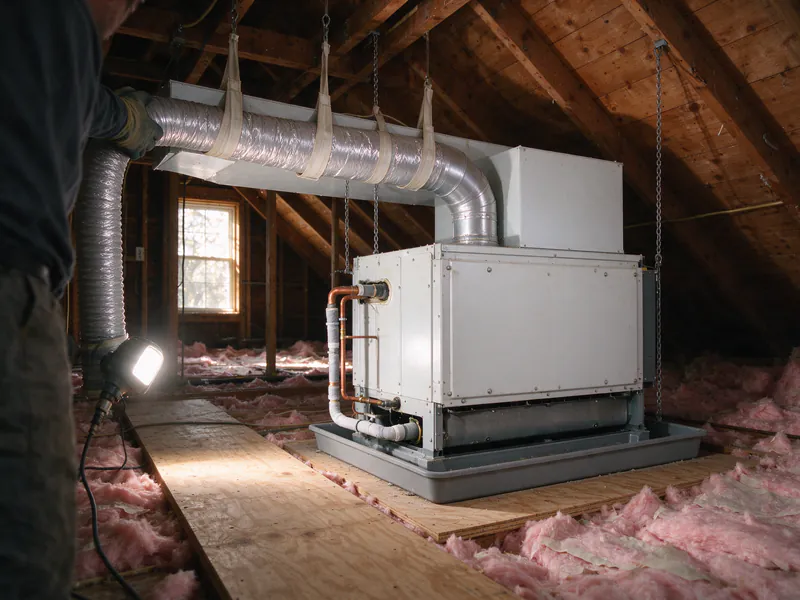
A two-story colonial gets two zones: a basement air handler on the furnace’s old ducts for the first floor, and an attic air handler for the bedrooms. We measure static pressure and returns before reusing anything; see furnace to heat pump conversion.
Ranches and capes
One air handler can serve a ranch from the basement. A cape’s upper rooms get kneewall or attic ducts. The sizing guide explains how room-by-room loads set each zone.
Base code, simple permits
Lynnfield is on the state’s base energy code. A heat pump job follows the base rules for duct sealing and insulation; the building department’s permit route is confirmed per address before we file.
Permits and the Reading Municipal Light Department side in Lynnfield
The town’s building department issues the electrical and sheet metal permits for a ducted job, plus a gas permit where a licensed gas fitter caps a line. The utilities and the rebate depend on which side of town you’re in.
| What | The Lynnfield figure |
|---|---|
| Electric, Lynnfield Center | Reading Municipal Light Department |
| Electric, South Lynnfield | Peabody Municipal Light Plant |
| Gas company | National Grid |
| Energy code | Base code |
| Heating fuel | Gas 54%, oil 37%, electricity 6% |
| Detached houses | About 82% |
Before the install, we check both programs’ paperwork rules, because each light plant has its own forms and timing. We keep the model numbers, the capacity data and the removal of the old system documented so the application has what it needs.
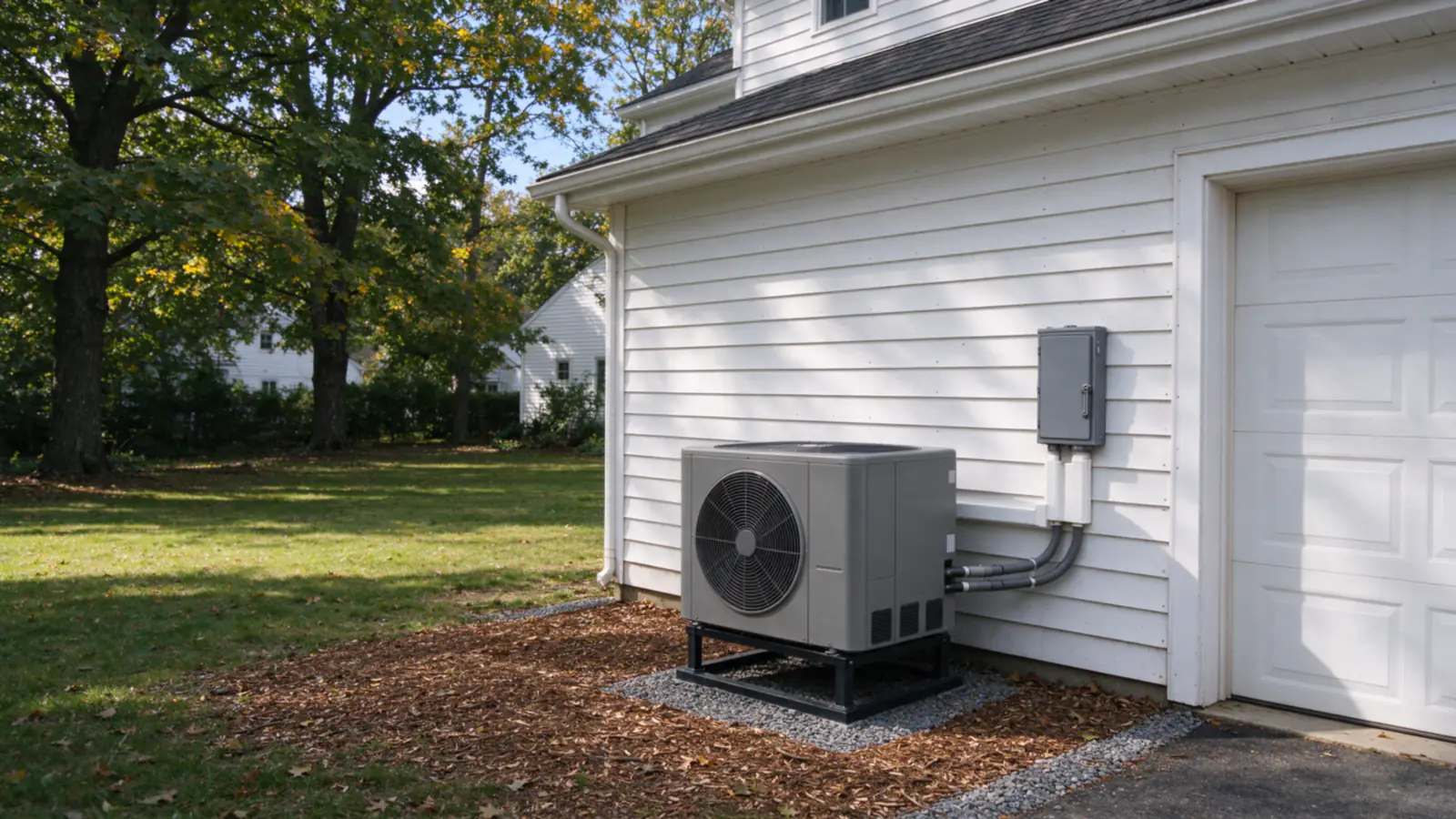
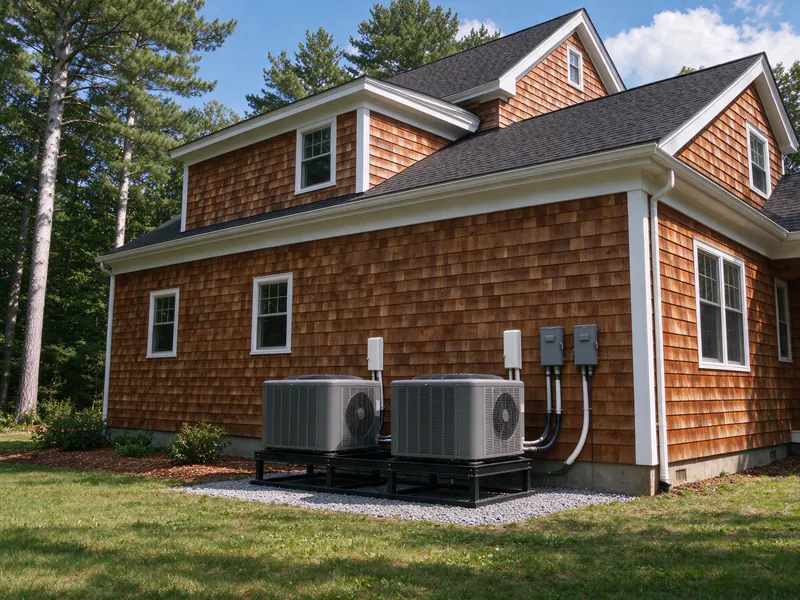
Outdoor units on wooded lots
Lynnfield’s big lots make placement easier than in the city, but trees bring their own problems. Leaves and pine needles clog a coil, and branches drop snow and ice.
- Clear of the canopy where possible, or far enough from the trunk that falling limbs and needle drop miss the unit.
- On a stand, with the coil above drifts and room for defrost water to drain; see the outdoor unit placement guide.
- Close to the air handler, so the line set stays short, and away from bedroom windows on both your side and the neighbor’s.
Inland winter nights near Route 128 run colder than the harbor, so we size at the design temperature for your address and list the unit’s capacity at 5°F on the estimate.
What happens, step by step, in Lynnfield
The first visit starts with your electric bill, then the load calculation, the ducts, the panel and the outdoor spot. Local noise and setback rules are confirmed per address.
- Written estimate with your light plant’s rebate (and Mass Save’s, for gas homes), equipment with its 5°F capacity, ducts, electrical, tank, permits and price.
- Permits, then the install: four to six working days for a two-zone colonial on existing ducts.
- Old system out where the rebate requires it.
- Commissioning: pressure test, vacuum, weighed charge, airflow and static measured, backup lockout recorded.
The cost guide lists all our ranges. Peabody shares South Lynnfield’s light plant, and Reading shares Lynnfield Center’s.