One municipal department sends many Wakefield homes both their gas bill and their electric bill. Clement Boston Heat Pumps handles heat pump installation in Wakefield, MA with that department’s rules in hand, because its rebate, not Mass Save’s electric side, usually pays toward your system.
Wakefield Municipal Gas & Light sets its own heat pump rebates. Which of its paths you take depends on what you burn now and how tight the house is.
How the light department’s rebate works
WMGLD’s heat pump rebates run from $500 to $7,500 across three paths. Which one fits depends on whether you keep your old system, add insulation, or take the fossil-fuel heat out.
The three paths
- Heat pump rebate: for a heat pump added to an existing house, with the old system still in place.
- Heat pump with insulation bundle: the heat pump plus insulation or weatherization work, which WMGLD also rebates separately from $50 to $2,000.
- Heat pump replacing a fossil-fuel system: the oil, propane or gas heat comes out, and this path carries the larger amounts.
What doesn’t qualify
WMGLD pays only on existing construction. New homes, and renovations big enough that the Wakefield Building Department requires a HERS rating, are left out. If you’re planning a gut rehab, that changes the budget before the design starts.
Why Mass Save’s electric side doesn’t apply
Mass Save’s oil, propane and baseboard rebates go through an electric sponsor such as Eversource or National Grid. Wakefield’s wires belong to the town, so those switches use WMGLD instead. A gas home with a Mass Save gas sponsor may still qualify there; we read the bills together.
The running cost on light department power
The state’s seasonal heat pump rates belong to Eversource, National Grid and Unitil, so they don’t reach Wakefield. Your running cost depends on WMGLD’s own rate, which we use in the estimate.
Oil homes
A third of Wakefield homes burn oil, against about 22% statewide. Oil costs more per delivered BTU than any other common fuel except electric resistance, so these homes gain the most. The burner and tank go, and the replacing-fossil path applies; see oil to heat pump conversion and our heat pump vs oil guide.
Gas homes
Gas heats about half the town. It’s cheap per BTU, so the case rests on central cooling, a furnace near the end, or WMGLD’s fossil-replacement path. We put both fuels on your actual rates in the estimate.
If you’d rather keep the gas furnace for the coldest nights, a dual fuel setup lets the heat pump carry most of the winter. That keeps the furnace in place, so it doesn’t fit the replacing-fossil path; the plain heat pump path is the one to price.
The tank
Our typical range to remove an accessible basement oil tank is $600 to $1,500, plus the fire department’s permit. See oil tank removal.
Wakefield houses, from the lake to Greenwood
About 32% of Wakefield homes date from before 1940, slightly above the state’s share. Just over half are detached houses, one in seven is a two-family, and a fifth sit in larger buildings.
Colonials and Victorians on radiators
Around the Common and the lake, older houses often heat with an oil or gas boiler. There are no ducts, so a boiler-to-heat-pump conversion brings an attic air handler for the bedrooms and a basement unit for the first floor. Our old houses guide covers plaster and balloon framing.
Post-war houses with a furnace
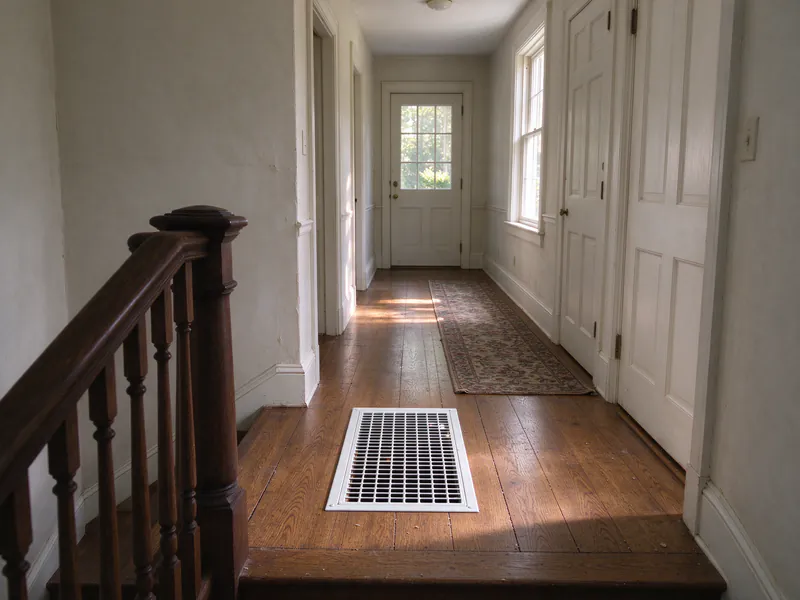
In Greenwood, Montrose and the West Side, many houses have warm-air furnaces and existing ducts. We measure static pressure and returns before reusing them; see furnace to heat pump conversion.
Two-families
Each floor gets its own system and its own load calculation. The top floor loses heat through the roof and needs more capacity than the floor below, even when the two plans match. Two outdoor units on a narrow lot get placed for sound and snow, and each floor’s electrical circuit runs from its own panel.
Insulation first, then size
The insulation path pays twice: WMGLD rebates the work, and a tighter house needs a smaller system. We run the load calculation on the house as it will be after the work. Our sizing guide shows why that matters.
Where the outdoor unit goes
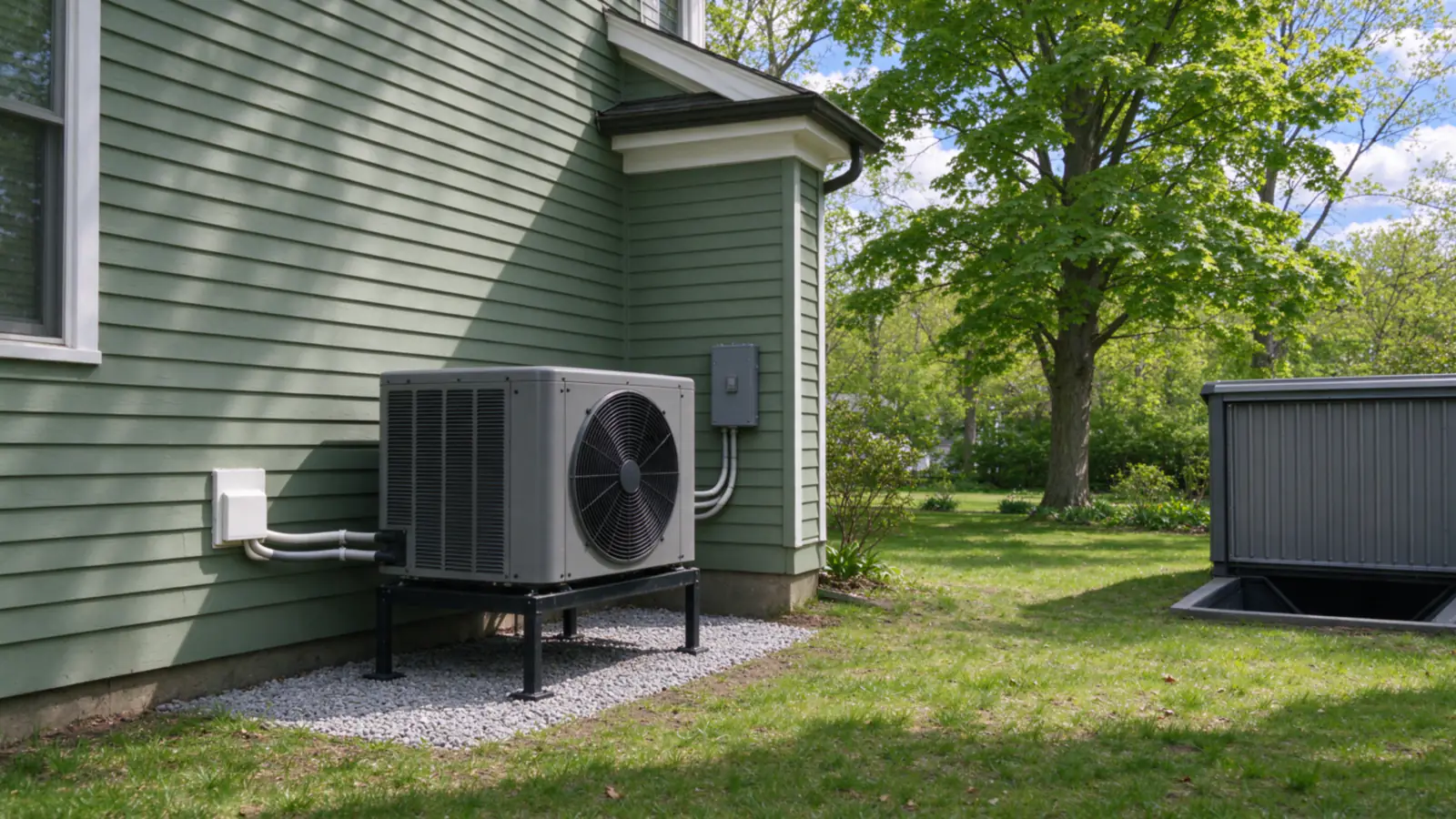
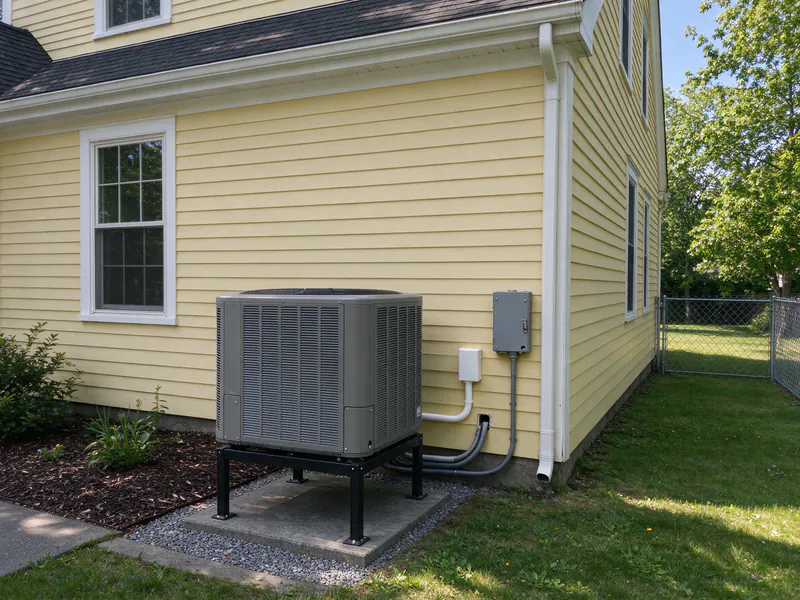
Local setback and noise limits are confirmed per address before we choose a spot. Then the house itself decides: where snow slides off the roof, where the bedrooms face, and how far the line set runs.
- Off the drip line, so meltwater and roof snow don’t land on the coil.
- On a stand, high enough to clear drifts and let defrost water drain away; see the outdoor unit placement guide.
- Short line sets: close to where the air handler sits, which keeps the charge simple and the efficiency up.
Filing, inspection and rebates in Wakefield
The Wakefield Building Department issues the electrical and sheet metal permits; its filing route is confirmed per address before we file.
| What | The Wakefield figure |
|---|---|
| Electric company | Wakefield Municipal Gas & Light Department |
| Gas company | WMGLD (National Grid also listed) |
| Heat pump rebate | WMGLD, $500 to $7,500 across three paths |
| Energy code | Specialized stretch code since July 1, 2024 |
| Heating fuel | Gas 49%, oil 33%, electricity 15% |
| Outdoor unit noise | Local limits confirmed per address |
How the work runs on a Wakefield job
The first visit adds one question to the usual load calculation, duct check and panel check: which WMGLD path fits, and whether insulation should come first.
- Written estimate with the unit’s 5°F capacity, ducts, electrical, tank, permits, the WMGLD path and the price.
- Insulation, if chosen, before the install, so the system matches the tighter house.
- Install: three to six working days on existing ducts, longer with new ones; the old system comes out for the replacing-fossil path.
- Commissioning: pressure test, deep vacuum, weighed charge, measured airflow, and the backup-heat lockout set; our aux heat guide explains it.
Our cost guide lists all our ranges. Reading next door runs its own light plant with different rebate amounts, and Stoneham is Eversource territory on Mass Save.