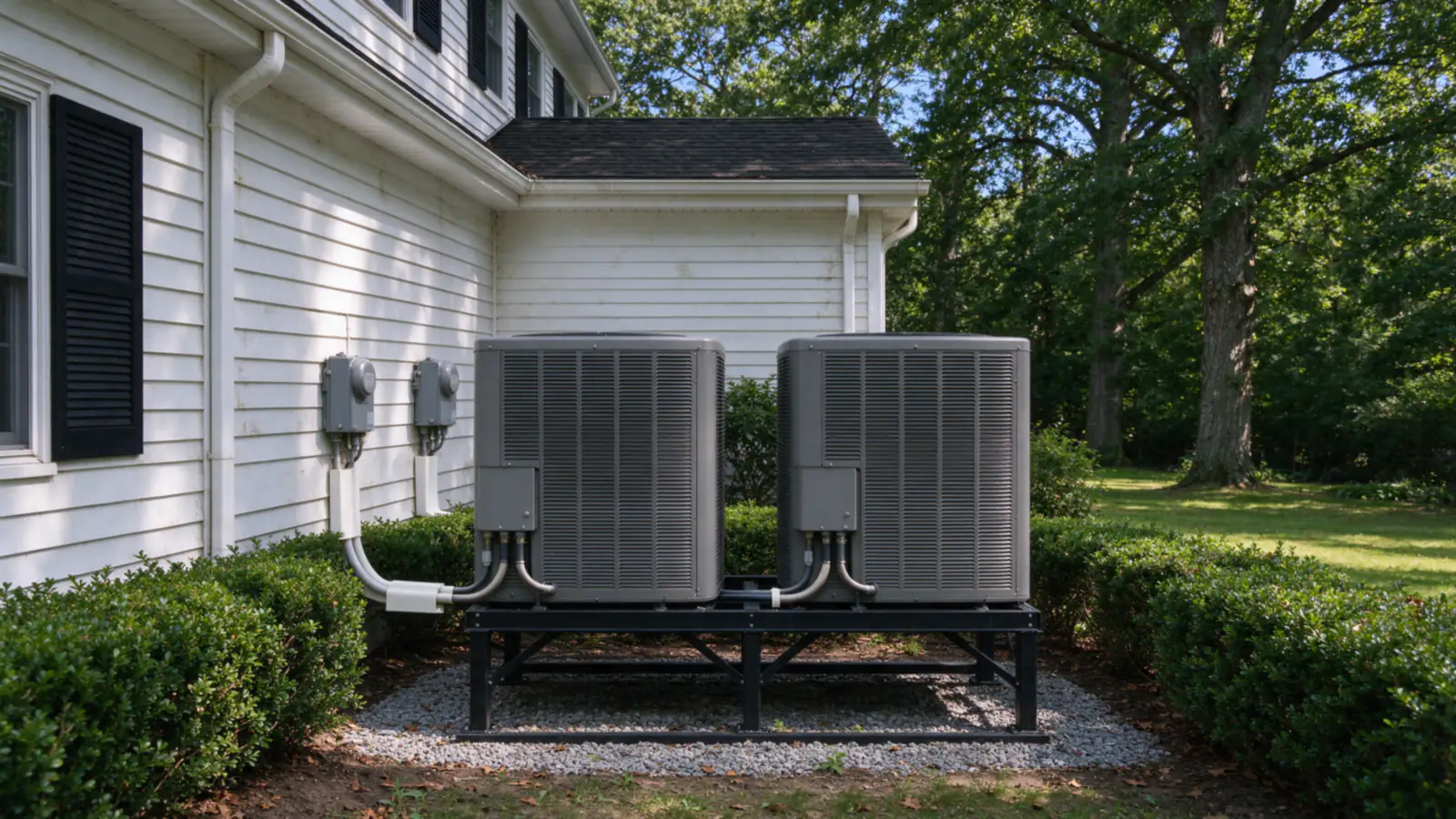
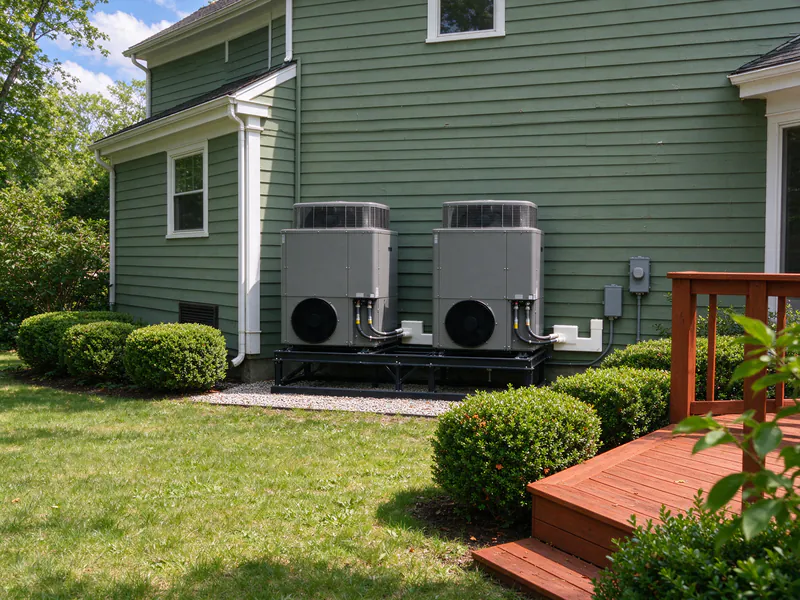
The bigger the house, the harder one heating system works to keep both floors even, and Needham’s houses run big. Clement Boston Heat Pumps handles heat pump installation in Needham, MA by treating each floor as its own zone, with its own air handler, ducts and thermostat.
That layout costs more than a single system, so the load calculation decides whether you need it. In a two-story colonial with a finished basement or attic, it usually does.
Why bigger Needham houses get two zones
Warm air rises up the stairwell, and the second floor gains sun through the roof in summer. One air handler can’t satisfy both floors at once, so one zone per floor is the even answer.
Basement and attic
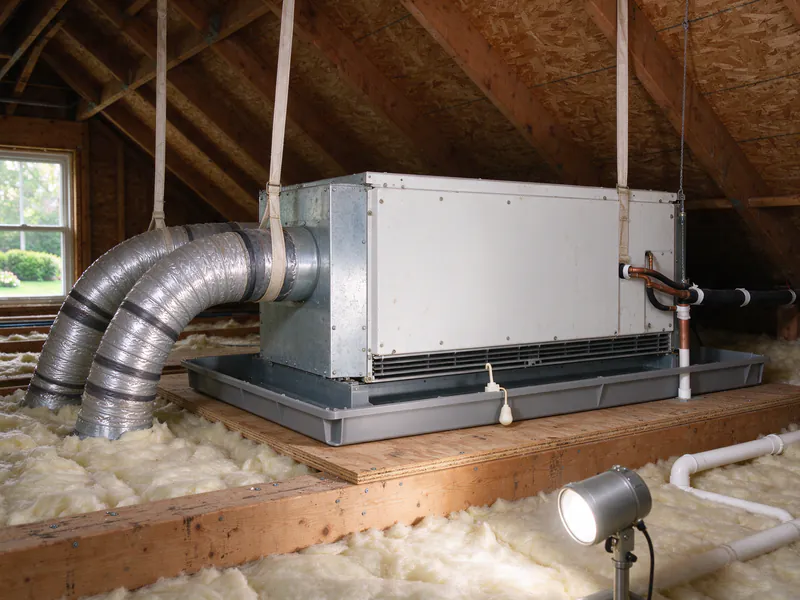
The first floor runs from a basement air handler, often on the old furnace’s ducts. The bedrooms run from an attic air handler, which may replace an existing central air unit up there. Each has its own thermostat; our thermostat guide explains why heat pump controls differ from furnace controls.
When one system is enough
A compact cape or ranch can run on one variable-speed system with motorized zone dampers. The deciding numbers are the room-by-room load from the Manual J calculation and the static pressure in the existing ducts.
Sizing each zone
Each zone is sized for its own floor at Needham’s design temperature, and the estimate lists its capacity at 5°F. Oversizing a zone makes it short-cycle; undersizing it leans on backup strips. Our sizing guide covers the method.
Three permits, filed online
Needham’s building department takes filings through an online portal. A ducted job usually needs an electrical permit and a sheet metal permit, and a gas fitting permit when a gas line is capped.
- Sheet metal permit: covers new or altered ductwork. It’s its own record type in Needham’s portal, so duct changes are filed and inspected separately.
- Electrical permit: the heat pump circuits, and any service upgrade.
- Gas fitting permit: pulled by a licensed gas fitter when the gas furnace comes out and the line is capped.
Fees are confirmed at filing. Local noise and setback rules are confirmed per address before we choose the outdoor spot.
Oil, gas and the case for switching
Gas heats a little over half of Needham’s homes, but about 28% still burn oil, more than the state’s share. Oil homes have the strongest running-cost case; gas homes usually switch for central cooling or an aging furnace.
If you heat with oil
A cold-climate heat pump on Eversource’s winter rate costs less per delivered BTU than oil, and the tank comes out. Our typical range for an accessible basement tank is $600 to $1,500, plus the fire department’s permit. See oil to heat pump conversion.
If you heat with gas
Eversource sells Needham both its gas and its electricity, so it sponsors Mass Save on both sides. Removing gas heat qualifies for the whole-home rebate just as removing oil does.
Gas is still cheaper per BTU than electricity, so the running-cost gap is small. Eversource’s winter heat pump rate, which lowers distribution and transmission charges on every household kilowatt-hour from November through April, narrows it further.
If the central air is the problem
An old AC condenser is often the trigger. Swapping it for a heat pump gives you cooling and heat from the same ducts; see replacing central air with a heat pump.
Older houses near Needham Center and the Heights
Only about 18% of Needham homes predate 1940, but they cluster around Needham Center, the Heights and the older streets near the rail stations. Many still heat with a boiler and radiators.
Those houses need ducts planned from scratch. The usual route is an attic air handler for the bedrooms and a basement unit for the first floor, with a stacked closet or a chase beside the chimney carrying the trunk between them. Where neither works, a small-duct high-velocity system threads flexible tubing through the framing with small round outlets.
Condos and townhouses
About one Needham home in six sits in a building of five or more units. A compact ducted unit in a closet or above a hall ceiling serves the whole condo, and the association signs off on where the outdoor unit sits. Our condo guide covers that approval.
Building new or adding on
Needham adopted the specialized stretch code effective July 1, 2024. It governs new homes and major renovations, and teardowns and large additions fall under it, so the heating plan belongs in the drawings.
The code allows an all-electric path or a pre-wired path with fossil equipment. For a new house, ducts for two or three heat pump zones go in before the drywall, which is the cheapest time to get them right; see heat pump ductwork.
Filing, inspection and rebates in Needham
Eversource handles both utilities in Needham, which keeps the rebate path simple: every fuel goes through Mass Save.
| What | The Needham figure |
|---|---|
| Electric and gas company | Eversource |
| Energy code | Specialized stretch code since July 1, 2024 |
| Heating fuel | Gas 56%, oil 28%, electricity 13% |
| Detached houses | About 74% |
| Permits | Online portal: sheet metal, electrical, gas fitting |
| Mass Save whole-home rebate | $2,650 per ton, capped at $8,500 |
From January 1, 2027, that becomes $2,350 per ton up to $7,500. A two-zone house often reaches the cap. The rebate guide lists the conditions, and our quote checklist shows what a complete estimate should include.
An Needham job, week by week
The first visit measures each floor separately: heat loss room by room, static pressure in each duct system, the panel, and space for one or two outdoor units.
- A written estimate per zone, each with its capacity at 5°F, plus ducts, electrical, permits, the rebate path and the total.
- Three permits filed through the portal.
- Install: four to six working days for a two-zone house on existing ducts.
- Commissioning, zone by zone: pressure test, vacuum, weighed charge, measured airflow and static, thermostats set and the backup lockout recorded.
Dedham shares Needham’s utility and code tier, and Wellesley next door buys power from its own light plant.