Keep the gas furnace or pull it out: in Dedham, that choice comes before the equipment, the size or the price. Clement Boston Heat Pumps handles heat pump installation in Dedham, MA, where most houses heat with Eversource gas and many colonials already have the ducts a heat pump needs.
A furnace kept as backup and a furnace taken out lead to different equipment sizes, different controls and a different Mass Save rebate, so we settle it on the first visit.
Keep the gas furnace, or take it out?
Both work in Dedham. A furnace with years left can stay as backup for the coldest nights. A furnace near the end of its life usually comes out, and the heat pump carries the whole house.
Dual fuel: the heat pump leads, the furnace backs up
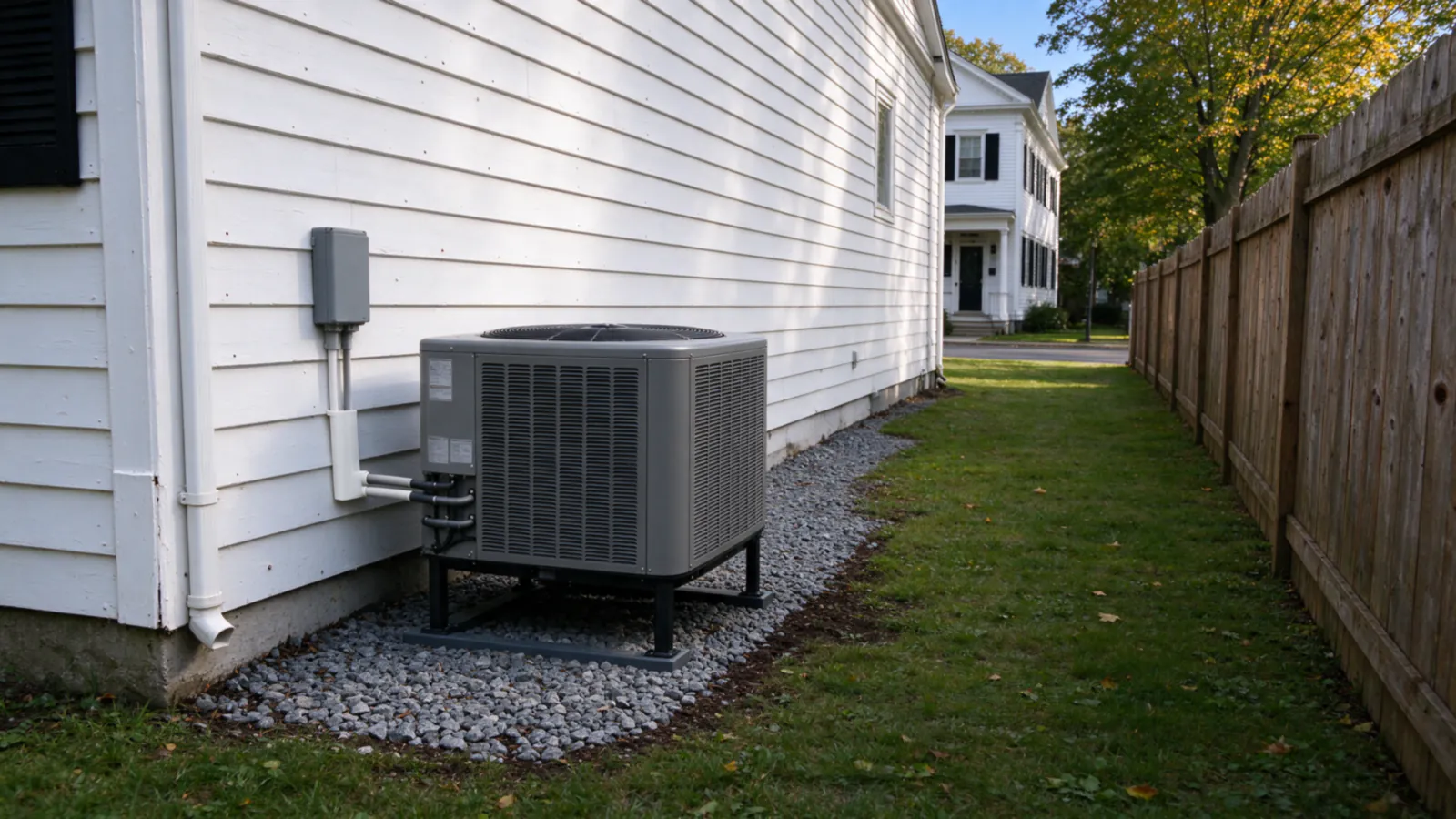
With dual fuel, the heat pump replaces the AC condenser and coil and heats the house most of the winter. Integrated controls hand off to the furnace below a set outdoor temperature. Mass Save’s partial-home rebate is $1,125 per ton up to $8,500, and it requires those integrated controls.
All-electric: the furnace comes out
When the furnace is twenty years old or the heat exchanger is suspect, we size the heat pump to carry the whole load and remove the furnace. That’s a furnace-to-heat-pump conversion, and it qualifies for the whole-home rebate of $2,650 per ton up to $8,500, the bigger of the two.
How we price each one
Dual fuel has no single range, because it depends on the furnace’s condition, the coil and the controls; we price it from what we measure. The whole-home system on reusable ducts falls in our typical range of $15,000 to $28,000 and up before rebates.
Colder nights than the city
Dedham is inland, and inland winter nights run colder than the harbor. The heat pump has to be sized for your address, not for Logan Airport’s 7°F design temperature.
Norwood Memorial Airport, a few miles south, averages about five nights a year at or below 0°F and about 18 at or below 10°F. Logan sees fewer than one and about seven. On those nights, an undersized system leans on electric strips that cost as much to run as baseboard.
- We size at the design temperature for Dedham, room by room, using a Manual J load calculation.
- The estimate lists capacity at 5°F, so you can see what the unit delivers on a cold night, not just its nameplate.
- Backup heat gets a lockout, set and recorded at commissioning; our aux heat guide explains why that matters.
Dedham houses, and where the equipment goes
About two-thirds of Dedham homes are detached houses. The rest are mostly apartments and condos in larger buildings, plus some two-families. Each form puts the air handler in a different place.
Colonials and capes with a furnace
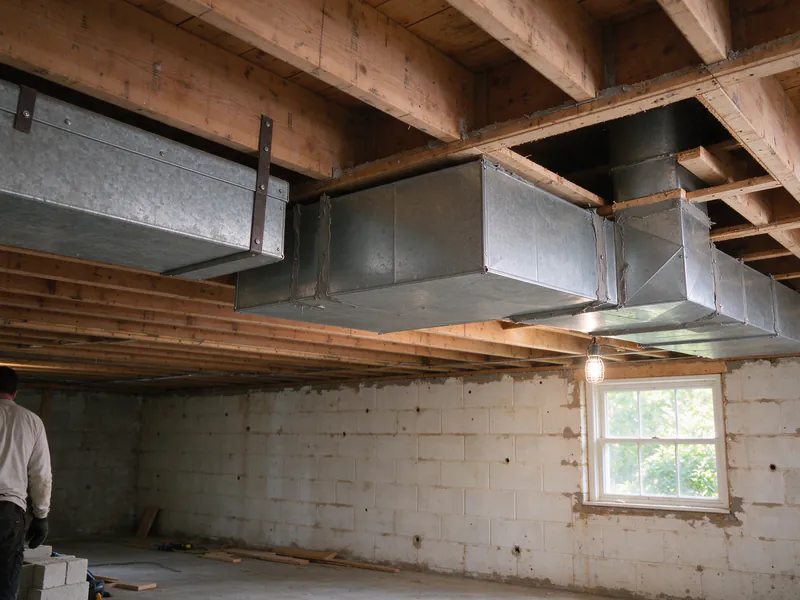
A furnace already has a supply trunk and returns. A heat pump moves more air at a milder temperature, so we measure static pressure and return size before reusing them. Where a second floor was cooled by an attic air handler, that unit can be replaced with a heat pump air handler; see attic air handler heat pumps.
Older houses in Dedham Square and East Dedham
Close to 30% of Dedham homes date from before 1940, many on hot-water or steam radiators. Those need new ducts: a basement air handler for the first floor and an attic unit for the bedrooms, joined through a closet chase. Our ductwork page covers routes in plaster houses.
When the AC is the part that fails
If the central air condenser quits before the furnace does, that is a good moment to switch. A heat pump drops into the same spot and gives you heat as well as cooling.
We check the indoor coil and the line set size before reusing either; see replacing central air with a heat pump.
Condos and apartments
About 15% of Dedham homes heat with electricity, mostly in apartments and condos. A small ducted air handler replaces the baseboard, and the association decides where the outdoor unit can go.
What the town and Eversource need from a Dedham job
Eversource supplies both electricity and gas in Dedham, so every heating fuel has a Mass Save path. The town’s building department issues the permits; its forms and fees are confirmed per address before we file.
| What | The Dedham figure |
|---|---|
| Electric company | Eversource |
| Gas company | Eversource |
| Energy code | Specialized stretch code since January 1, 2025 |
| Heating fuel | Gas 68%, electricity 15%, oil 13% |
| Homes built before 1940 | About 30% |
| Outdoor unit noise | Local limits confirmed per address |
Gas homes claim the whole-home rebate through Eversource’s gas side when the furnace comes out; oil, propane and baseboard homes go through the electric side. From January 1, 2027, the whole-home rebate becomes $2,350 per ton up to $7,500. The rebate guide lists every condition, including cold-climate equipment and proof of weatherization.
The winter rate
Eversource’s heat pump rate cuts distribution and transmission charges on every household kilowatt-hour from November through April. It applies to your whole bill, lights and appliances included, not just the heat pump’s share.
Gas is still the cheapest fuel per delivered BTU, so a Dedham gas home switches mainly for central cooling, a furnace near the end or a renovation. The winter rate narrows the running-cost gap; our heat pump vs gas furnace guide puts the comparison in numbers.
How the work runs on a Dedham job
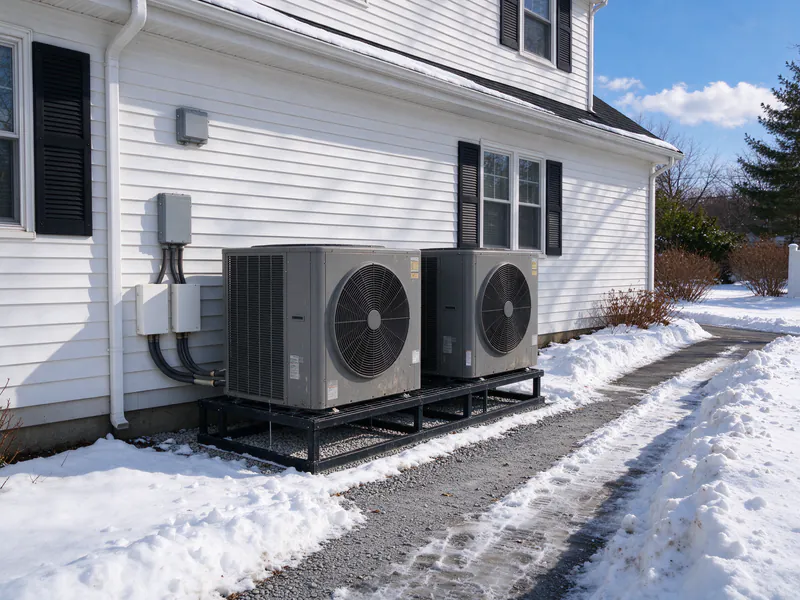
The first visit settles the furnace question, then measures everything the estimate depends on: room-by-room load, duct static pressure, return size and leakage, the panel, and a level outdoor spot clear of the driveway snow pile.
- Written estimate: equipment with its 5°F capacity, duct changes, electrical, permits, the rebate path and the price.
- Permits through the town, then the install, usually three to six working days on existing ducts.
- Furnace decision carried out: integrated controls wired for dual fuel, or the furnace removed and a licensed gas fitter caps the line.
- Commissioning: nitrogen pressure test, vacuum below 500 microns, charge by weight, measured airflow and static, and the backup lockout recorded.
The cost guide sets out all our ranges. Next door, Needham shares Dedham’s utility and code tier, while Norwood buys its power from its own light plant.