Here is the short version for a Holbrook oil home: the boiler, the burner and the tank all go, and a ducted heat pump takes over heating and cooling. Clement Boston Heat Pumps handles heat pump installation in Holbrook, MA, a base-code town where oil still heats almost as many homes as gas.
About 41% of Holbrook homes burn oil, nearly double the state’s share. For those owners, the switch saves the most and earns the largest Mass Save rebate.
Oil heats almost as many homes as gas
Oil and gas each heat about four Holbrook homes in ten. Oil costs more per delivered BTU, and a cold-climate heat pump on National Grid’s winter rate costs less to run than an oil burner.
What the switch replaces
The burner, the oil deliveries, the annual tune-up and the tank. A heat pump replacing oil also adds central cooling, which most oil-heated capes don’t have. Our heat pump vs oil guide puts the running cost in numbers.
The tank comes out
Our typical range to remove an accessible basement tank is $600 to $1,500, plus the local fire department’s removal permit. A buried tank is priced after we see it. See oil tank removal.
Gas homes
Gas homes switch mainly for central cooling or because the boiler or furnace is near the end. Eversource sells Holbrook’s gas and sponsors Mass Save’s gas side, so removing gas heat qualifies for the whole-home rebate too.
What the base code means for your project
Holbrook hasn’t adopted the stretch or specialized energy code. For a heat pump in an existing house, that changes little: ducts are sealed, refrigerant lines insulated, and the permits pulled under the base rules.
It matters more for new homes and big additions. Base-code projects aren’t held to the stretch code’s HERS performance targets, so a builder has more choices. We still size every heat pump from a room-by-room Manual J calculation, whatever the code requires.
Capes and ranches: where the ducts go
About 84% of Holbrook homes are detached houses, and only about 19% predate 1940. Most are capes, ranches and split-levels, and many oil homes heat with a boiler and baseboard, which means no ducts.
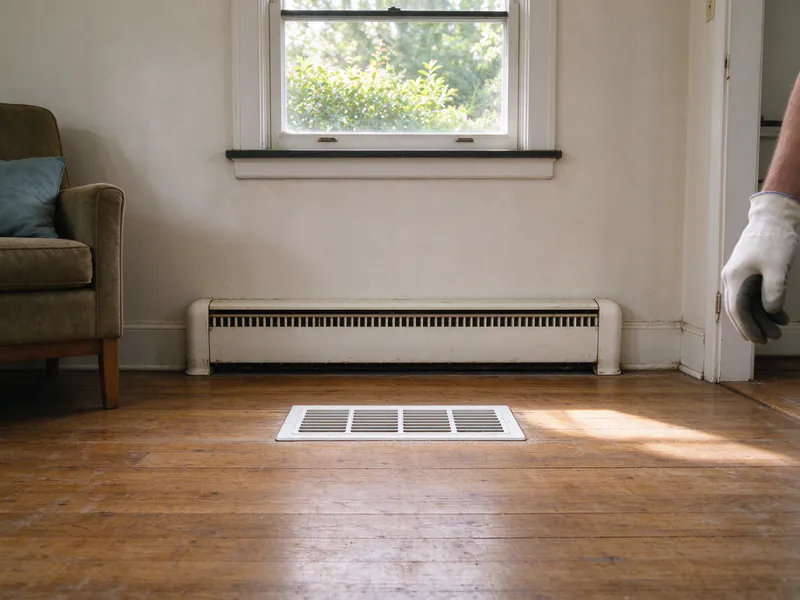
Capes with hot-water baseboard
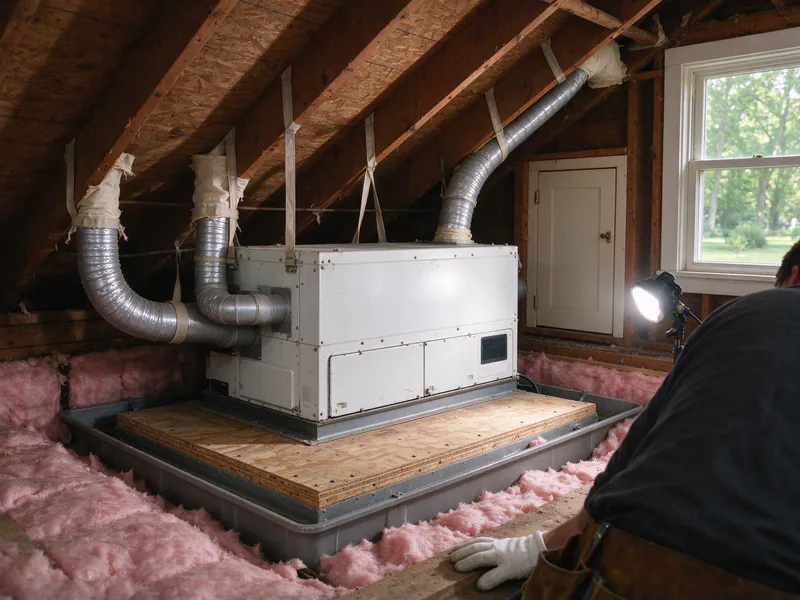
The first floor gets a basement air handler with floor registers. The upstairs bedrooms get an air handler in the kneewall space or the attic above, with short runs to each room. A boiler-to-heat-pump conversion page explains the layout, and our attic air handler page covers kneewall installs.
Ranches with a furnace
A one-story house with an oil furnace already has its ducts in the basement. We measure static pressure and the return before reusing them; often the return is the one piece that needs enlarging.
Split-levels
Three short levels can run from one air handler with careful balancing, or two small ones when the upper bedrooms run warm. The load calculation and the duct measurements decide, and we show you both numbers on the estimate before you choose.
Sizing for an inland winter
Holbrook sits inland, away from the harbor water that keeps Logan Airport’s winter nights mild. We size at the design temperature for your address, not the airport’s 7°F, and list the unit’s capacity at 5°F on the estimate.
An oil home switching to a heat pump should never find the electric backup strips doing the heating, because strips cost as much to run as baseboard; our sizing guide explains how the load calculation prevents it.
Your rebate through National Grid
National Grid is Holbrook’s electric company and the Mass Save sponsor for oil, propane and electric-heat switches. Its whole-home rebate is the largest Mass Save pays.
- Amount: $2,650 per ton up to $8,500, becoming $2,350 per ton up to $7,500 from January 1, 2027.
- Conditions: cold-climate listed equipment, a contractor in Mass Save’s Heat Pump Installer Network, the old system removed or disconnected, and proof of weatherization.
- Income-eligible homes: up to $16,000.
The rebate guide lists the rest. Mass Save’s 0% HEAT Loan covers up to $25,000 through participating lenders, applied for before work.
The winter rate
National Grid’s heat pump rate lowers the distribution charge on every household kilowatt-hour from November 1 to April 30. It leaves transmission at the standard price; see the winter rate guide.
The panel and the outdoor unit
Many post-war capes still have 100-amp service. A ducted heat pump adds a large circuit, so we run a load calculation on the panel before deciding anything.
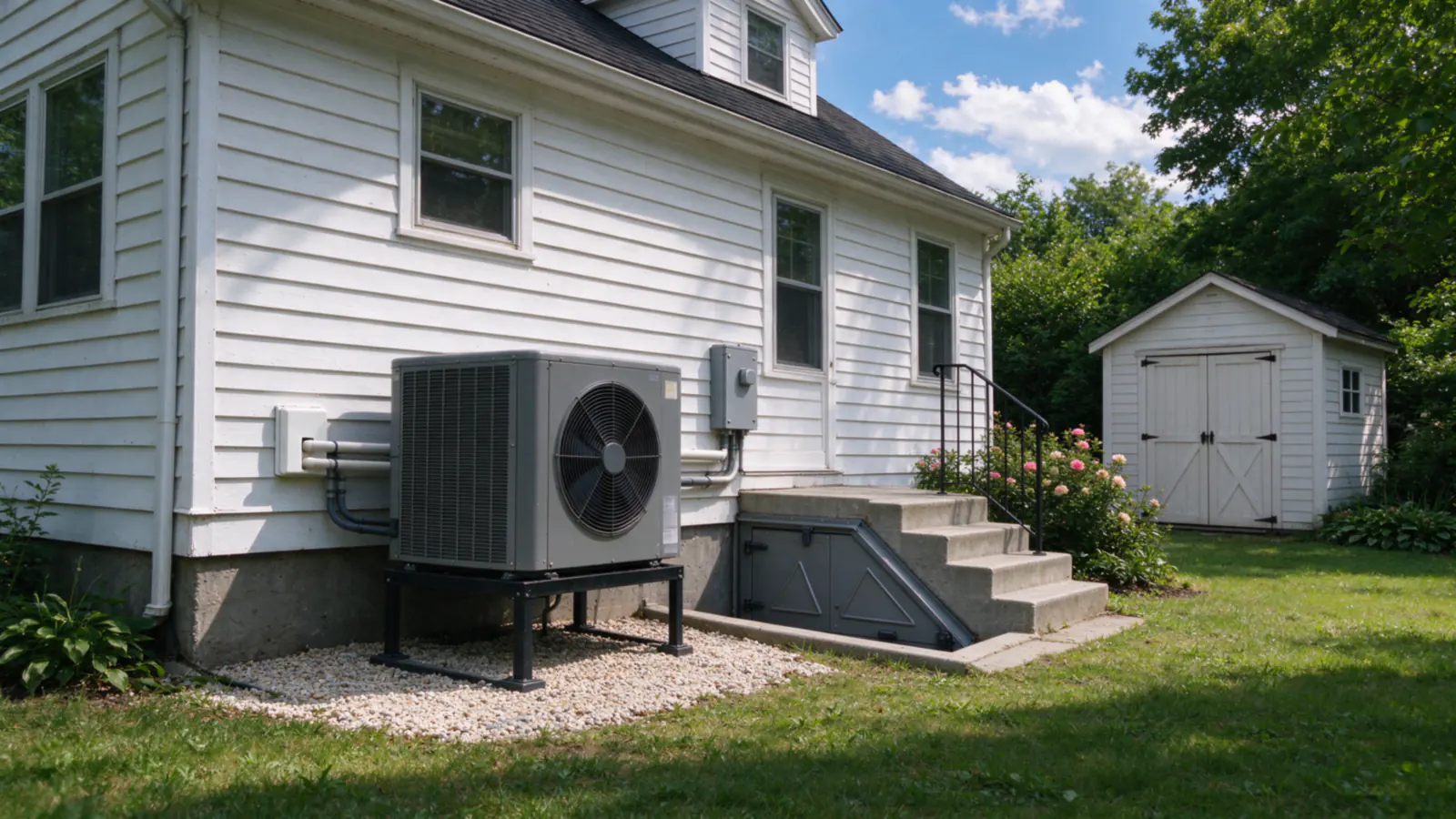
If the service has to grow, our typical range for an electrical service upgrade is $3,000 to $6,500, coordinated with National Grid. Local setback and noise rules for the outdoor unit are confirmed per address. We set it on a stand, off the roof’s drip line, close to the air handler.
When the power goes out
A heat pump needs electricity, and so does an oil burner’s pump and controls. Our power outage guide covers generator inlets sized for a heat pump.
Mass Save money and Holbrook paperwork
The town’s building department issues the electrical and sheet metal permits; its filing route and fees are confirmed per address. The fire department issues the tank removal permit.
| What | The Holbrook figure |
|---|---|
| Electric company | National Grid |
| Gas company | Eversource |
| Energy code | Base code |
| Heating fuel | Gas 41%, oil 41%, electricity 11%, propane 5% |
| Detached houses | About 84% |
How we run a Holbrook install
We start in the basement: the boiler or furnace, the tank, the panel. Then the load, room by room, and a walk outside for the unit’s spot.
- Written estimate: equipment with its 5°F capacity, new or reused ducts, electrical, tank removal, permits, the rebate path and the price.
- Permits from the town and the fire department.
- Install: three to five working days on existing ducts, six to eight with new ones; the tank comes out at the end, once the heat pump carries the house.
- Commissioning: pressure test, vacuum, weighed charge, airflow measured and the backup lockout recorded.
Randolph shares both of Holbrook’s utilities but adopted the stretch code, and Braintree buys its power from its own light plant.