In Norwell, the heat usually arrives by truck. Nearly half the town’s homes burn oil and another 7% burn propane, so for most owners a heat pump replaces a delivery schedule, not a gas bill.
Clement Boston Heat Pumps approaches heat pump installation in Norwell, MA with that in mind, and the savings case is among the strongest near Boston. Close to four in ten homes use gas; most of the rest pay delivered-fuel prices.
When the heat comes by truck
Oil and propane cost more per unit of heat than any other fuel in Massachusetts. A heat pump on National Grid’s winter rate lands well below both, and it cools the house in summer too.
What the switch saves
The saving depends on your house, your fuel price and how well it’s insulated. We put the running cost on your actual rates in the written estimate. Our heat pump vs oil guide shows how the comparison is built.
What Mass Save asks first
The whole-home rebate needs proof of weatherization, so an energy assessment and any air sealing or insulation it recommends come before or alongside the install. A tighter house also needs a smaller heat pump.
What it ends
No more delivery contracts, tank inspections, or a furnace that fails when a delivery is late. The tank comes out, or the propane company reclaims it.
Oil or propane: what each switch involves
Both switches qualify for Mass Save’s whole-home rebate through National Grid. The work differs mostly in what happens to the tank.
| You heat with | Share of Norwell homes | What happens to the fuel side |
|---|---|---|
| Oil furnace | about 47% (oil overall) | We remove an accessible tank for $600 to $1,500 |
| Oil boiler | (included above) | New ducts; tank removed the same way |
| Propane furnace | about 7% | The supplier reclaims its tank |
See oil to heat pump conversion and oil tank removal. If propane also runs a range or water heater, the tank can stay for those.
Big houses, and how many systems they need
More than nine in ten Norwell homes are detached houses. Where a house is large or spread out, one heat pump on one duct system rarely serves every room evenly.
Splitting by floor or wing
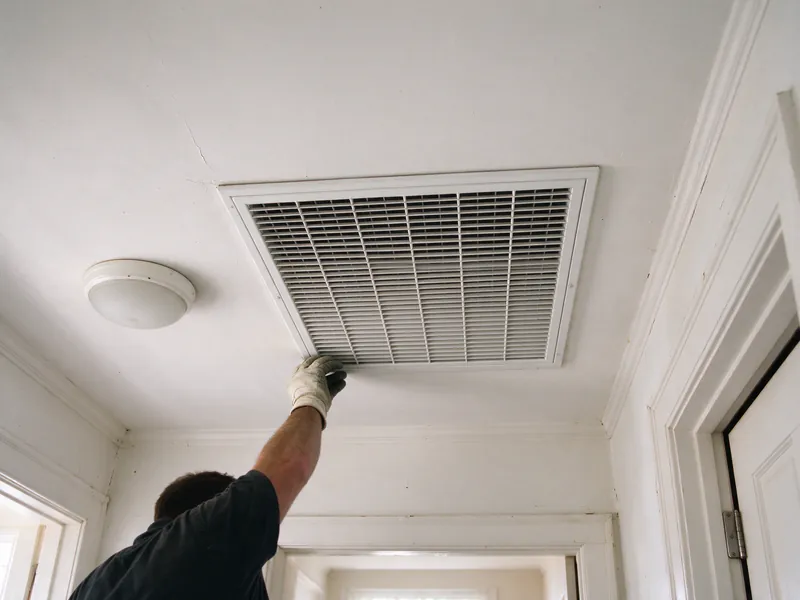
A two-story colonial usually gets one system per floor: a basement air handler for the first, an attic air handler for the second. A house with a wing or a room over the garage may get a third, sized for that space alone. See whole-home heat pumps.
Boiler houses without ducts
Where an oil boiler feeds radiators, the attic and basement each take an air handler, and closets that stack between floors carry a trunk. Our boiler conversion page and attic air handler page explain the routing.
Older houses near Norwell Center
Fewer than one Norwell home in five predates 1940. In those, low attics and plaster walls limit routes, and a small-duct system that threads flexible tubes through walls and floors can avoid opening finished rooms. See heat pump ductwork.
The panel
Two or three systems plus backup heat can push an older service. We run a load calculation on the panel first. Our typical range for a 200-amp upgrade is $3,000 to $6,500; see panel upgrades.
Wooded lots and long winters
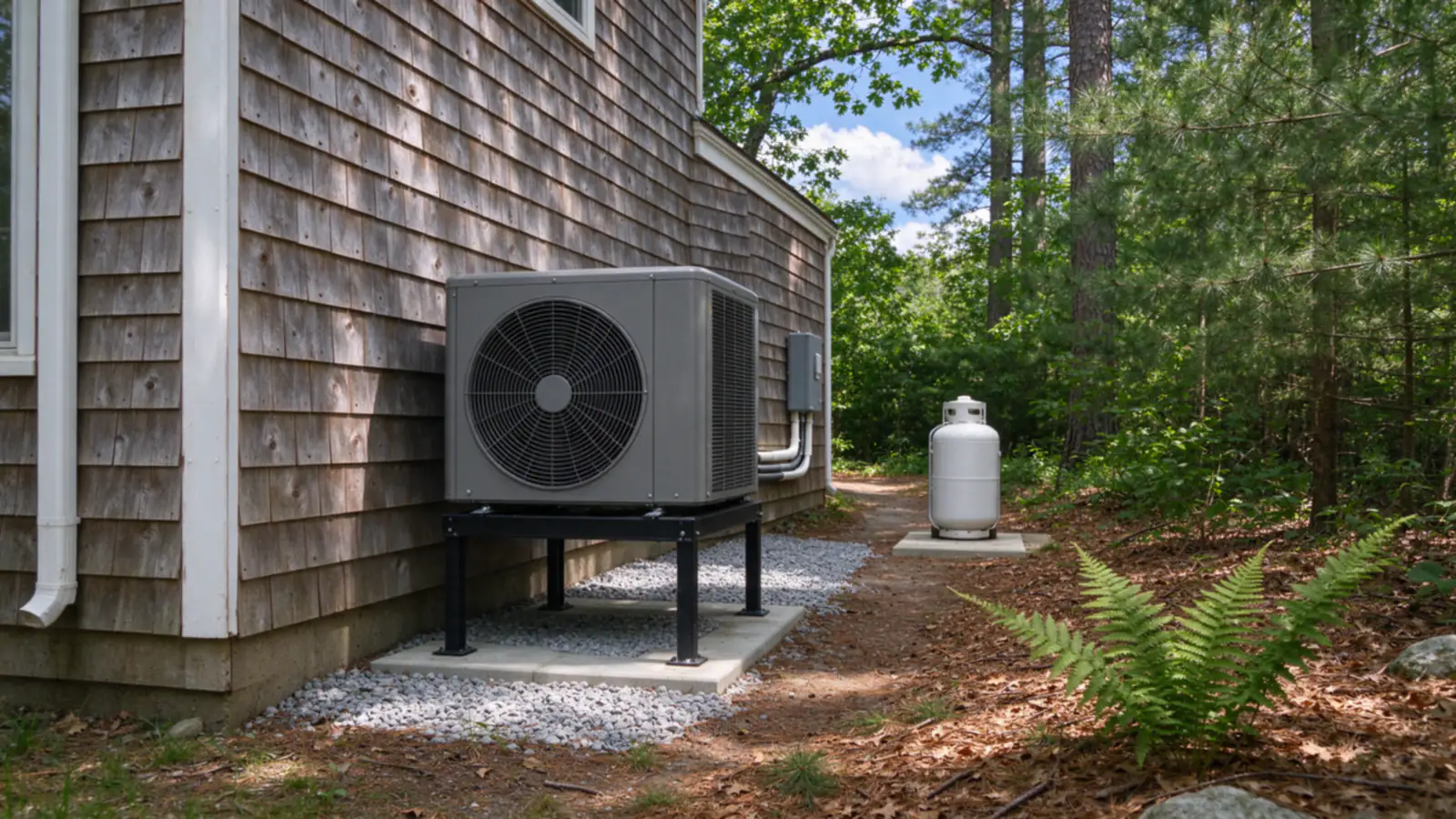
Norwell lots are often wooded, which shapes where the outdoor unit goes and what it has to handle in snow.
- Clear of drip lines: ice falling from a roof edge can crush a fan guard.
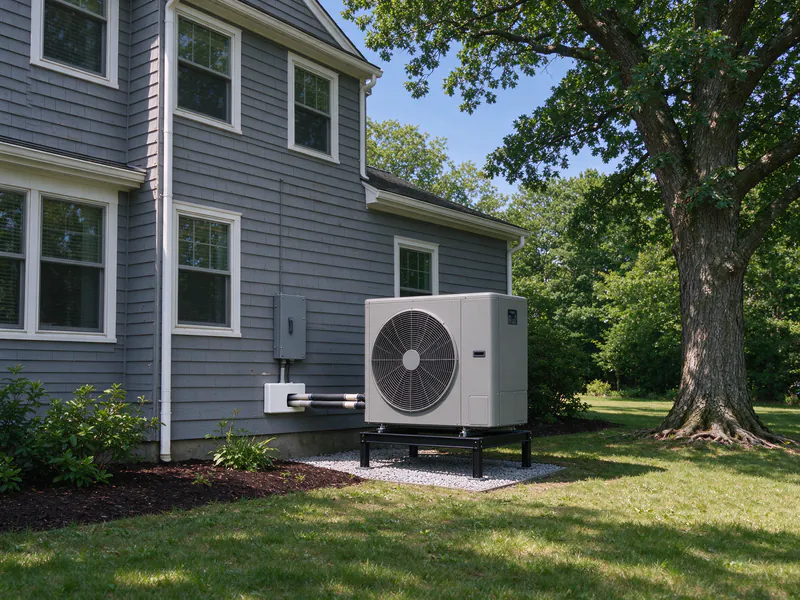
- On a stand: above drifting snow, so the coil can defrost and drain. See our placement guide.
- Short line sets: the unit sits close to the air handler where the layout allows.
- Sized for the cold: a room-by-room load calculation at your town’s design temperature, with equipment chosen by its output at 5°F.
Along the North River
Norwell is one of the state’s coastal-zone towns, with the tidal North River along its southern edge. Most houses sit well back from it, but some along the river roads are close enough for the air to carry salt.
Massachusetts has no siting rule for heat pumps in salt air, so near the river we keep the unit out of direct exposure and where rain can rinse it. Flood zones are checked per address, and equipment is raised where one applies.
Power outages on a wooded street
Like an oil or propane furnace, a heat pump needs electricity to run. On streets where trees take down lines, a backup generator is worth planning for.
A heat pump draws more than a furnace blower, so the generator has to be sized for the heat pump’s running load, with backup strips locked out while it runs. A variable-speed unit starts gently, which keeps that size down. Our power outage guide covers the options.
National Grid, Eversource Gas and Mass Save in Norwell
Norwell gets its electricity from National Grid and its gas from Eversource Gas. For oil and propane homes, National Grid is the Mass Save sponsor.
| What | The Norwell answer |
|---|---|
| Permits | Town building department: electrical and sheet metal |
| Energy code | Stretch code since May 5, 2015 |
| Electric utility | National Grid |
| Gas utility | Eversource Gas |
| Rebate program | Mass Save |
| Winter heat pump rate | National Grid, distribution charge only |
National Grid’s winter heat pump rate lowers the distribution charge on every household kilowatt-hour from November 1 to April 30. The rebate guide lists each condition.
From the estimate to the first cold night
The order matters on a delivered-fuel house: the heat pump carries the house before the oil or propane side is shut down, so you’re never without heat.
- First visit: load calculation, ducts or routes for new ones, panel, tank and outdoor spot.
- Written estimate: equipment with its capacity at 5°F, duct work, electrical, tank, permits, rebate path and price.
- Install: four to five working days on existing ducts; longer with new ducts or a second system.
- Final checks: nitrogen pressure holds, the vacuum reads under 500 microns, the charge is weighed in, airflow and static match the design, and the backup heat lockout is set and noted. Only then does the oil or propane side get shut down for good.
Hanover shares Norwell’s utilities; Hingham runs its own light plant and rebate.