Hingham Light pays up to $1,000 extra when a heat pump is sized to carry your whole house, on top of $750 a ton for the system itself. That adder rewards what a careful load calculation aims for.
Clement Boston Heat Pumps plans heat pump installation in Hingham, MA so the sizing math and the light plant’s rebate point the same way. Hingham’s power comes from its own municipal light plant, not Eversource or National Grid. That changes the rebate program, the winter rate and the paperwork, so we sort out your side of it first.
Which rebate program your house falls under
In Hingham, the fuel you’re replacing decides the program. Oil, propane, electric and wood homes go through Hingham Light; gas homes go through Mass Save.
| You heat with | Share of Hingham homes | Program |
|---|---|---|
| Gas | about 54% | Mass Save (National Grid gas) |
| Oil | about 28% | Hingham Light |
| Electricity | about 15% | Hingham Light |
| Propane | about 3% | Hingham Light |
The light plant’s program
For a qualifying cold-climate heat pump, Hingham Light pays $750 a ton up to $4,500. A whole-home adder of up to $1,000 applies when the system meets 100% of the home’s heating needs, and a weatherization adder of up to $500 applies when the work is done within six months. An energy assessment is required first.
Gas homes
Hingham Light directs gas-heated customers to Mass Save, where the whole-home rebate is larger: $2,650 a ton up to $8,500 for installs through 2026. Our rebate guide lists its conditions. Gas is the cheapest fuel per unit of heat, so most gas owners switch when the furnace and AC are both due; see furnace to heat pump conversion.
Sizing to earn the whole-home adder
The adder goes to a heat pump sized for the house’s full heating need. That means a real room-by-room load calculation, not a guess from the old boiler’s rating.
What we measure
We run ACCA Manual J for every room at your town’s design temperature, using your windows, insulation and air leakage. Then we choose equipment by its rated output at 5°F, because that’s what it delivers on the coldest nights. Our sizing guide walks through it.
Why oversizing doesn’t help
A unit that’s too big cycles on and off, dehumidifies poorly in summer and costs more up front. Right-sizing with variable-speed equipment carries the whole house and still runs quietly on mild days. Backup heat covers the rare night below the design point and locks out above a set temperature.
Oil boilers and older Hingham houses
About 28% of Hingham homes burn oil, and roughly one in five predates 1940. Many of those heat with a boiler and radiators, so there are no ducts to reuse.
Attic and basement air handlers
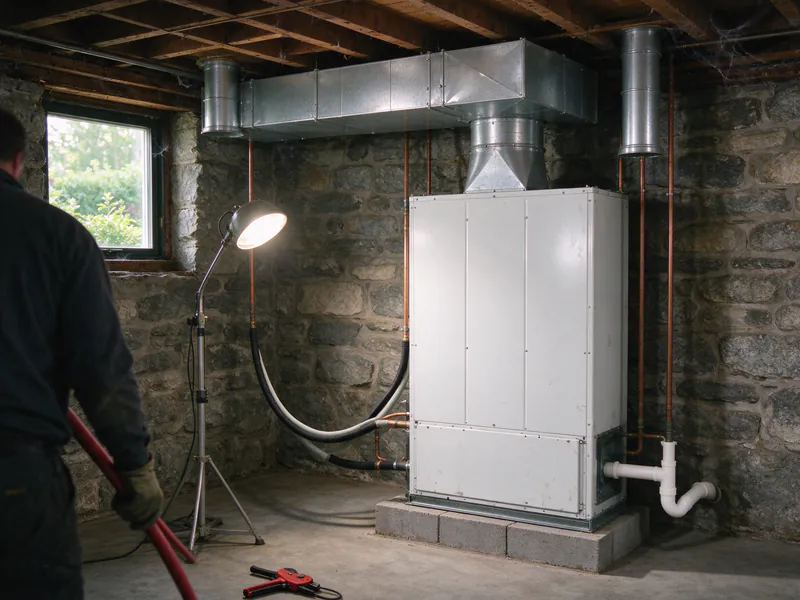
A colonial or cape near Hingham Square can take an air handler in the attic for the upper floor and one in the basement for the first. Closets that stack between floors carry a trunk without opening finished walls. See boiler to heat pump conversion and our old-house guide.
The tank
The oil tank comes out after the heat pump carries the house. Our typical range for an accessible basement tank is $600 to $1,500, with the fire department’s removal permit as part of the job. See oil tank removal.
Condos and townhouses
About one Hingham home in five sits in a building of five or more units. In a condo, the association’s rules and master deed decide where the outdoor unit goes and what it looks like.
What the board needs to see
We bring the equipment spec, its sound rating and a placement sketch to that approval early, so the board decides on facts. Each unit gets its own system sized for that unit, and the rebate follows the fuel that unit heats with. Our condo guide covers the steps.
Salt air and the harbor edge
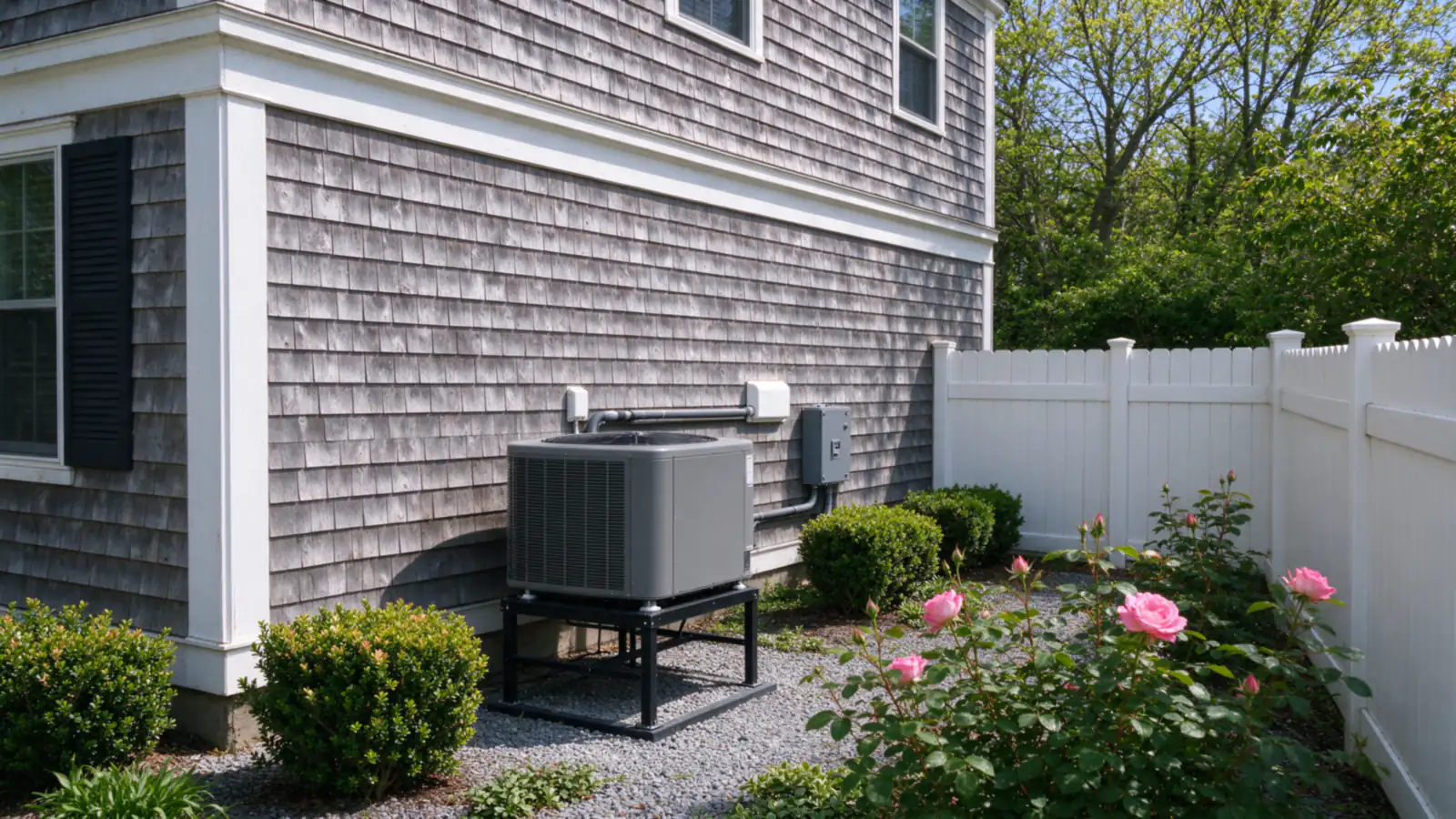
Hingham is a coastal town, and houses near the harbor, Crow Point and World’s End sit in salt air. Massachusetts has no siting rule for that, so placement is about good practice.
- Out of direct spray: the unit goes on the sheltered side of the house.
- Where rain reaches it: not under eaves, so rain rinses salt off the coil.
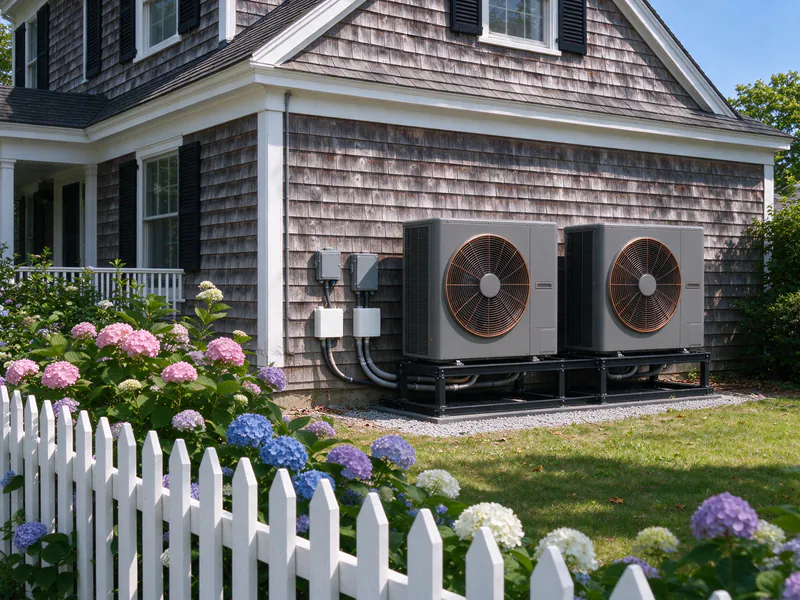
- On a stand: level, above snow, draining freely. See our placement guide.
- Coating: a manufacturer’s coastal-protection option where exposure is high.
- Flood zones: checked per address; equipment raised where one applies.
Specialized code for renovations
Hingham adopted the specialized code on January 1, 2026, after running the stretch code since 2018. It applies to new homes and major renovations, not an equipment swap in an existing house.
If you’re adding a wing or gutting a floor, the specialized code’s all-electric or pre-wired paths shape the plan. We size the heat pump for the finished house and run the ducts while the framing is open.
What Hingham permits and Hingham Municipal Light Plant rebates involve
Hingham’s building department takes permits online through PermitEyes. A ducted job needs an electrical permit and a sheet metal permit, plus a gas permit where a line is capped.
| What | The Hingham answer |
|---|---|
| Permit route | Hingham Building Department, PermitEyes |
| Energy code | Specialized code since January 1, 2026 |
| Electric utility | Hingham Municipal Light Plant |
| Gas utility | National Grid |
| Rebate for oil, propane, electric | Hingham Light: $750 a ton up to $4,500, plus adders |
| Rebate for gas homes | Mass Save |
The state’s seasonal heat pump rate covers Eversource, National Grid and Unitil customers, so it doesn’t apply on Hingham Light. We figure running costs on the light plant’s own rates. The cost guide explains how our prices are built.
How a Hingham project comes together
The energy assessment and the load calculation come first, because the rebate and the size both depend on them.
- Energy assessment scheduled through the light plant’s program, if you heat with oil, propane or electricity.
- First visit: load calculation, ducts or routes for new ones, panel, tank and a sheltered outdoor spot.
- Written estimate: equipment with its capacity at 5°F, duct work, electrical, permits, the rebate program and price.
- Install and commissioning: pressure test, vacuum below 500 microns, charge by weight, airflow and static measured, backup lockout recorded.
Weymouth runs on National Grid and Mass Save; Hull has its own light plant.