Melrose Victorians were piped for radiators long before anyone ran a duct. Where yours still has an oil boiler in the basement and nothing above it but plaster, Clement Boston Heat Pumps handles heat pump installation in Melrose, MA that brings ducted heat and cooling in without tearing the place apart.
The trick is finding the routes. The attic, the basement and closets that stack between floors carry most of the duct work, and the first visit is mostly about finding them.
Getting ducts into a house built for radiators
New ducts follow the paths the house already has: an attic over the bedrooms, a basement under the first floor, and closets or chases that line up between them. We map those before choosing equipment.
The attic for the second floor
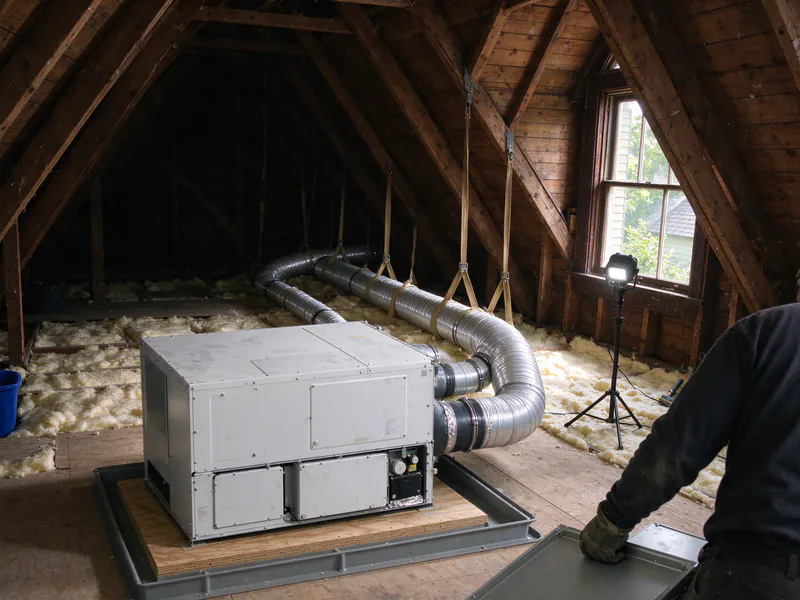
An air handler in the attic feeds each bedroom with a short run into the ceiling. Where the attic is unheated, the ducts get sealed and insulated, and the air handler sits on a platform with a drain pan. See attic air handler heat pumps.
The basement for the first floor
First-floor rooms take floor registers fed from a basement trunk, or a second air handler in the basement. A big Victorian often needs two systems, because one long duct run can’t serve three floors evenly.
When no closet lines up
Some houses have no stacked closets at all. A small-duct high-velocity system uses 2-inch flexible tubes that thread through walls with little opening. Our ductwork page and old house guide compare the routes.
The return air nobody plans for
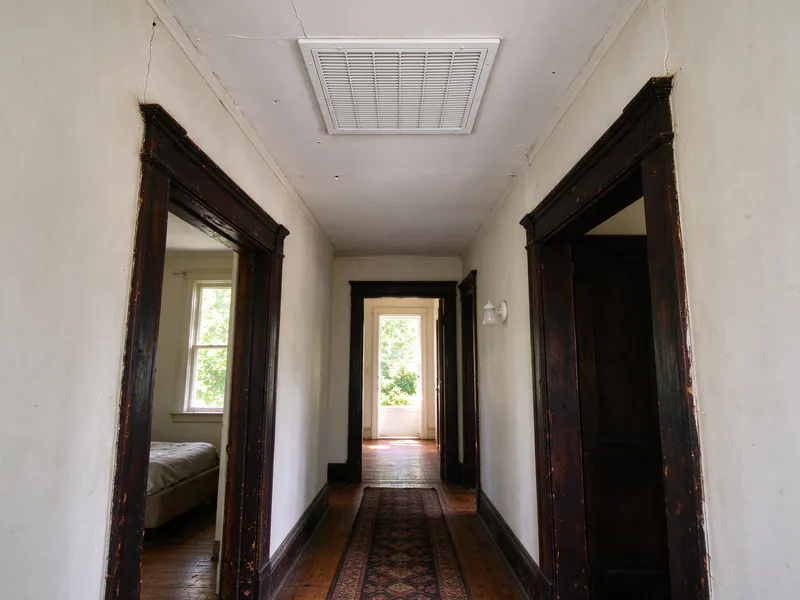
Supply ducts get the attention, but a heat pump also needs air coming back. In a house with no ducts, that means a return grille in a hall ceiling or a stair landing, sized so the air handler doesn’t whistle. We size returns with the supply runs, not afterward.
Radiators, boilers and the rebate
A Melrose house without ducts heats with hot water or steam, on oil or gas. Whether the boiler stays or goes changes the rebate and the plan.
Taking the boiler out
When the boiler is old, the heat pumps carry the house and the boiler and radiators come out. Mass Save’s whole-home rebate then applies: $2,650 per ton up to $8,500 for installs through December 31, 2026, and $2,350 per ton up to $7,500 from January 1, 2027. See boiler to heat pump conversion.
Keeping it for the coldest nights
A newer boiler can stay as backup in a dual-fuel design with integrated controls. That earns the partial-home rebate instead. Our heat pump vs boiler guide lays out the trade.
Oil versus gas
About 20% of Melrose homes heat with oil and 63% with gas. Oil homes save the most per winter, since oil costs more per unit of heat than a heat pump on National Grid’s winter rate. See oil to heat pump conversion.
Ducted or ductless in a Melrose house
Wall-mounted ductless heads are the other common choice in radiator houses. We install ducted systems only, and here’s why that fits a Melrose Victorian.
Fewer things on the walls
A ducted system puts one air handler out of sight and a register in each room, instead of a wall unit in every bedroom. On a Victorian’s tall walls and trim, that keeps the rooms looking like themselves.
One system per floor, not per room
Ducted air handlers move air through every room on their floor, including small rooms and baths that a wall head would skip. Our ducted vs ductless guide walks through where each fits.
The panel, the yard and the plaster
Three practical questions come up in an older Melrose house: whether the electric service can carry the heat pump, where the outdoor unit can sit, and what gets patched afterward.
Electric service
Where an older house still runs on 100-amp service, a whole-house heat pump with backup strips can push past it. We do the load math on the first visit. Where the panel can’t carry it, an electrical panel upgrade is a separate line; our typical range is $3,000 to $6,500, with National Grid scheduling the service change.
The outdoor spot
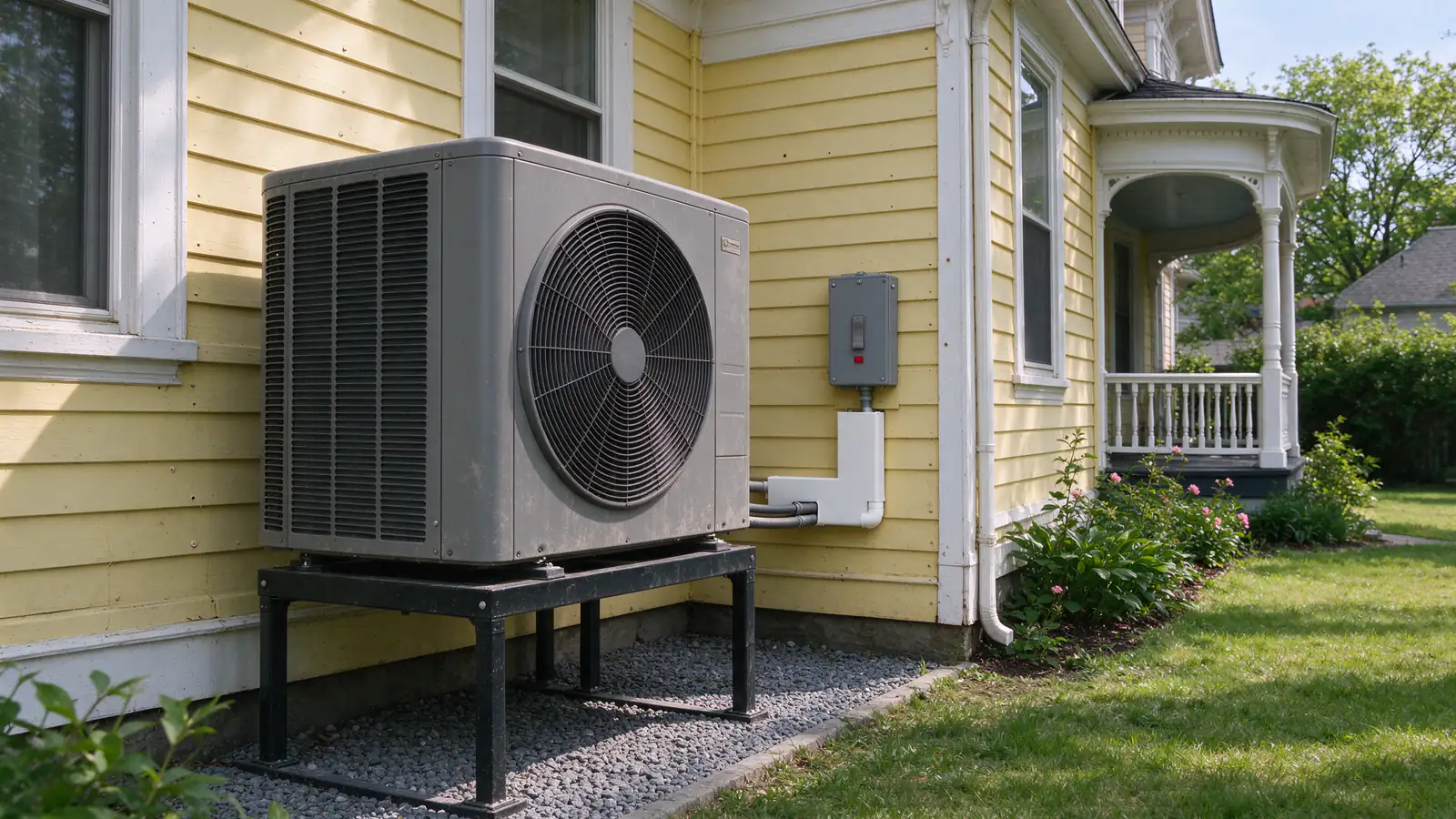
The unit needs clear air on all sides, a stand above the snow line, and distance from bedroom windows next door. We avoid spots under a roof valley, where sliding snow lands on the coil. See snow stands and placement.
Patching
Registers and closet chases mean some cuts in ceilings and closet floors. We list every opening on the estimate, along with who patches and paints it, so there’s no surprise hole in a finished room.
Permits, code and utility in Melrose
Melrose takes every building, electrical, mechanical, plumbing and gas application through its online system, SimpliCity. A ducted job needs electrical and sheet metal permits, and gas where a line gets capped.
| What | Melrose |
|---|---|
| Electric and gas utility | National Grid for both |
| Energy code | Specialized stretch code since July 1, 2024 |
| Permit filing | Online only, through SimpliCity |
| Rebate route | Mass Save, through National Grid |
| Winter heat pump rate | National Grid, lower distribution charge November to April |
The specialized code applies to new homes and major renovations, so a heat pump that’s part of a gut renovation has to meet it. A replacement in an existing house doesn’t. The rebate guide lists Mass Save’s conditions.
Start to finish in Melrose
The first visit is a duct-route survey as much as a load calculation: attic, basement, every closet, and the panel. We check the outdoor spot against the neighbor’s windows, since noise limits are confirmed per address.
- Written estimate: each system with capacity at 5°F, duct routes room by room, electrical, permits, the rebate path, and the price. Our quote checklist shows what to look for.
- Install: six to ten working days for a new-duct job.
- Commissioning: pressure test, vacuum below 500 microns, charge by weight, measured airflow per room, and backup heat lockout recorded.
Neighboring Malden shares National Grid with denser housing, and Stoneham, past the Fells, is on Eversource.