Close to six in ten Roslindale homes are lived in by their owners, against about a third across Boston, and those owners usually ask us one question first: convert the whole house now, or one floor at a time? At Clement Boston Heat Pumps, every heat pump installation in Roslindale, Boston, starts from that decision.
The answer sits in your basement and attic: what heats the house today, where the ducts run, and how much room the electrical panel has left. We measure all three before anyone talks about equipment.
Whole house now, or one floor at a time?
Convert the whole house when the furnace or boiler is near the end and your ducts can carry the load. Go floor by floor when the old system still has years in it, or when only one floor is uncomfortable.
When whole-home makes sense
A full conversion removes or disconnects the old heating system, which is what Mass Save’s whole-home rebate asks for. Through 2026 that rebate pays $2,650 per ton up to $8,500, falling to $2,350 per ton up to $7,500 from January 1, 2027.
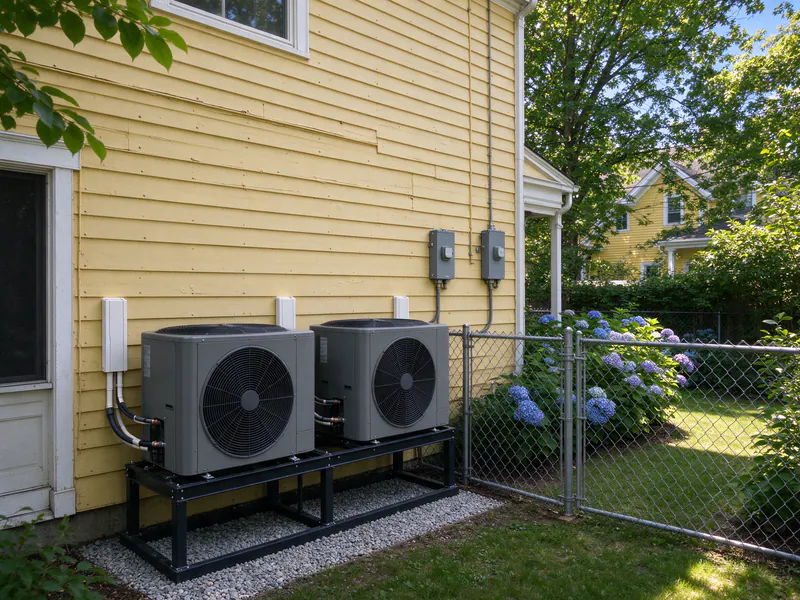
It also suits a colonial where both floors already have ducts, even if they were installed decades apart. Our whole-home heat pump page shows how one or two systems share the load.
When partial makes sense
Keeping the furnace or boiler as backup is allowed in Boston, which is not a fossil-fuel-free town. Mass Save’s partial-home path pays $1,125 per ton up to $8,500 when integrated controls decide which side runs.
Partial works well for an owner who wants cooling upstairs this summer and plans the rest later. We size the first system so the second one fits beside it without redoing the work.
What’s heating your Roslindale house today
About seven in ten homes in the Roslindale ZIP heat with gas, and roughly one in nine still burns oil, a larger share than across Boston. Each one starts a different job.
| What you have | What usually happens |
|---|---|
| Gas warm-air furnace | Heat pump on the existing ducts; the furnace comes out or stays as backup |
| Oil furnace or boiler | Oil equipment and tank removed, air handler takes its spot in the basement |
| Steam or hot-water radiators | New ducts, or a heat pump for cooling and shoulder seasons with the boiler kept |
| Attic central AC, cooling only | Attic air handler swapped for a heat pump unit on the same ducts |
Gas furnaces and attic AC
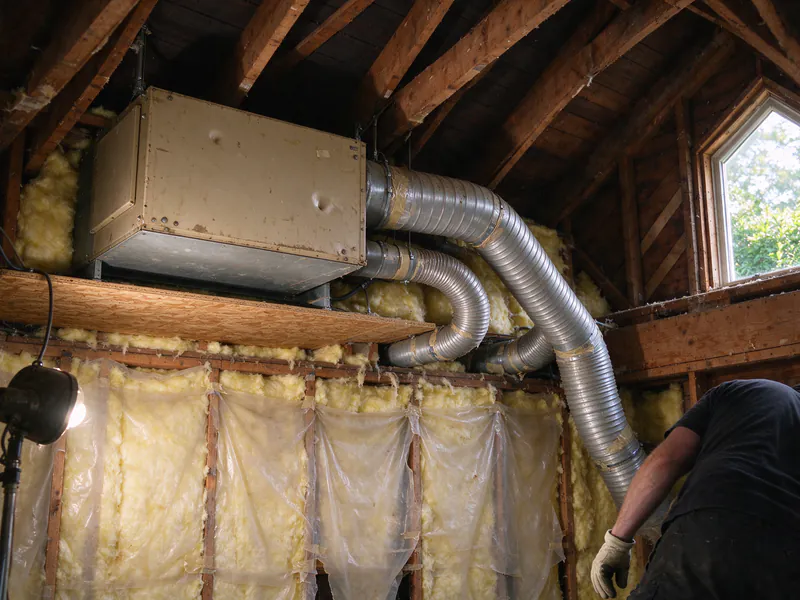
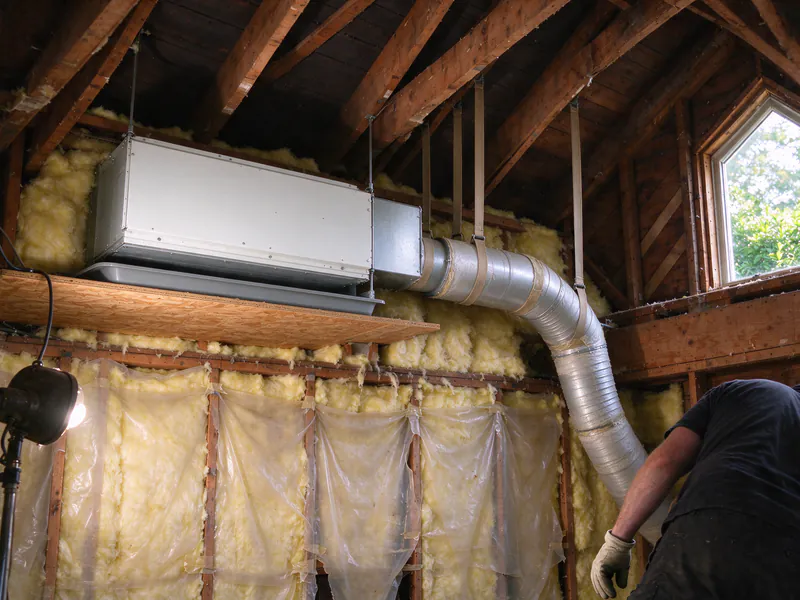
Where a colonial near Roslindale Village has a furnace in the basement and a cooling system added later in the attic, each floor already has its own ducts, which a furnace-to-heat-pump conversion can reuse, with an attic air handler taking over upstairs.
Oil
Burning oil now costs more for each unit of heat than running a heat pump through an Eversource winter, so an oil house saves more than a gas one. Our oil-to-heat-pump page covers the tank, the chimney and the basement layout, and the heat pump vs oil guide runs the numbers.
Radiators
More than half of Roslindale’s homes were built before 1940, many for radiators. Where a Victorian on Metropolitan Hill still has steam or hot water, ducts are the big decision. Closets, the attic and the basement usually carry them; see boiler and radiator homes.
Two-families where you live on one floor
About one Roslindale home in five sits in a two-unit building, close to double Boston’s share. Where the owner lives on one floor and rents the other, that changes the order of the work.
Separate systems, separate meters
Each floor gets its own heat pump, its own thermostat and a circuit on that unit’s panel. The first floor’s air handler sits in the basement; the second floor’s goes in the attic or a hall closet. The top floor loses heat through the roof, so its unit is sized from its own load, never copied from downstairs.
Timing the second floor
An owner can convert their own floor first and the upstairs unit between leases, when rooms are empty and ceilings can be opened. We plan both line sets and outdoor spots on day one so the second phase drops in cleanly.
Will your electrical panel carry it?
Some will, some won’t. Of about 230 Boston permits in the Roslindale ZIP that name a space-heating heat pump since late 2021, roughly one in six also lists a service upgrade, often from 100 to 200 amps.
The load calculation decides it. A right-sized heat pump with modest backup heat can fit a 100-amp service in a smaller house; a larger colonial with an electric range and dryer may not. If you need more capacity, our typical range for an electrical service upgrade is $3,000 to $6,500, shown as its own line in the estimate.
Permits, noise and rebates in Roslindale
Roslindale lies outside the Boston Landmarks Commission’s local districts, so outdoor units here don’t go through design review. The rest is the same city process as any Boston neighborhood.
| What | In Roslindale |
|---|---|
| Permit office | Boston Inspectional Services: electrical, plus sheet metal for duct work |
| Short-form building permit fee | $20 plus $10 per $1,000 of work |
| Outdoor unit noise | 50 dBA at the lot line outside daytime hours |
| Energy code | Specialized stretch code since January 1, 2024 |
| Electric utility and rebates | Eversource, Mass Save |
| Oil tank removal | Boston Fire Department permit, $110 |
Placing the outdoor unit
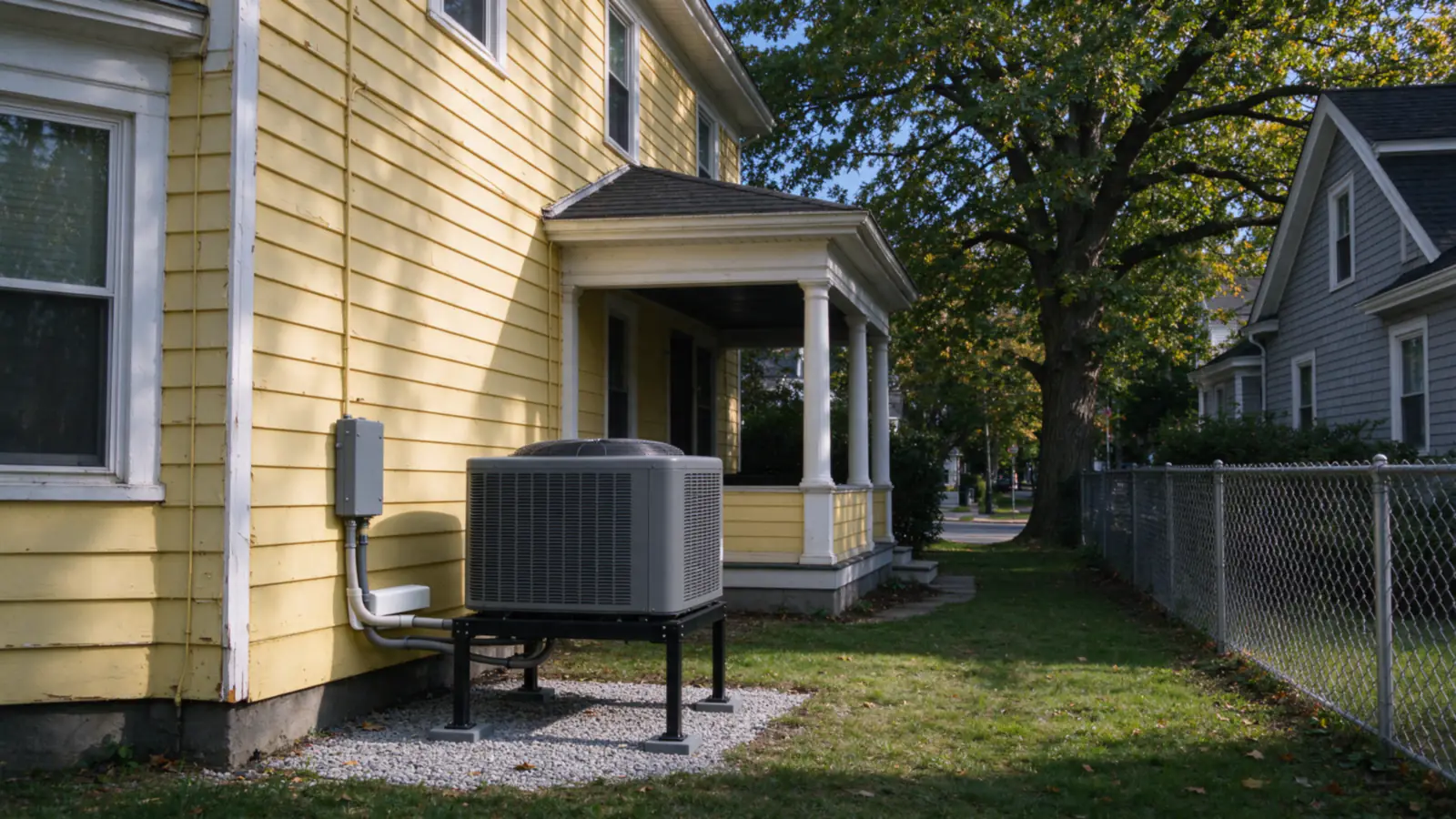
Where a side yard between two houses is narrow, the noise limit decides the spot. We measure the distance from the unit to each lot line and pick the quietest spot that still keeps the line set short, usually the rear corner on a stand above drifting snow. Our placement guide explains the stand height.
Rebates and running costs
Eversource’s seasonal heat pump rate lowers winter delivery charges on every kilowatt-hour once you heat with a heat pump. The cost guide shows how rebates come off the price.
Between the first visit and the first winter bill
Once permits are in hand, a Roslindale conversion usually takes two to six working days on site, longer when new ducts go into an older house.
- We measure the house. A Manual J load for every room at Boston’s 7°F design night, a static pressure reading on each duct system, a look at the panel, and tape-measured distances from the outdoor spot to your lot lines.
- You get both options in writing. When whole-home and partial both fit, the estimate prices them side by side, each listing the unit’s output at 5°F, duct work, wiring, permits and its Mass Save path.
- Old equipment goes, new goes in. Oil burner and tank, or furnace and gas line, leave with the right trade; the air handlers, line sets and outdoor units follow.
- We prove it works. The lines hold nitrogen pressure, pull down under 500 microns and take a weighed charge; then we read airflow and static and set the point where backup heat locks out.
Neighboring West Roxbury has more single-family houses on larger lots; Jamaica Plain has more radiators and three-deckers. For older houses generally, see heat pumps in old houses.