Gut a Brookline condo or house and the new heat will almost certainly be electric. Clement Boston Heat Pumps plans that heat for condos, brownstones and single-families, so heat pump installation in Brookline, MA starts with one question: does your project count as a major renovation under the town’s fossil-fuel-free by-law?
The by-law took effect on February 22, 2024. It bars new gas and oil equipment from construction and large renovations while leaving routine replacements alone, so one house can face two rule sets depending on how much work you’re doing.
What the by-law means for your renovation
Brookline was among the first towns the state accepted for its fossil-free building pilot. The by-law governs what heat a renovation may add, not what an untouched house may keep.
Inside a major renovation
In the renovated space, a new gas furnace or boiler is off the list, and so is a hybrid design built around one. The heat pump is the whole heating plant, so we size it to hold the house at design temperature without help from fuel.
The by-law’s definitions decide where “major” begins. We confirm the answer with the Building Department before the design is fixed, because it changes the equipment, the panel and the price.
Outside a renovation
Swapping a worn-out furnace, or adding air conditioning, is not a major renovation. You may go fully electric with a whole-home heat pump or hold on to gas as backup; Mass Save pays more when the gas equipment is removed.
The specialized code
On top of the by-law, the town adopted the specialized code effective July 1, 2023, for new homes and big renovations. Put together, any large Brookline project should assume an all-electric design.
Condos, buildings and boards
More than half of Brookline’s homes sit in buildings of five or more units, and only about 18% are detached houses. So most Brookline plans need an association’s sign-off.
| Brookline home type | Share | Who has a say |
|---|---|---|
| Detached house | 18.3% | You |
| Two-family | 10.0% | You and the other owner |
| Three or four units | 15.7% | The owners together |
| Five or more units | 50.8% | The board, under the master deed |
Units on shared steam
In an older building where one steam boiler heats every unit, a single owner can still leave it with the association’s approval: the unit gets its own heat pump and a licensed plumber disconnects that unit’s radiators so the rest of the system stays balanced. See boiler to heat pump.
What the board needs
State condo law binds each owner to the master deed, by-laws and rules, which usually cover roofs, walls and common land. We bring the spec sheet, sound rating, a placement drawing and the roof or wall mounting detail. Our condo guide lists the usual questions.
Top floors and attics
A top-floor unit with an attic above is the easiest to convert: an attic air handler feeds each room through the ceiling. Lower units use closet air handlers and soffits; see heat pump ductwork.
Sound and placement on a tight lot
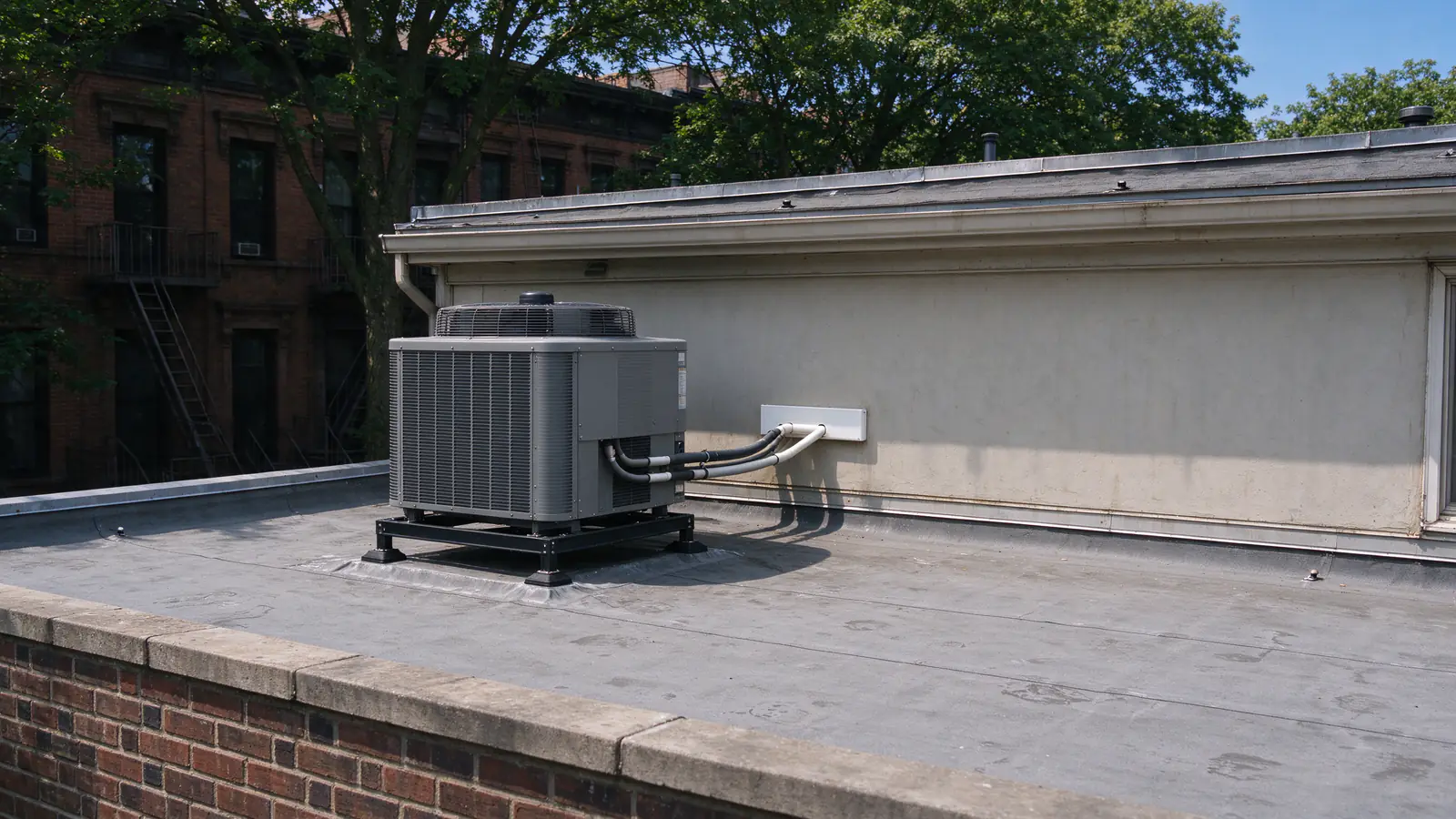
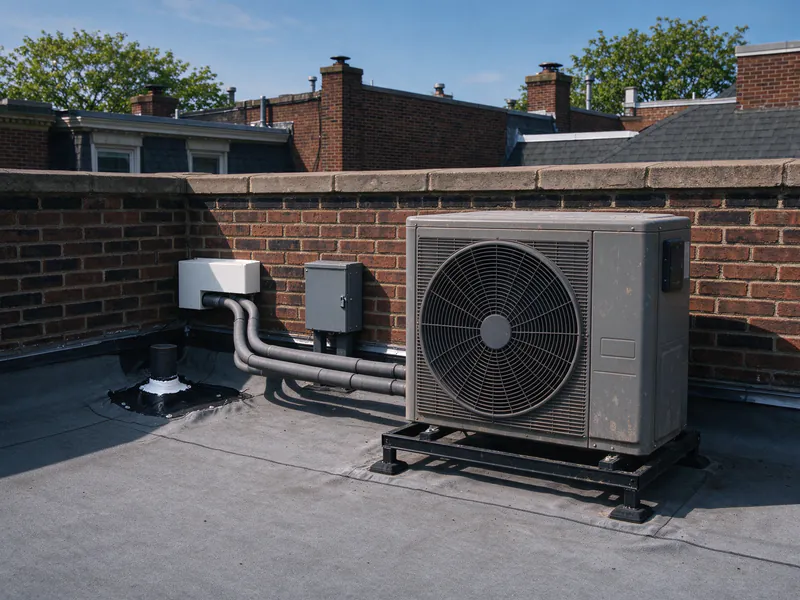
Brookline lots near Coolidge Corner and Brookline Village are narrow, so an outdoor unit often belongs on a flat rear roof. Setbacks and sound limits for equipment are confirmed per address; we compare the unit’s rated sound with the distance to the nearest window and pick the quiet side of the building.
A roof unit needs a frame that spreads its weight and lifts it above snow, plus a line-set route the board accepts. See the snow stand guide.
Single-family houses in South Brookline and Chestnut Hill
Brookline’s detached houses cluster on the hills and to the south, from Fisher Hill and Aspinwall Hill to Chestnut Hill. Many are large and old, with radiators or a furnace serving only part of the house.
Houses with radiators
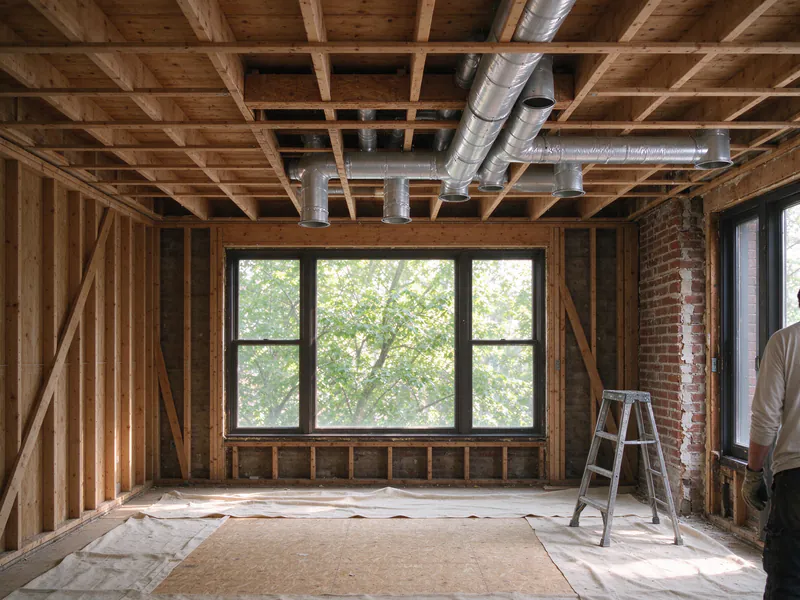
A large house with steam or hot-water radiators needs new ducts. Two systems, one in the basement and one in the attic, with stacked closets carrying the trunk, reach every floor without opening finished walls. Our old houses guide shows the routes.
Houses with a furnace
In an older colonial whose furnace heats downstairs and leaves the upstairs short, the heat pump reuses the downstairs ducts and an attic unit takes over upstairs; see furnace to heat pump.
Fuel and running cost in Brookline
Gas heats about 60% of Brookline homes, electricity about 27% and oil about 9%.
Electric heat
Electric baseboard delivers exactly the energy it draws. A heat pump delivers several times as much, and from November to April Eversource bills heat pump households at a lower delivery rate. See baseboard to heat pump.
Gas and oil
Natural gas remains the least expensive fuel to burn, which narrows the savings; renovation, an aging boiler or wanting central air are the common triggers. Oil, by contrast, runs dearer than a heat pump on Eversource’s seasonal rate.
The Brookline permit and rebate picture
Permits come from Brookline’s Building Department: electrical and sheet metal for the heat pump, plus the renovation’s building permit. We check the current filing route and fee for your address.
| What | The Brookline picture |
|---|---|
| Fossil-fuel-free by-law | In effect since February 22, 2024 |
| Energy code | Specialized stretch code since July 1, 2023 |
| Electric utility | Eversource |
| Gas utility | National Grid |
| Built before 1940 | 51.7% |
Leaving oil, propane or electric heat? Your Mass Save rebate comes through Eversource. Leaving gas? National Grid handles it. Every requirement is in our rebate guide, and the cost guide explains how the ranges are built.
An Brookline job, week by week
We start by settling the renovation question, then measure each room’s heat loss, map duct routes through the open framing or the closets, check the unit’s panel and photograph the outdoor spot for the board.
- Board package and estimate: spec, sound rating, drawing, and a line-by-line price with the rebate path.
- Sequenced with the builder: duct rough-in happens before the ceilings close.
- Four to nine days on site, set by how much duct is new; our installation process guide walks through each day.
- Startup: the lines hold nitrogen, the vacuum pulls under 500 microns, refrigerant goes in by weight, and airflow and controls are checked.
Newton runs a similar fossil-fuel-free ordinance; Dedham to the south does not.