The oil boiler in an Everett two-family usually heats both floors through one set of pipes, and replacing it raises questions a single-family never faces. Clement Boston Heat Pumps handles heat pump installation in Everett, MA by giving each floor its own ducted system.
That split decides almost everything else: where each air handler sits, how two outdoor units fit on a small lot, and how the rebates are counted.
Why Everett jobs are planned floor by floor
More than half of Everett’s homes are in two-families and three-deckers, and more than half were built before 1940. A single system can’t serve two households well, so we plan one per unit.
Each floor loses heat differently
The top floor loses heat through the roof, the first floor through the basement and the sills. A load calculation for each unit, room by room, sizes each system for its own floor instead of splitting one number in half. Our three-decker guide walks through the method.
Where each air handler goes
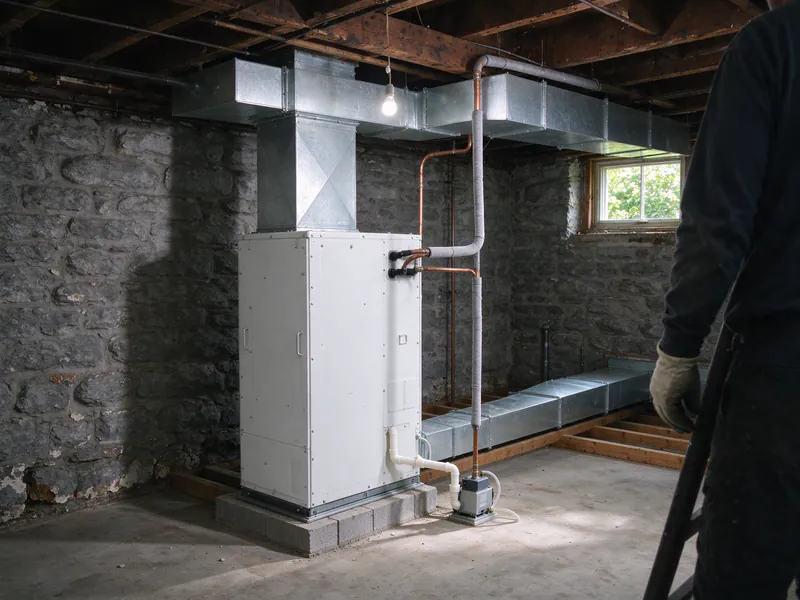
The first floor’s unit hangs in the basement and feeds floor registers. The top floor’s goes in the attic and feeds ceiling registers. A middle floor gets a closet unit or a small-duct system that runs through the floor joists above. See boiler and radiator homes.
Two units, one small lot
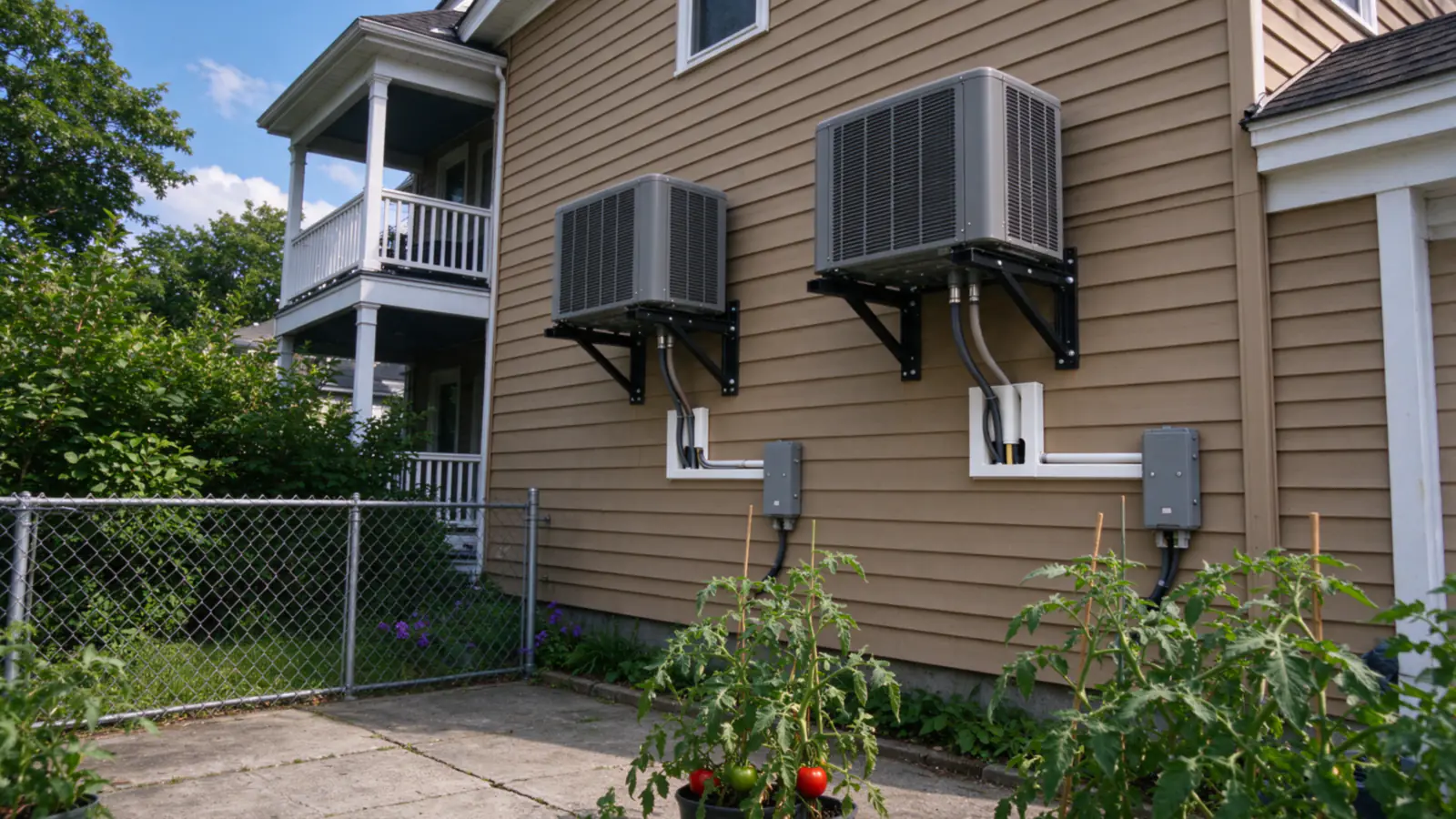
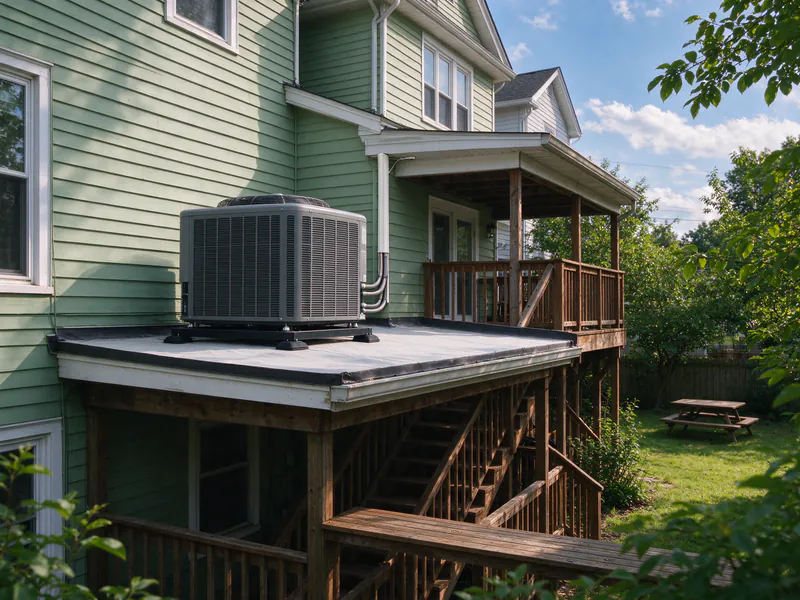
Everett lots leave little side yard. We favor rear yards and rear porch roofs, and bracket units to a back wall where the ground is taken. The city’s noise and setback rules are confirmed per address before we set anything.
Oil, gas and the National Grid winter rate
About two in three Everett homes heat with gas, 18% with electricity and 12% with oil. The oil homes have the strongest running-cost case, and National Grid’s seasonal rate helps every group.
If your boiler burns oil
Oil is the most expensive common heating fuel per delivered BTU. A cold-climate heat pump on the winter rate costs less to run, and the deliveries stop. We remove the basement tank at the same time; see oil to heat pump conversion and oil tank removal.
If your boiler burns gas
Gas costs less per BTU than oil, so the savings are smaller. Most gas owners switch because the boiler is near the end, or because they want central cooling on every floor. Our heat pump vs boiler guide compares the two.
What the winter rate does
National Grid’s optional heat pump rate cuts the distribution charge on every household kilowatt-hour from November 1 to April 30. Transmission and supply stay the same. See our winter rate guide.
Old houses, and routes for new ducts
Everett’s pre-1940 houses have plaster walls, balloon framing and boilers that never needed ducts. The work is finding routes that don’t open finished rooms.
- Basement first: the first floor is the easy one. The trunk runs between joists, registers go in the floor, and the return sits in a central hall.
- Attic for the top floor: a low attic takes a compact horizontal air handler and short insulated branches to ceiling registers.
- Closets and chases: stacked closets carry trunks between floors when a unit needs a second route. Old chimneys sometimes help, once lined or abandoned.
- Small-duct systems: where none of that works, 2-inch flexible tubes fit through spaces a standard duct can’t. Our old house guide covers them.
Panels in older two-families
Many Everett two-families still have a 100-amp service per unit. A ducted heat pump often fits on it after a load calculation, and where it doesn’t, the service is upgraded first. See panel upgrades for heat pumps.
When the two floors don’t share one owner
Plenty of Everett two-families and three-deckers have been split into condos. Then each owner decides on their own system, and shared spaces need everyone’s agreement.
Shared basements, attics and walls
The first-floor owner’s air handler in a shared basement, or a top-floor line set running down a common rear wall, touches property the other owners hold in common. We bring a placement drawing showing every penetration, line set and outdoor unit so the association can approve it once.
One owner switching first
It’s common for one floor to go electric while the others stay on their own boilers for now. We plan the first system so it doesn’t block the others’ routes later: the trunk stays out of the shared chase, and the outdoor unit leaves room on the porch roof for a second. Our condo guide covers board approvals.
Keeping the bills separate
One system per unit, on that unit’s own panel and meter, keeps each household’s heating cost on its own electric bill. Mixing circuits between units creates billing problems that are hard to undo.
Rebates and permits, Everett edition
Everett’s building department issues the permits; its online route is confirmed per address. The job needs an electrical permit and the city’s mechanical permits for ducts and equipment.
| What | The Everett figure |
|---|---|
| Electric utility | National Grid |
| Gas utility | National Grid (Boston Gas) |
| Energy code | Stretch code since July 1, 2015; specialized code not adopted |
| Heating fuel | Gas 66.6%, electricity 18.1%, oil 12.0% |
| Housing | 25.7% two-unit, 26.8% three- or four-unit buildings |
Because National Grid sponsors Mass Save on both the electric and gas side, oil, baseboard and gas homes all have a rebate route. The whole-home tier pays $2,650 per ton up to $8,500 for installs through December 31, 2026; see the rebate guide.
Everett is also on the state’s coastal list, along the Mystic River and Malden River. Lower Broadway and the waterfront blocks get units set out of wind-driven spray.
Start to finish in Everett
The first visit covers both units: a load calculation for each floor, duct routes, the panels and a spot for each outdoor unit.
- Written estimate per unit: equipment and its capacity at 5°F, duct work, electrical, permits, tank removal and each unit’s rebate path.
- Sequencing: the occupied floor stays heated while the other is switched, so a household is never without heat.
- Install: usually five to nine working days for both floors with new ducts.
- Commissioning: pressure test, vacuum below 500 microns, charge weighed for each line length, airflow and controls recorded.
The cost guide sets out our ranges. Malden next door has much the same two-family stock, and Chelsea shares the Mystic waterfront.