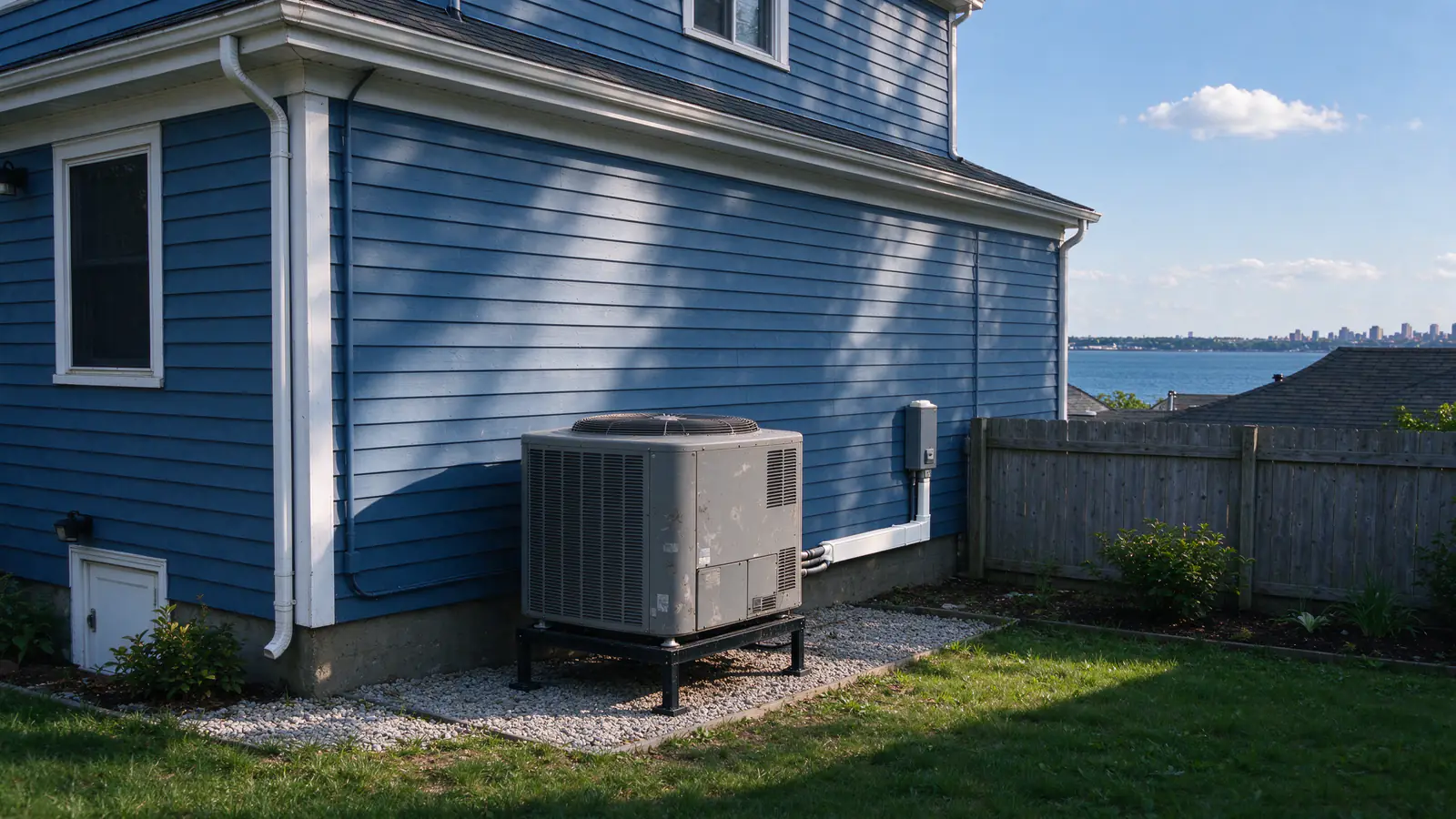
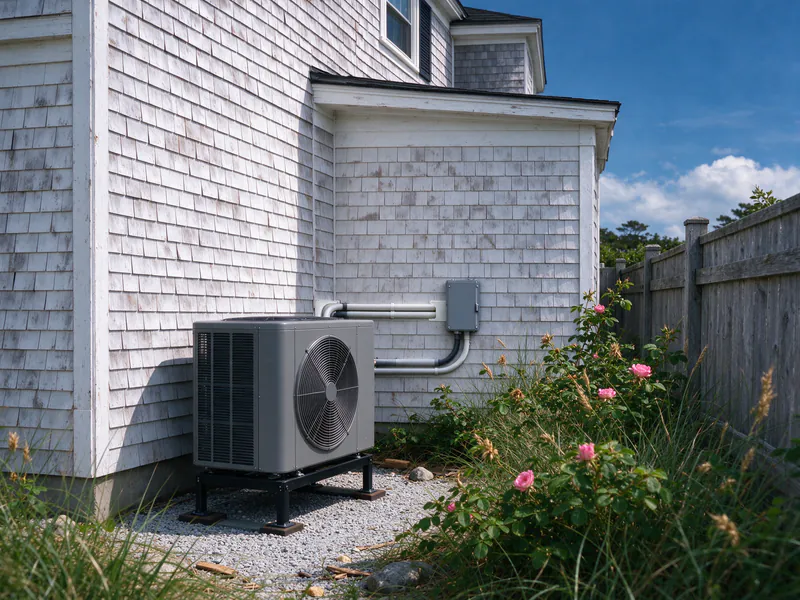
Point Shirley, Winthrop Beach and the Highlands all sit a short walk from salt water, and every outdoor unit in town lives with the spray. So Clement Boston Heat Pumps plans heat pump installation in Winthrop, MA around that exposure first, then the house.
Most Winthrop homes predate 1940, and plenty sit a short walk from the seawall. So the first visit looks at where the unit can hide from the wind, how high the lot sits, and what heat the house runs on today.
Where the outdoor unit can live on a Winthrop lot
The outdoor unit is the part the ocean attacks, so its spot gets decided before the equipment does. Wind, spray and flood height each push it somewhere different, and we weigh all three.
Out of the salt wind
Salt settles on the coil fins and the cabinet, and a unit that faces open water corrodes faster than one behind a house. We look for the lee side of the building, away from Winthrop Shore Drive or the harbor edge, with clear airflow on every side.
Where no sheltered spot exists, several manufacturers offer a coastal coating on the outdoor coil. We price it as its own line so you can see what it adds. Our snow stand and placement guide covers clearance and drainage.
Above the flood line
Winthrop is one of the state’s coastal communities, and some parcels sit in a FEMA flood zone. Where yours does, the building code’s flood provisions set how high the outdoor unit and any basement air handler must sit for that address.
We check the flood map on the first visit, not after the permit goes in. On low lots near Point Shirley or the beach, that often moves the air handler out of the basement and into a closet or the attic; see attic air handlers.
Close neighbors
Winthrop lots are tight, with many two-families and condo buildings shoulder to shoulder. Noise limits for HVAC equipment are confirmed per address, so we check the unit’s rated sound against the distance to the neighbor’s windows before we choose a spot.
Older houses, two-families and the duct question
More than half of Winthrop’s homes were built in 1939 or earlier, and only about three in ten are detached single-families. Building form decides how many systems you need and where the ducts can run.
Two-families
Roughly a quarter of homes are in two-unit buildings. Each unit gets its own heat pump sized to its own floor, since the top floor loses heat through the roof. The first floor’s air handler goes in the basement where the flood map allows; the second floor’s goes in the attic or a closet.
Houses that already have ducts
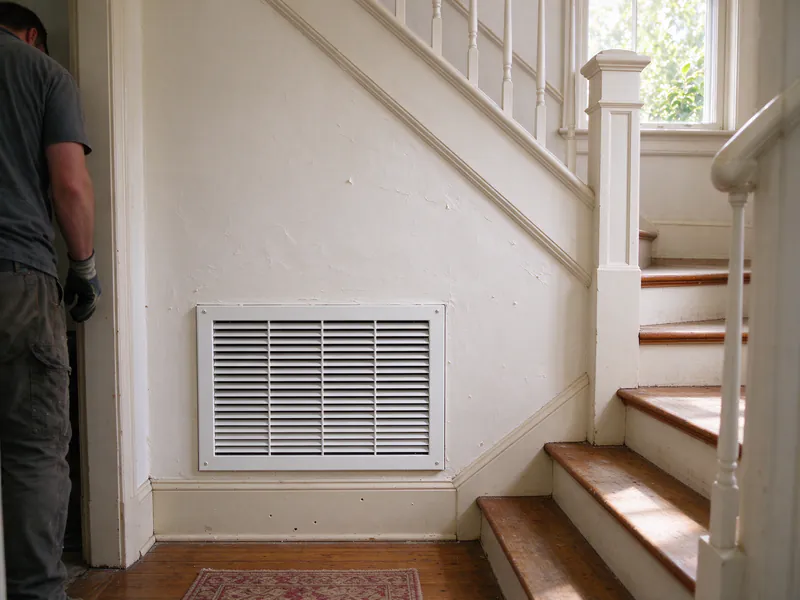
A house with a forced-air oil or gas furnace has the easiest path: we measure the ducts, fix what leaks, and reuse them. See furnace to heat pump for how we test them.
Where a basement stays damp after storms, we check the supply plenum and trunk for rust and seal every joint with mastic. Leaky basement ducts pull in moist air, and a heat pump moves more air for longer than the old furnace did, so leaks matter more.
Radiator houses
Older Winthrop houses on a hot-water or steam boiler have no ducts at all. Attic and basement air handlers, stacked closets or small-duct systems bring ducted heat without opening every wall. Our boiler conversion page and old house guide explain the routes.
Gas, oil and electric heat in Winthrop
About 64% of Winthrop homes heat with gas, 13% with oil and 19% with electricity. National Grid supplies both the electricity and the gas, which gives every fuel a path to Mass Save.
Oil and electric baseboard
These homes pay the most per unit of heat, so they gain the most from a cold-climate heat pump. Mass Save’s electric side, through National Grid, treats oil, propane and electric resistance as eligible systems to replace. See oil to heat pump conversion and oil tank removal.
Gas
Gas is cheaper per BTU, so the savings case is closer. Owners on gas tend to switch when the boiler or furnace is near the end or they want central cooling. National Grid is also the Mass Save gas sponsor here, so the whole-home rebate still applies when the gas system comes out.
The winter rate
National Grid’s heat pump rate lowers the distribution charge on your household electricity from November through April. It doesn’t touch the supply charge; our electric rate guide explains who gets it.
Permits, code and rebates in Winthrop
Winthrop takes building, electrical and sheet metal applications through its online permit portal. A ducted job needs an electrical permit and a sheet metal permit, plus gas where a line gets capped.
| What | Winthrop |
|---|---|
| Electric and gas utility | National Grid for both |
| Energy code | Stretch code since January 1, 2013; specialized code not adopted |
| Coastal status | Coastal community, Boston Harbor region |
| Flood elevation for equipment | Set per parcel where a FEMA flood zone applies |
| Rebate route | Mass Save, through National Grid |
Mass Save’s whole-home rebate is $2,650 per ton up to $8,500 for installs through December 31, 2026, and $2,350 per ton up to $7,500 from January 1, 2027. It needs cold-climate equipment and an installer in Mass Save’s network. Our rebate guide lists every condition, and the cost guide sets out our ranges.
How the work runs on a Winthrop job
Logan’s design temperature of 7°F sits just across the water, so that’s the number the load calculation uses. The rest of the job follows a set order.
- First visit: room-by-room load calculation, a duct leakage and static pressure check, the panel, and the outdoor spot judged for wind, spray and flood height.
- Written estimate: equipment with its capacity at 5°F, duct changes, electrical, any coastal coating, permits, the rebate path and the price.
- Permits, then an install of three to seven working days depending on ducts.
- Commissioning: nitrogen pressure test, vacuum below 500 microns, charge by weight, measured airflow, and backup heat lockout set.
Next door, Revere shares the salt exposure on a bigger housing mix, and Chelsea faces the same harbor from the other side.