Plenty of Medfield streets have a gas main under them and oil tanks in the basements beside them. If yours is one, you have three choices when the oil furnace wears out: convert to gas, switch to a heat pump, or run both.
Clement Boston Heat Pumps handles heat pump installation in Medfield, MA, and we lay the three side by side before recommending one. About one Medfield home in four still burns oil, and roughly one in twenty runs on propane.
Gas, heat pump, or both?
Each option solves the oil problem differently. The right one depends on your ducts, your panel, whether you want central cooling, and how long you plan to stay.
| Option | What it takes | What you end up with |
|---|---|---|
| Convert to gas | Gas service line, new furnace, new venting | Gas heat; cooling stays separate |
| Whole-home heat pump | Air handler on your ducts, outdoor unit | Heating and cooling from one system |
| Dual fuel | Heat pump plus a gas furnace for the coldest nights | Two systems, smaller rebate |
A gas conversion trades one fuel bill for another and puts new money into equipment that only heats. A heat pump replaces the AC too, and Mass Save’s whole-home rebate covers it. See oil to heat pump conversion and our heat pump vs gas furnace guide.
When dual fuel fits
If the house is large, loosely built, or you simply want a flame for the coldest nights, a heat pump with a gas furnace as backup works. A listed integrated control hands off at a set outdoor temperature, and Mass Save’s partial-home tier pays a smaller rebate. See dual-fuel heat pumps.
What each choice costs to run
Per unit of heat delivered, oil is the most expensive fuel in Massachusetts, then propane. A heat pump on Eversource’s winter rate lands well below both, and gas remains the cheapest.
Against oil and propane
Leaving oil or propane for a heat pump lowers the heating bill in most houses, and the summer cooling comes from the same equipment. Our heat pump vs oil guide shows how the numbers are built.
Against gas
Gas beats a heat pump per unit of heat on most days. The case for skipping it rests on avoiding the service line and furnace cost, getting cooling, and the larger rebate. We put both running costs in the estimate on your own rates.
Medfield colonials, and where the air handlers go
A typical Medfield colonial has a basement furnace feeding the first floor and an AC air handler in the attic for the second. That layout makes a two-system heat pump plan natural.
Two floors, two systems
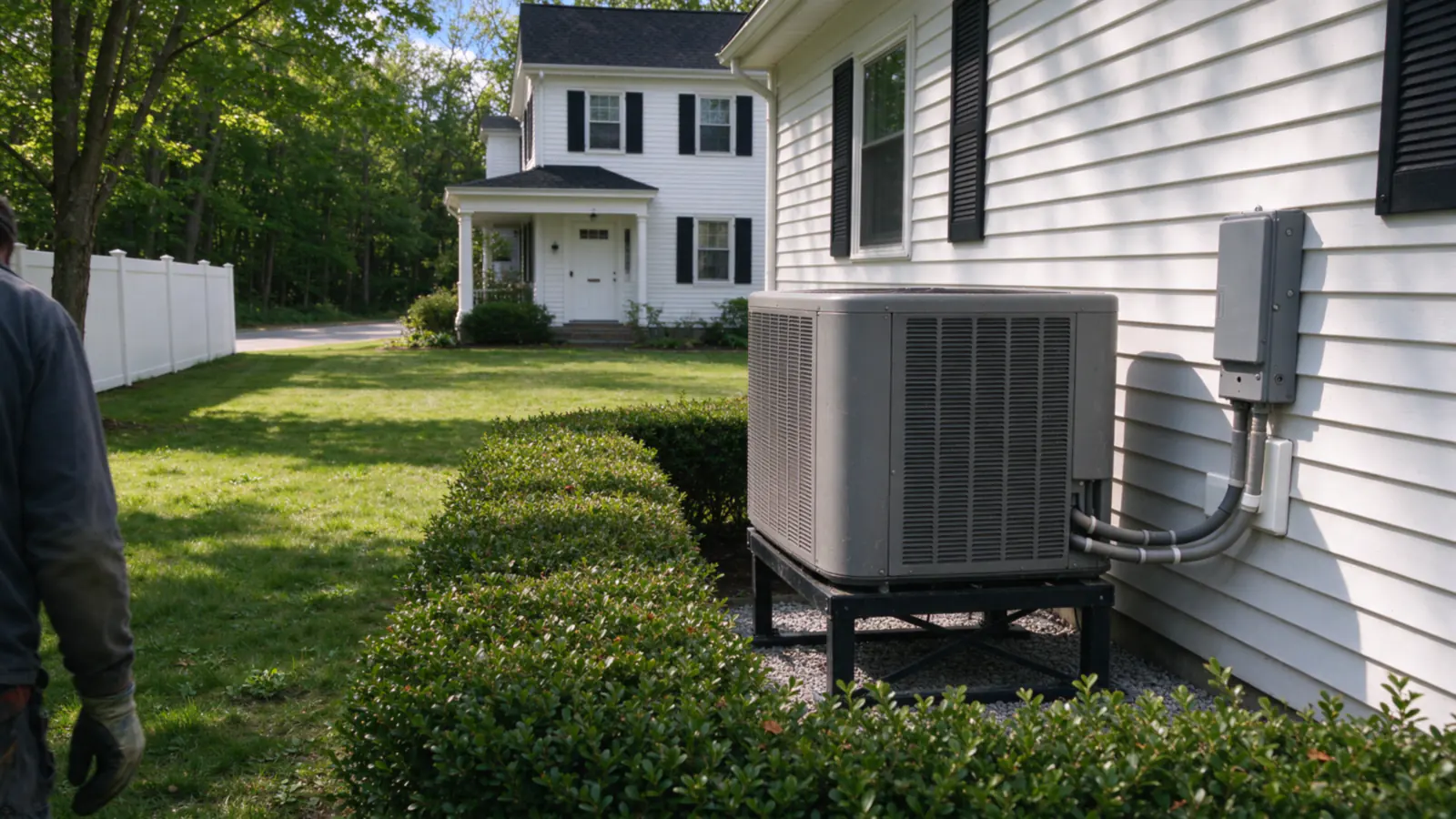
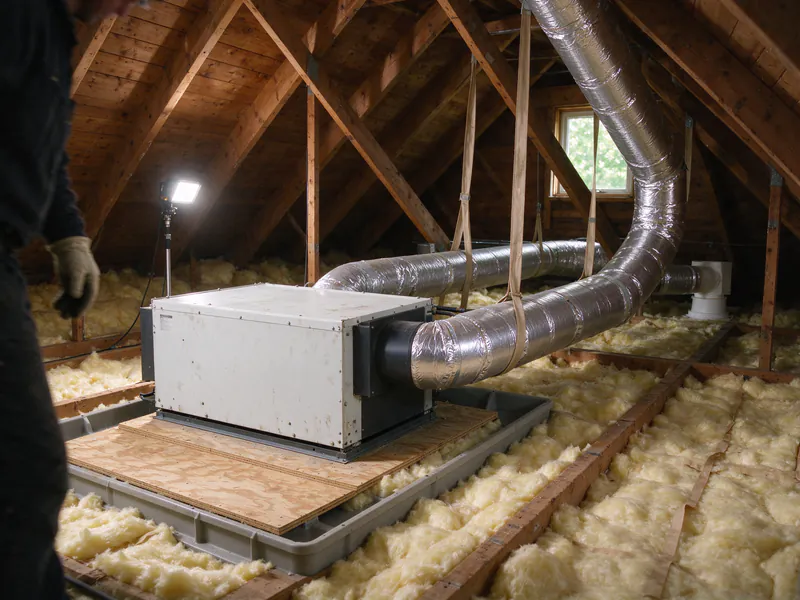
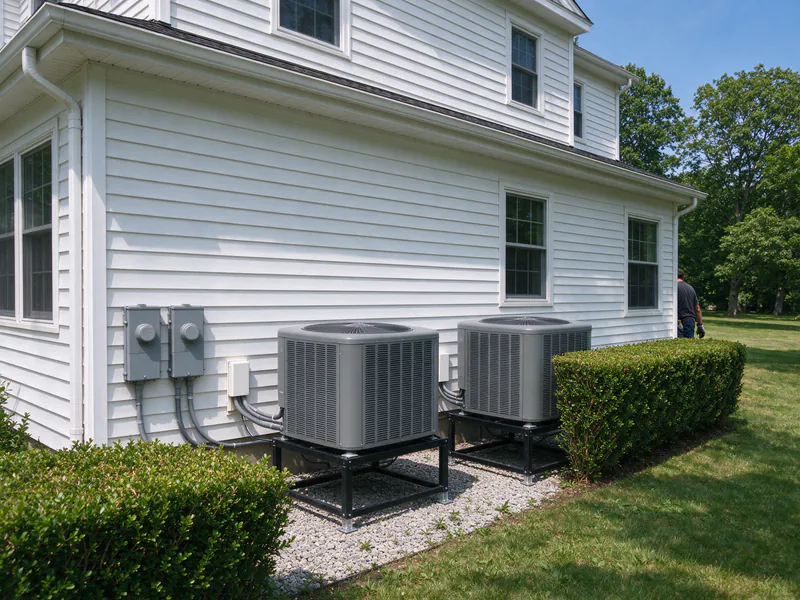
The basement air handler takes the furnace’s place on the existing plenum. The attic unit replaces the AC air handler on a platform with a secondary drain pan. Each is sized for its own floor, because the upper floor loses more heat through the roof. See attic air handlers.
Before we reuse the ducts
We measure static pressure, check return size and look for leaks in the attic, where a leak pulls cold air into the house all winter. Leaking flex gets replaced with sealed, insulated duct.
Older houses near the center
Fewer than one Medfield home in eight predates 1940. Where one heats with a boiler and has no ducts, closets that stack between floors carry a trunk, or a small-duct system threads through the walls.
Sizing in a town this far inland
Medfield sits about 17 miles from downtown Boston, along the Charles, and its winter nights run colder than the city’s. We size every system for that.
A room-by-room Manual J load calculation at your town’s design temperature sets the size. Equipment is chosen by its capacity at 5°F, and backup heat locks out above a set temperature. Our sizing guide explains each step.
Cooling the second floor
Eight in ten Medfield homes are detached houses, and in a two-story colonial the upstairs bedrooms are where summer heat collects. An attic AC that struggles in July is a common reason to start this conversation.
A heat pump in the attic does the cooling that AC did, with variable speed that runs longer at low output and pulls more moisture out of the air. The same unit heats the floor in winter. Our heat pump vs central AC guide compares the two.
Propane homes off the gas main
About 5% of Medfield homes heat with propane, usually where there’s no gas main. Propane costs more per unit of heat than gas, so the running-cost case is strong.
Extending a gas main to those streets isn’t an option you control, so the real choice is propane or electric. The propane company reclaims its own tank once the heat pump is carrying the house.
Same plan, same rebate
A propane furnace on ducts makes the same two-system plan as oil. Mass Save covers propane replacement on the same terms as oil; our rebate guide lists the conditions.
The paperwork in Medfield
The Town of Medfield’s building department issues the permits. The filing route, fees and any local noise rules are confirmed per address when we apply.
| What | The Medfield answer |
|---|---|
| Permits | Town building department: electrical, sheet metal, gas where capped |
| Energy code | Stretch code since January 1, 2017 |
| Electric utility | Eversource |
| Gas utility | Eversource Gas |
| Rebate program | Mass Save |
| Winter heat pump rate | Eversource, November 1 to April 30 |
Eversource’s winter heat pump rate lowers distribution and transmission charges on all household kilowatt-hours through the heating season.
Your first visit, and what follows
We start with the load calculation and the ducts, then the panel, the tank and the outdoor spot.
- Written estimate: equipment with its capacity at 5°F, duct changes, electrical, tank, permits, rebate path and price.
- Install: four to six working days for a two-system house on existing ducts.
- Tank: removed after the heat pump carries the house, for $600 to $1,500 when it’s accessible.
- Proving it works: both refrigerant circuits pass a nitrogen test and a vacuum under 500 microns, get charged by weight, and each floor’s airflow and static are read. The backup heat lockout goes on the start-up record, and the thermostats are set up with you before we leave.
Walpole shares Medfield’s utilities and its oil-heavy mix; Westwood sits closer in on Eversource.