Sudbury’s houses are young by Boston standards: barely one in twenty was built before 1940. That means full basements, attics with room to work, and in places beyond the gas main, a propane tank by the driveway.
Those houses suit ducted systems well, and that’s what Clement Boston Heat Pumps brings to heat pump installation in Sudbury, MA: cold-climate units on existing or new ducts, with the Eversource side of Mass Save paying toward the switch.
Propane, oil and the Eversource rebate path
About 62% of Sudbury homes heat with gas, 22% with oil and nearly 7% with propane. The oil and propane homes pay the most per BTU today, and Mass Save’s whole-home rebate covers replacing either fuel.
Why propane homes gain the most
Per delivered BTU, propane and oil both cost more than a cold-climate heat pump on Eversource’s winter rate. The truck stops coming, and the rebate pays $2,650 a ton up to $8,500 on installs through December 31, 2026. Our heat pump vs oil guide explains the comparison, which works the same way for propane.
The tank
A propane tank is usually the supplier’s property. If it only fed the furnace, the supplier disconnects and removes it; if it also feeds a range or fireplace, it stays. An oil tank in the basement comes out for $600 to $1,500 in our typical range; see oil tank removal.
Gas homes
Gas stays the cheapest fuel per BTU, so a gas-heated house switches mainly for central cooling or because the furnace is near the end. National Grid is the gas company here, and the whole-home rebate applies once the furnace comes out.
Large colonials, two floors, two systems
About 84% of Sudbury homes are detached houses, one of the highest shares among the towns we cover. Where a house runs to two full floors over a basement, one air handler rarely serves both well.
Basement and attic
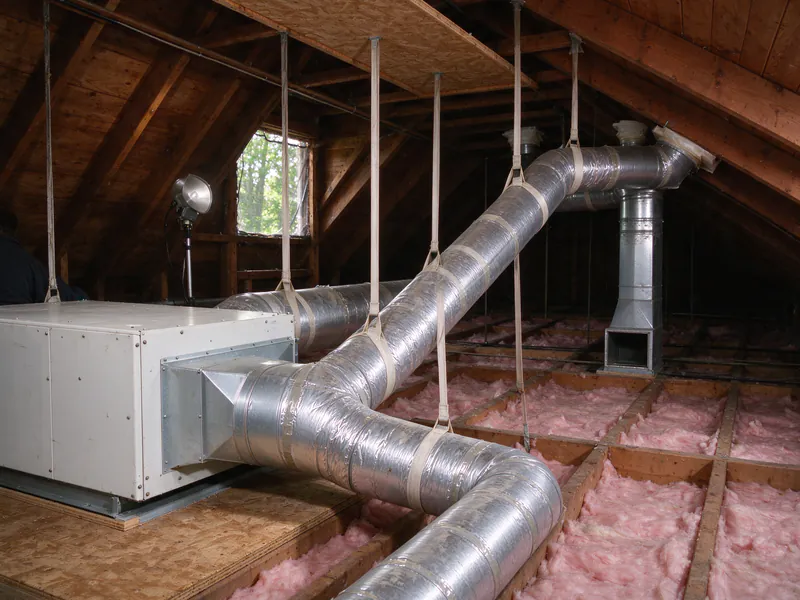
The basement unit feeds the first floor through the existing trunk, and an attic air handler serves the bedrooms through short ceiling runs. Each floor gets its own returns and thermostat. Where the attic already holds a cooling-only air handler, the heat pump takes its place.
Ducts that live in the attic
An attic is outside the heated house, so any duct up there loses heat in January and gains it in July.
We replace loose flex with sealed, insulated duct, mastic the joints and set the air handler on a platform with a secondary drain pan. The bedrooms get the air the unit made, not what’s left after the attic takes its share.
Variable speed for mild days
Most of a Sudbury winter is mild, not zero. A variable-speed unit runs low and steady through those hours, which evens out temperatures between floors and keeps cycling down; see variable-speed heat pumps.
Additions and bonus rooms
A room over a garage tends to run cold, with unheated space below it and weather on three sides. It can get its own small duct branch from the attic system rather than a separate unit. See heat pump ductwork.
What the specialized code changes, and what it doesn’t
Sudbury adopted the specialized energy code effective September 1, 2025. It sets the rules for new homes and major renovations, not for replacing the heat in an existing house.
- Replacing a furnace or boiler: a mechanical job with electrical and sheet metal permits, the same as before the code changed.
- Adding a wing or gutting a floor: the new space follows the specialized paths, which push toward all-electric heat or wiring for it.
- Building new: the plans set the heating approach from the start, and a ducted heat pump is the straightforward fit.
If you’re planning a renovation and a heating change together, tell us at the first visit. Running ducts while the framing is open costs less than threading them through finished rooms later.
Sizing west of Route 128
Sudbury sits inland, west of the Sudbury River, where winter nights run colder than at Logan Airport. We size from a room-by-room Manual J at your address’s design temperature, not the city’s.
Capacity at 5°F
The estimate lists what each unit delivers at 5°F, not just its nominal tons. That’s the number that decides whether backup strips ever run; our sizing guide explains the load calculation.
The outdoor spot
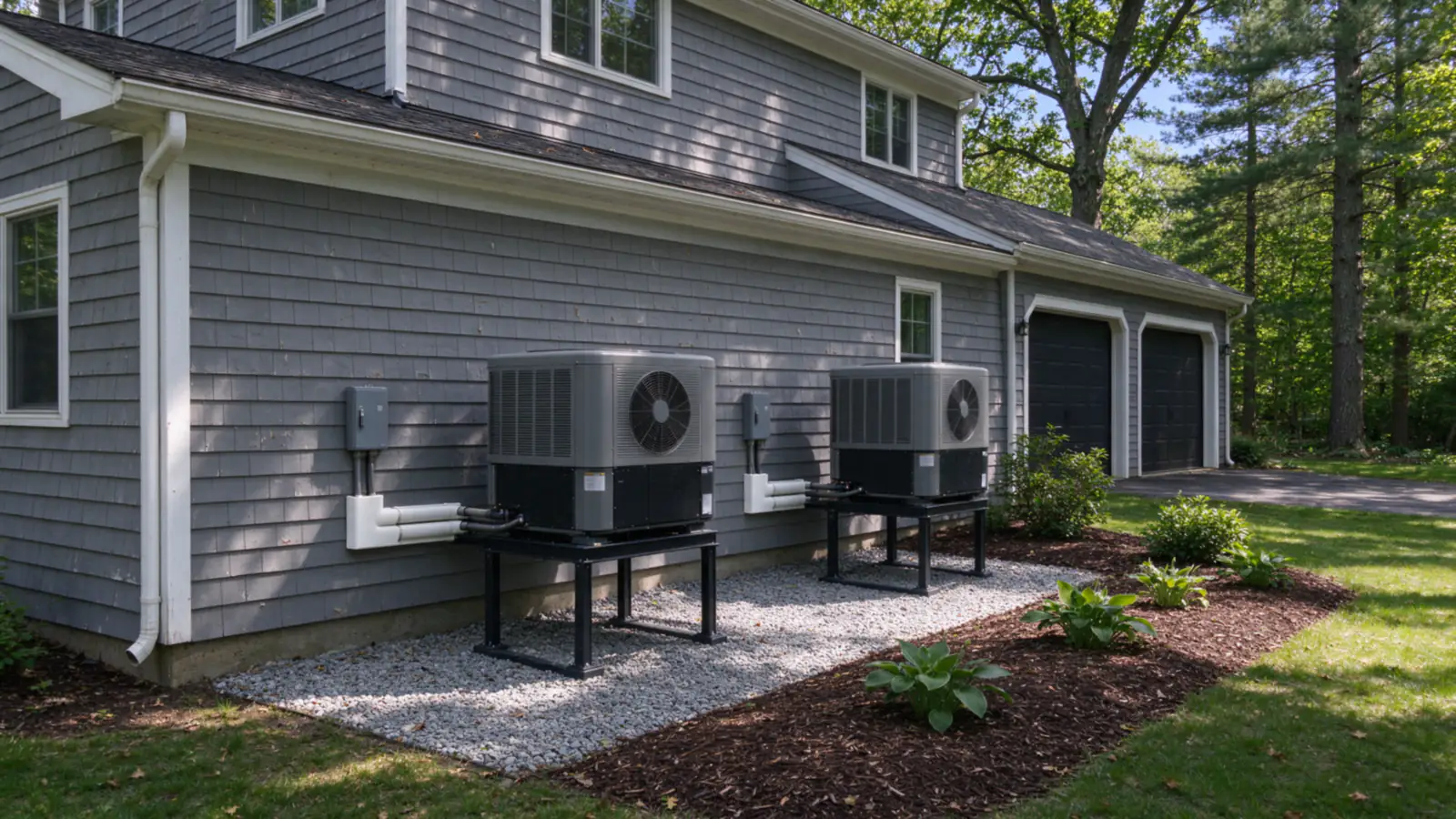
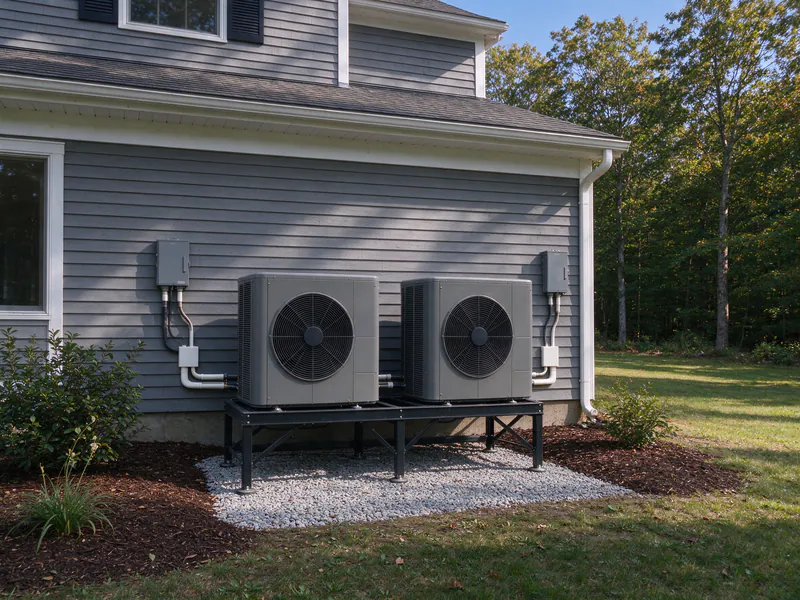
Setback and sound limits are confirmed per address. Where the lot allows, the unit goes to the rear or side, on a stand above drifting snow and out from under the roof edge, with its sound rating checked against the distance to the nearest neighbor’s windows.
Sudbury’s permits, rate and rebates
The Sudbury Building Department takes permit applications online through ViewPoint Cloud, so filing doesn’t wait on office hours.
| What | The Sudbury figure |
|---|---|
| Electric utility | Eversource |
| Gas company | National Grid (Boston Gas) |
| Energy code | Specialized code since September 1, 2025 |
| Heating fuel | Gas 61.9%, oil 22.2%, propane 6.6%, electricity 8.4% |
| Built before 1940 | About 6% |
| Online permits | ViewPoint Cloud |
Eversource’s seasonal heat pump rate cuts distribution and transmission charges on every household kilowatt-hour from November through April; see the winter rate guide. Installs from January 1, 2027 earn $2,350 a ton up to $7,500 under the whole-home tier, as the rebate guide explains.
What happens, step by step, in Sudbury
A first visit covers heat loss room by room, both floors’ ducts or the routes for new ones, the electrical panel, and the yard and driveway for unit and tank access.
- Written estimate: each system with its 5°F capacity, duct and return changes, electrical, permits, tank handling and the Mass Save path.
- ViewPoint filing, then four to six working days for a two-system house.
- The old system out, with gas capped by a licensed gas fitter or the propane supplier called for the tank.
- Commissioning: pressure and vacuum tests, refrigerant weighed in, airflow on each floor, strip heat lockout written on the air handler.
Wayland to the east shares the specialized code, while Concord to the north runs its own light plant rebate.