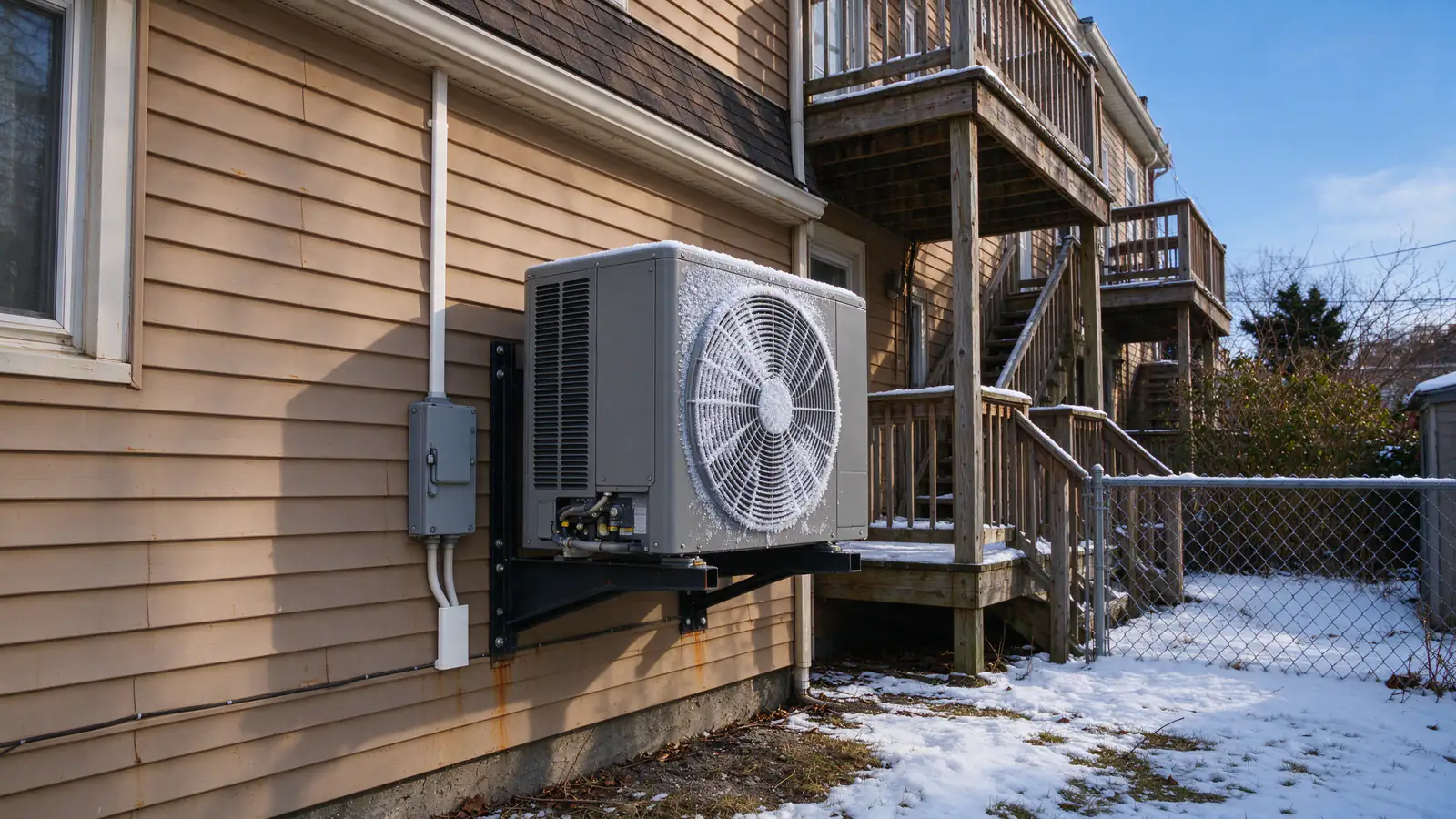
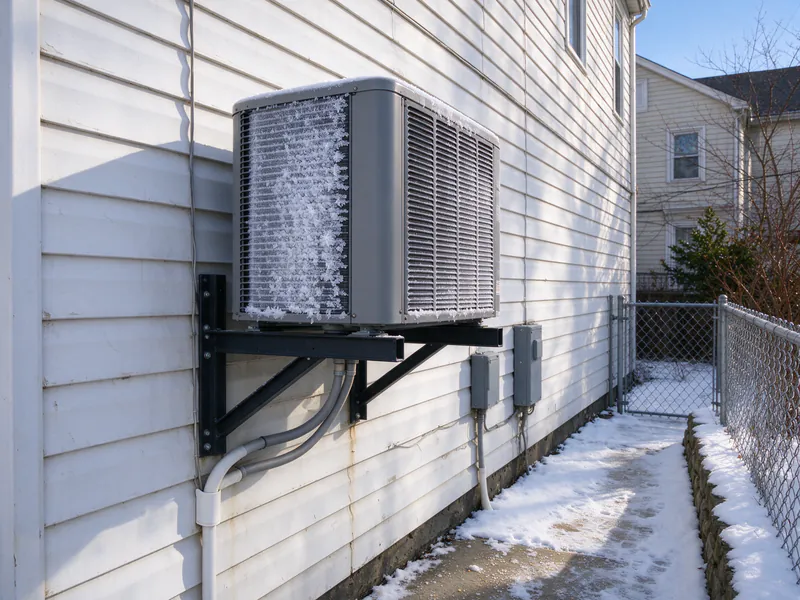
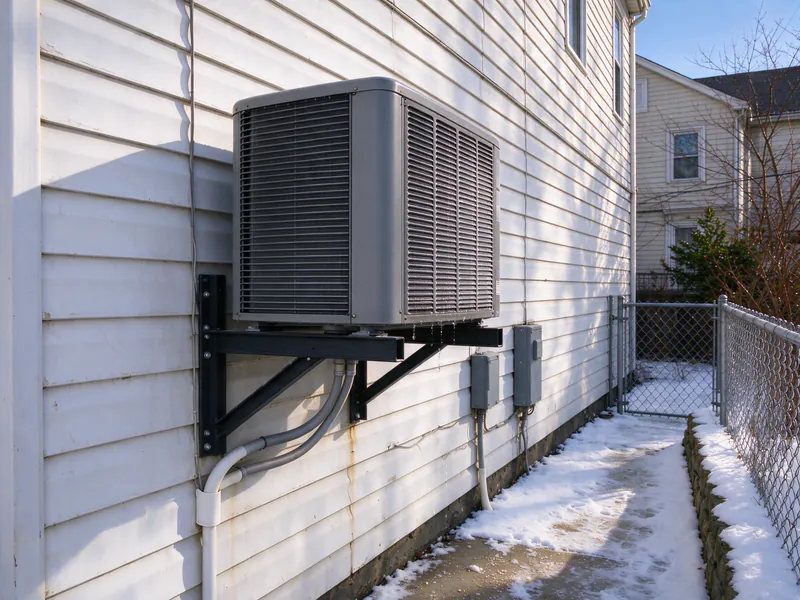
The house is cold, the thermostat says aux heat, and the outdoor unit is either silent or wrapped in ice. Clement Boston Heat Pumps handles heat pump repair in Boston and nearby towns for ducted heat pumps: the outdoor unit, the air handler and the controls between them.
We don’t repair gas furnaces, boilers or wall-mounted mini splits. On a ducted heat pump, we measure before we replace anything, and the repair price is in writing before the work.
Heat pump not heating?
Check the thermostat mode and the breakers first, then look at the outdoor unit. Cool air for a few minutes in January can be normal; a coil iced solid or aux heat all day is not.
Cool air during defrost
Every so often in cold, damp weather the unit reverses to melt frost off the outdoor coil. For those minutes the air at the registers feels cool unless backup heat covers it, and the outdoor unit may steam. That’s normal. Cool air for an hour isn’t, and neither is ice that keeps building.
Aux heat all day
If the thermostat shows aux or emergency heat on a 35°F day, the heat pump has stopped carrying the load. The cause can be a fault outside, a low charge, a thermostat setup problem or an undersized system. We test each before naming one. Our aux heat guide and thermostat guide cover the settings side.
Common ducted heat pump faults and their causes
A symptom narrows the list; it rarely proves the cause on its own. That’s why the repair starts with readings, not with a part off the truck.
| What you notice | What can cause it | What we check |
|---|---|---|
| Outdoor coil iced into a block | A failed defrost sensor or board, low charge, blocked airflow, snow over the unit | Sensor resistance, a forced defrost, pressures, clearance |
| On and off every few minutes | Oversizing, thermostat location or setup, low airflow, a failing part | Run times, static pressure, thermostat wiring |
| Water around the air handler | A clogged trap, sagging drain line, cracked pan, tripped float switch | The drain path, the pan, the switch |
| Outdoor fan or compressor won’t start | Capacitor, contactor, a tripped breaker, a failed motor | Voltage, capacitance, amp draw |
| Loud noise outside | A fan blade hitting ice, loose panels, a worn motor bearing, vibration through the stand | Fan, mounts, compressor sound under load |
| A high bill with the house comfortable | Backup heat running too much, a lockout setting, duct leaks | Lockout, aux run time, duct static |
Short cycling and a high bill can go back to how the system was sized and set up. When that’s the cause, a part won’t fix it, and we say so. The sizing guide explains why.
What happens on a repair visit
We start with what you saw and when. Then we read the fault codes, watch the system run through its sequence, and take electrical and refrigerant readings before touching a part.
- Codes and pattern. Fault codes on the board or thermostat, and when the problem shows: only in deep cold, only in cooling, only at night.
- Electrical tests. Sensors against the maker’s resistance chart, capacitors against their rating, contactor and board outputs.
- Refrigerant readings. Pressures and temperatures, superheat and subcooling, compared with the maker’s targets.
- Airflow. Static pressure and the filter, because a choked air handler looks like a refrigerant problem.
You get a written price for the repair. When the numbers point to a failing compressor or a leaking coil on an old system, a replacement estimate sits beside it.
Refrigerant leaks get found, not topped off
A heat pump doesn’t use up refrigerant. A low charge means a leak, and adding refrigerant without fixing it means buying the same refrigerant again next winter.
We find the leak with an electronic detector, bubble solution or a nitrogen standing test, repair it, pressure-test with nitrogen, pull a vacuum below 500 microns and weigh the charge back in. Flare joints at the air handler and line sets rubbing on framing are places to look first.
Older refrigerants
A system on R-22 can still be repaired with reclaimed refrigerant, but it’s expensive and the equipment is old. Newer systems use R-410A or R-454B, and their parts aren’t interchangeable. Our refrigerant guide explains the change.
Near the harbor, salt is part of the diagnosis
In East Boston, South Boston, Winthrop, Revere and along the Quincy shore, salt air works on outdoor coils, fin edges and electrical connectors. Near the water, sensor plugs and fan motors get checked early.
Makers of coastal units advise keeping the unit out of direct spray, letting rain wash it instead of tucking it under an eave, and rinsing it with fresh water. We clean the salt film as part of the repair, and a yearly heat pump maintenance visit keeps it from building back.
When repair stops making sense
A failed compressor or a leaking outdoor coil on a system past its middle years costs a large share of a new one. That’s when we put both numbers in front of you.
Our typical range to replace an existing ducted heat pump is $12,000 to $24,000. Replacing a heat pump qualifies for Mass Save’s basic rebate, $250 per ton up to $2,500, not the larger whole-home amount. See heat pump replacement and the lifespan guide.
Indoor parts on their own
A cracked drain pan, a failed blower motor or a leaking indoor coil doesn’t always mean a new outdoor unit. Where the outdoor unit is sound and the refrigerants match, air handler replacement can be the right repair.
What we don’t take on
Gas furnaces, boilers, oil burners and wall-mounted ductless units are outside what we repair. If a dual-fuel system’s furnace side fails, a heating contractor handles the burner; we check that the heat pump and the controls hand off to it correctly once it’s fixed. A dual-fuel heat pump page explains how that handoff is set.