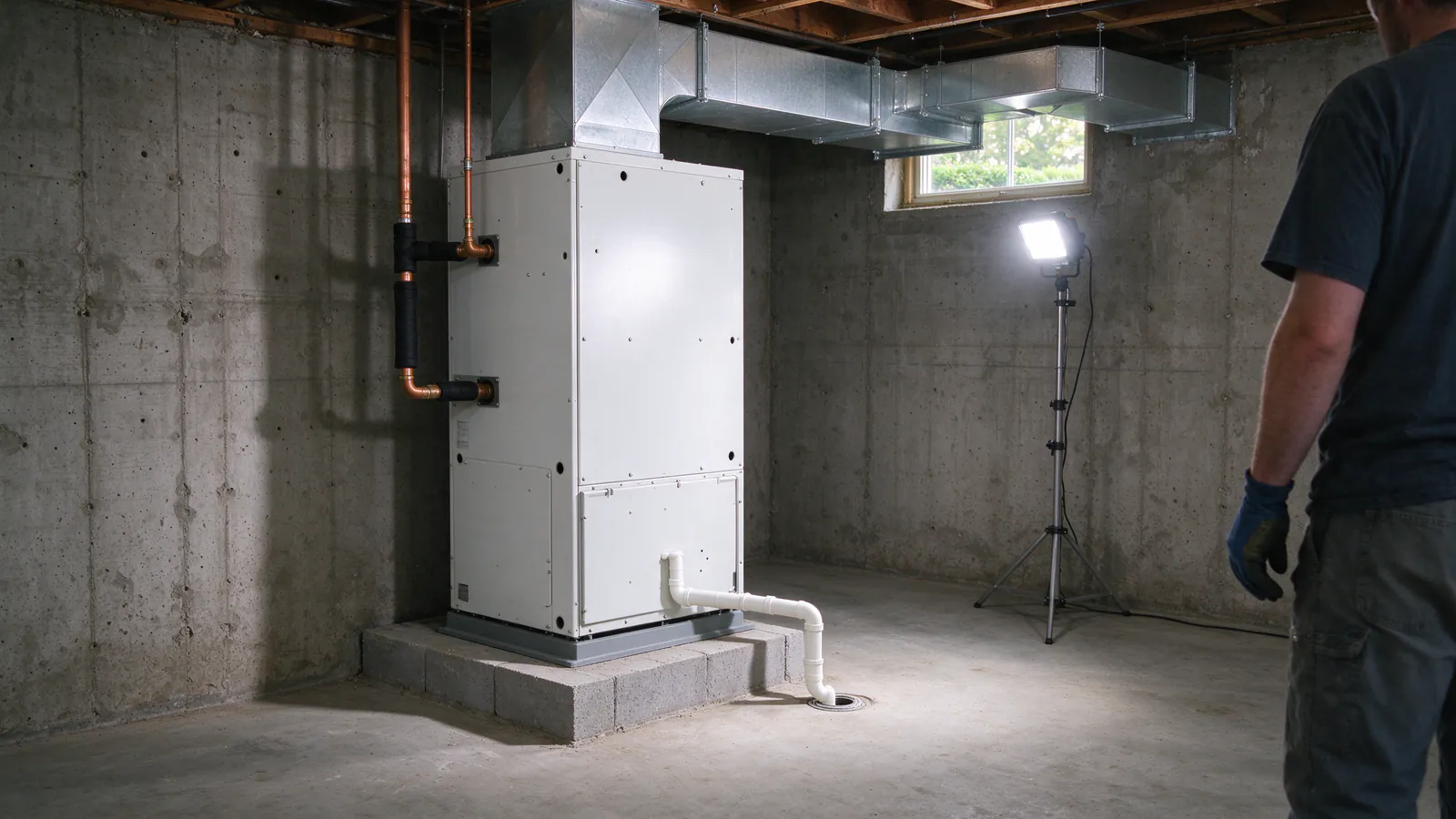
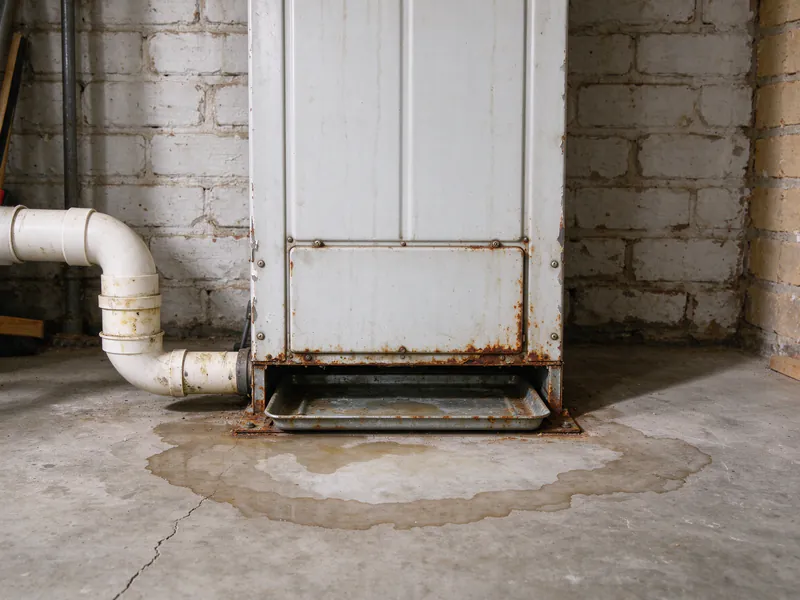
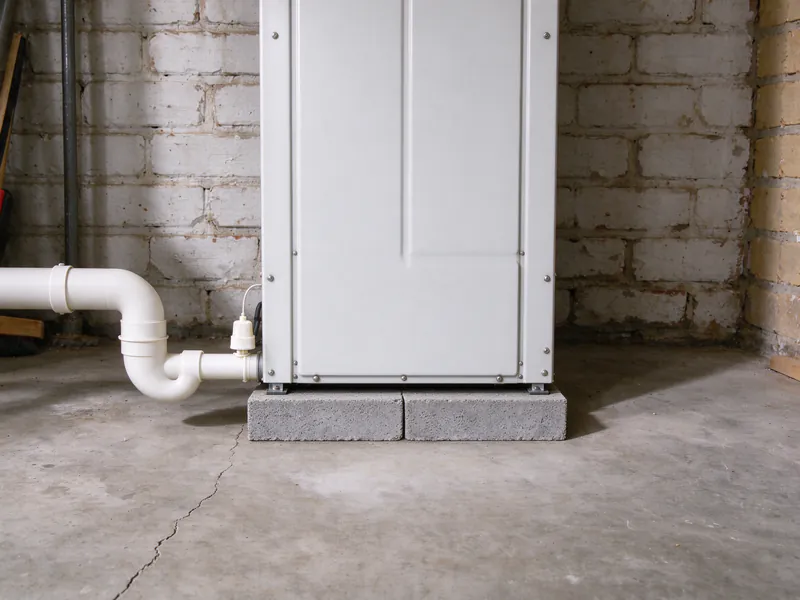
Water under the basement air handler, a coil that needs refrigerant every season, a blower that barely moves air: the indoor half is failing while the outdoor unit still has years left. Clement Boston Heat Pumps handles heat pump air handler replacement across Boston and nearby towns, matching the new indoor unit to the outdoor unit you keep.
Our typical range for an air handler replacement is $1,500 to $4,200 and up, for the air handler alone, matched to the existing outdoor unit. Duct changes are separate lines, and the home visit and written estimate set your price.
What the air handler does
The air handler is the indoor half of the system. It holds the refrigerant coil, the blower, the metering device, the backup strips and the drain pan, and pushes heat or cooling through your ducts.
- Coil. In winter it releases heat into the air; in summer it pulls heat and moisture out.
- Metering device. A thermostatic or electronic expansion valve that feeds refrigerant to the coil. On a heat pump it has to work in both directions of flow.
- Blower. Current units mostly use a variable-speed motor that holds airflow steady as filters load and dampers move.
- Backup strips. Electric elements for defrost and the coldest hours, rated in kilowatts.
- Drain pan and trap. Collect summer condensate; a float switch shuts the system off if the drain backs up.
Do you have to replace the air handler with the heat pump?
Not always. It depends on what you’re replacing and how old each half is.
Replacing a worn-out heat pump
A new outdoor unit runs on a newer refrigerant, so the indoor unit changes with it. That’s a full heat pump replacement, priced in its own range.
Converting from central AC
An AC-only coil may not be rated for heating duty, and its metering device may only work one way. Most AC air handlers get replaced in a conversion; see replacing AC with a heat pump.
Keeping a newer outdoor unit
This is the job this page covers. The outdoor unit is a few years old and healthy, and the indoor unit has failed. We replace the air handler with one the manufacturer lists as a match for that outdoor model.
Why the match decides how it performs
A heat pump’s capacity and efficiency ratings come from testing a specific outdoor unit with a specific indoor coil. Swap one half for an unlisted part and those ratings no longer describe your system.
A coil that’s wrong for the refrigerant flow starves or floods, ices up in cooling and gives up heat output in winter. The AHRI directory lists the combinations tested together. We choose from that list, and your closeout shows the matched pair with its SEER2 and HSPF2 ratings.
When the outdoor unit runs on R-410A
Many outdoor units installed a few years ago run on R-410A. Matching R-410A air handlers are still made for servicing existing systems, so a healthy outdoor unit doesn’t force a whole new system. We confirm the listed match and its availability before quoting; the refrigerant guide covers the change.
Signs the indoor unit is the problem
These point to the air handler, though none proves a single cause on its own. We test before we price.
- Rust through the cabinet floor or drain pan, and water under the unit.
- Repeated refrigerant top-ups, with the leak traced to the indoor coil.
- Weak airflow at every register with a clean filter, from a failing motor or a fouled coil.
- Strips that trip their breaker or smell of burning well past the first cold days.
- Ice on the indoor coil while cooling.
Several of those also come from ducts, controls or charge. A choked return or a duct problem can look like a weak blower, so we read static pressure before blaming the unit.
How the swap is done
In a basement, the swap is about a day on site. The refrigerant work decides whether the outdoor unit you kept still performs as rated.
- Recover the remaining charge, or pump it into the outdoor unit if the coil still holds.
- Disconnect power, controls, drain and ducts, and remove the old unit.
- Set the new cabinet level, on a block off a damp floor where needed, and refit the plenum and return.
- Size the strips to the house and the circuit, not to whatever the old unit carried.
- Braze the lines under nitrogen, pressure-test, and pull a vacuum below 500 microns.
- Charge by weight for the actual line length, then confirm with subcooling or superheat as the instructions require.
- New trap, drain and float switch; airflow and static measured; thermostat and lockout set.
Why the strips get resized
Old air handlers often carry 10 kW of strips because that’s what came in the box. If the heat pump covers the house down to a few degrees above zero, 5 kW may be plenty, which means a smaller breaker and less panel load. We size the strips from the load calculation and record the outdoor lockout temperature.
Basement, closet or attic
Where the unit sits changes the job more than the unit itself. A basement swap is simplest; closets and attics add access, drainage and sometimes framing work.
Closet units in condos and triple-deckers have tight openings, so the new cabinet has to fit the space it replaces. Attic units need a platform, a secondary pan with its own float switch and a route out through the hatch; see our attic air handler page.
What sets the price, and rebates
Mass Save’s heat pump rebates are paid on qualifying whole systems, so an air handler swap on its own normally falls outside them. The price comes down to a handful of drivers.
- Cabinet size and blower type.
- Strip kilowatts and the circuit they need.
- Access: open basement, tight closet or attic.
- Line length, and whether old flare joints are replaced with brazed ones.
- Plenum and drain changes to fit the new cabinet.
Our cost guide shows how this job sits beside full replacements, and heat pump repair covers single-part fixes.