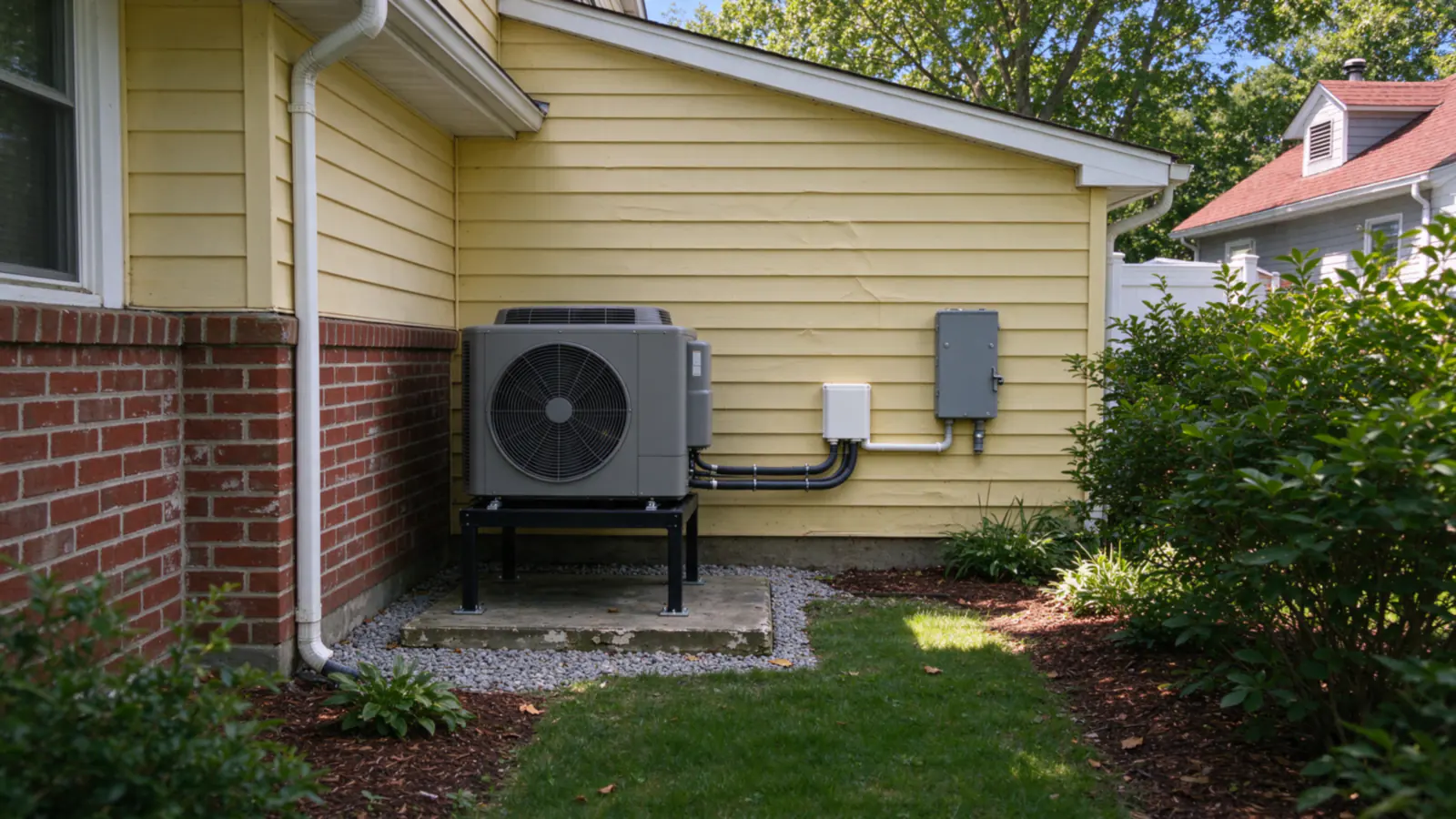
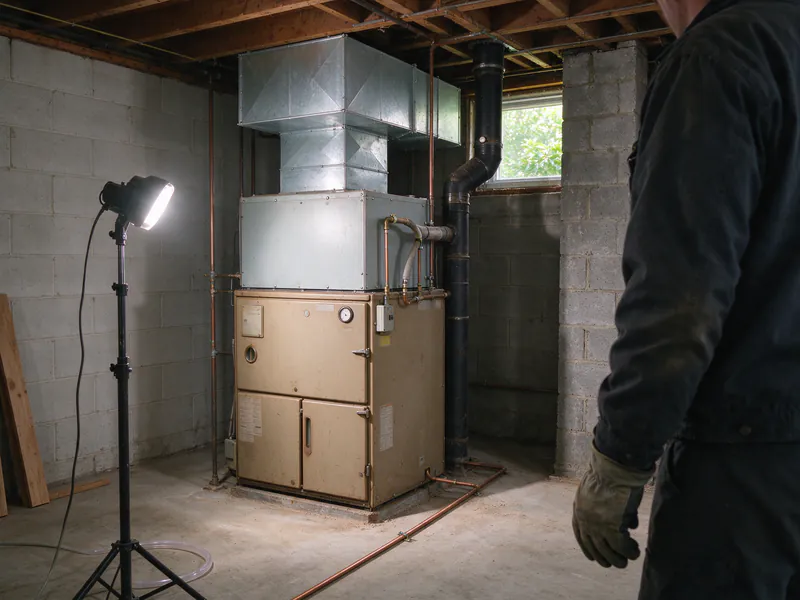
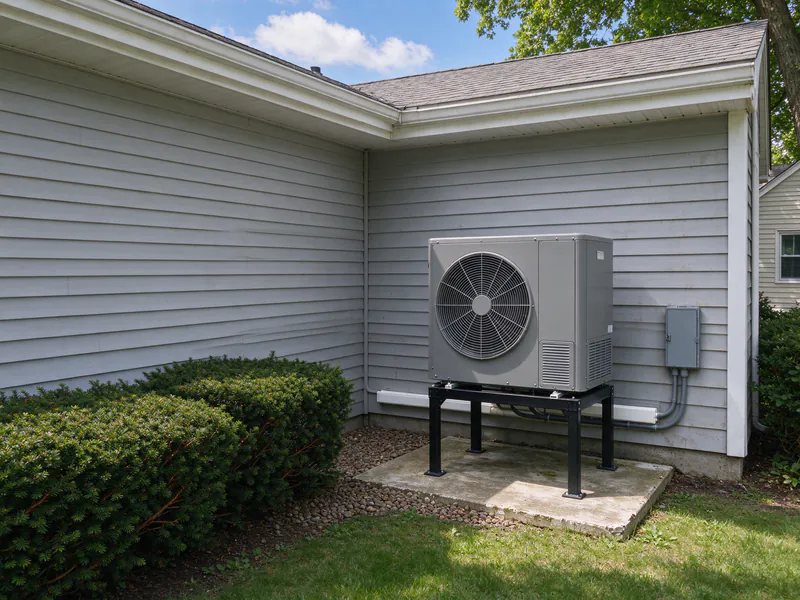
A Burlington ranch or split-level with central air already has most of what a ducted heat pump needs: ducts that reach every room and a pad outside for the condenser. Clement Boston Heat Pumps builds each heat pump installation in Burlington, MA on that head start, then checks whether the ducts can carry winter air.
That makes many jobs here shorter than in older towns. About 94% of Burlington’s homes were built after 1939, mostly with forced air.
Ducts that are already there
A furnace and central air leave a duct system the heat pump can reuse. The question is whether ducts sized for summer cooling and a furnace’s hot air move enough air for a heat pump in January.
What we measure
We read total static pressure with the blower running, size the return against the airflow the new system needs, and look for leaks at the plenum and joints in the basement or attic. A heat pump moves more air at a lower temperature than a furnace, so a tight return is the most common fix.
Fixes that keep it a short job
A second return grille, a larger filter rack or a sealed plenum often solves it without opening ceilings. When a branch is undersized, we replace just that run; see heat pump ductwork.
Replacing only the air conditioning
If the AC is the part that’s worn out, a heat pump can replace it and share the work with the furnace. Our heat pump vs central AC guide compares the two, and replacing AC with a heat pump explains the job.
When the house has a boiler and no ducts
Not every Burlington house came with forced air. Some ranches and colonials heat with an oil or gas boiler and baseboard, with window units or nothing for cooling.
Ranches
A one-story ranch is the easiest boiler house to convert. The air handler goes in the attic or the basement, and short branches drop to ceiling or floor registers in every room. Our attic air handler page explains the attic option.
Colonials and split-levels
Two-story houses usually split into two systems: one in the attic for the bedrooms and one in the basement for the main floor. Where a closet stacks between floors, one system can sometimes serve both. See boiler to heat pump conversion.
Condos and townhouses
About 22% of Burlington homes sit in buildings of five or more units, many of them complexes near Route 128 and Route 3. The equipment choice there follows the association’s rules as much as the load.
What the association decides
The master deed sets where outdoor units can sit, how line sets cross shared walls and who maintains them afterward. A compact air handler in a closet usually replaces the old furnace or AC unit in place; see condo heat pump replacement.
Oil, gas and the Eversource winter rate
About 52% of Burlington homes heat with gas and 32% with oil, well above the state’s 22% oil share. Both groups qualify for Mass Save, through Eversource on the electric side or National Grid on the gas side.
- Oil homes drop the costliest common fuel. The tank comes out under the fire department’s permit; see oil to heat pump conversion.
- Gas homes switch for cooling, a tired furnace or one system year-round; see furnace to heat pump conversion.
- Electric heat homes, about 12%, swap baseboard that gives one unit of heat per kilowatt-hour for equipment that gives two to three.
The winter rate
Eversource’s heat pump rate lowers distribution and transmission charges on every kilowatt-hour from November 1 to April 30. Mass Save rebate recipients are usually enrolled automatically; see the electric rate guide.
Mass Save timing: this year or next
The whole-home rebate steps down on January 1, 2027, from $2,650 a ton up to $8,500 to $2,350 a ton up to $7,500. For a three-ton house, that is $900 less.
What the rebate needs
Cold-climate listed equipment, an installer in Mass Save’s network, the old system removed or disconnected, and proof of weatherization. We install qualifying equipment as a participating contractor; the rebate guide covers the details.
Paying over time
Mass Save’s HEAT Loan offers 0% financing up to $25,000 through participating lenders, and you apply before work begins. The HEAT Loan guide explains the steps.
Sizing for Hanscom’s cold nights
Burlington borders Bedford, where Hanscom Field averages about 5.3 nights a year at or below 0°F against 0.6 at Logan. Those nights set the size of the system, and they come more often here than closer to the harbor.
We calculate the load room by room at Burlington’s design temperature and choose equipment by its capacity at 5°F. Sizing to the full heating need also earns Mass Save’s $500 sizing bonus; our sizing guide explains the method.
Rebates, rates and permits for Burlington houses
Burlington takes permit applications through its OpenGov portal. The exact set is confirmed per address, usually electrical plus the mechanical permit for equipment and ducts.
| What | The Burlington figure |
|---|---|
| Electric utility | Eversource |
| Gas utility | National Grid |
| Mass Save whole-home rebate | $2,650 a ton up to $8,500 through 2026; $2,350 a ton up to $7,500 from January 1, 2027 |
| Energy code | Stretch code since July 1, 2019 |
| Built after 1939 | About 94% of homes |
| Heating fuel | Gas 52.1%, oil 31.8%, electricity 11.8% |
Where new ducts are needed, our typical range is $20,000 to $40,000 and up before rebates. The cost guide lists our other ranges and what moves them.
What to expect on a Burlington job
With ducts in place, most Burlington installs run two to four working days. The first visit decides whether that holds.
- Visit: load calculation, static pressure and return check, panel, and the old condenser pad.
- Estimate: equipment with 5°F capacity, duct fixes, electrical, permits, rebate tier and price.
- Install: air handler swap, outdoor unit, line set, and the furnace and tank removed if planned.
- Commissioning: nitrogen pressure test, vacuum below 500 microns, charge by weight, airflow and backup lockout set.
Woburn, Bedford and Lexington border Burlington, each with its own permit office.