Inside Marblehead’s town line there is more than three times as much water as land, and no house sits far from salt air. Clement Boston Heat Pumps plans every heat pump installation in Marblehead, MA around that exposure first, and around houses that were mostly built long before anyone pictured ducts.
The rebate comes next. Marblehead buys its power from its own light department, which pays by the ton and caps the tons each year.
Salt air and the outdoor unit
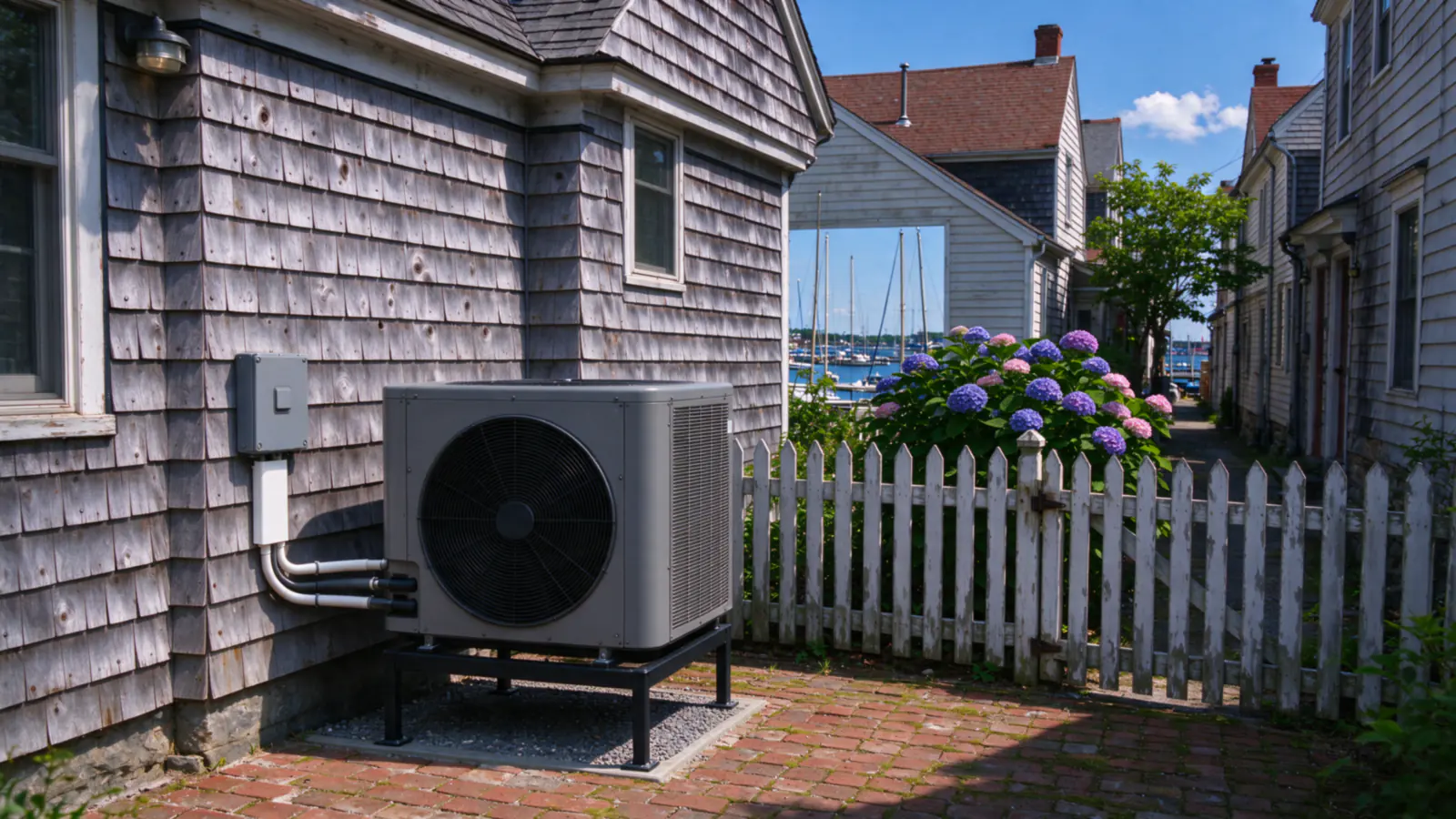
On a peninsula, the outdoor unit’s spot matters more than the brand. Spray carries salt onto coils and fasteners, and a coil that corrodes loses capacity long before the compressor wears out.
Shelter, height and rinsing
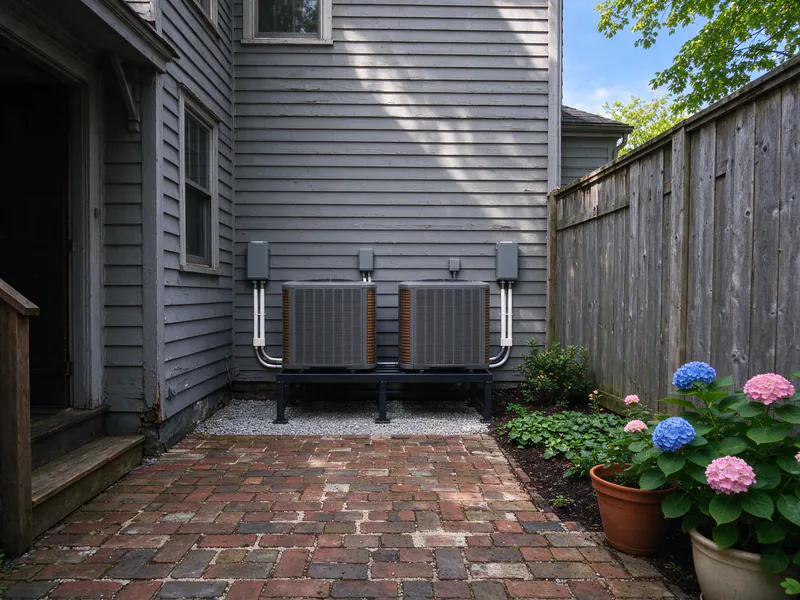
We put the unit on the side of the house away from the prevailing spray, raised on a stand that clears drifting snow and lets rain wash the coil. Where a house faces the open ocean on the Neck or at Devereux, we can spec a factory-coated coil. Our outdoor unit placement guide covers clearances.
Tight lots in Old Town
Lanes near the harbor leave little room between houses. A rear yard or a side set back from the street keeps the unit quieter for neighbors and out of view. Marblehead’s local sound and exterior-review rules are confirmed per address before we choose.
Old houses, and where the ducts can go
About 46.5% of Marblehead’s homes were built before 1940, far above the state’s 30.5%. Most were built for a boiler and radiators, with plaster walls and no chases, so routing ducts is the real design work.
Attic down, basement up
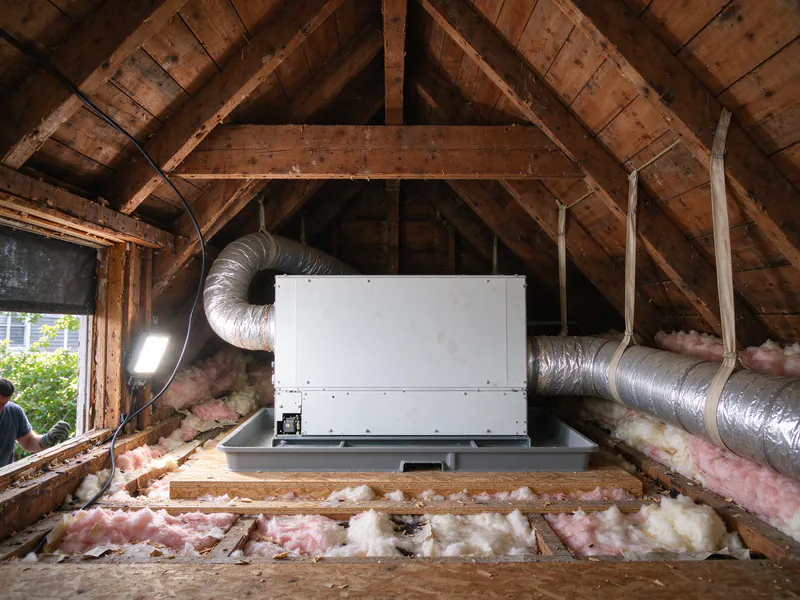
The usual answer is two smaller systems: an attic air handler that reaches the bedrooms through the ceiling, and a basement unit that feeds the first floor through floor registers. A closet that stacks between floors carries a return. See the attic air handler page and heat pumps in old houses.
When the attic is tight
Low, steep roofs on some Old Town houses leave little attic space. Small-duct high-velocity runs fit through gaps a standard trunk can’t, at a higher price; see heat pump ductwork.
Postwar houses in Clifton and Devereux
Newer houses farther from the harbor more often have a furnace and ducts already. Those ducts get measured for static pressure and return size before we decide they can carry heat pump air.
The light department’s rebate and the three-ton limit
The Marblehead Municipal Light Department pays $500 a ton for qualifying air-source heat pumps and $750 a ton for ground-source, with a limit of three tons of heat pumps per year.
What qualifies
The equipment has to meet SEER2 15.2, HSPF2 8.1 and a COP of 1.75 at 5°F. Most cold-climate ducted equipment clears those numbers; we check the exact model on the estimate. The ratings guide explains what each figure measures.
Planning around three tons
At $500 a ton, three tons returns $1,500. Many older Marblehead houses need about that much once air sealing is done, so the load calculation and the limit often line up. A larger house can phase a second system into a later year, though the first system should never be undersized to fit; our sizing guide explains why.
Gas, oil and the running cost
About 74% of Marblehead homes heat with gas, 17% with oil and 7% with electricity. Gas is the cheapest fuel per delivered BTU, so most owners here switch for comfort, cooling or an old boiler.
- Gas boiler homes: National Grid supplies the gas and sponsors Mass Save, and the light department’s decision tree points eligible homes there. See heat pump vs boiler.
- Oil homes: the running-cost gain is largest, and the basement tank comes out under the fire department’s permit; see oil tank removal.
- Electric heat: a heat pump delivers two to three times the heat of baseboard for the same power.
Older wiring and the electrical panel
A house that has run on a gas or oil boiler for decades may still have a small electrical service. A heat pump and its backup strips add a large new load, so the panel gets checked on the first visit.
What we check
We total the house’s existing loads against the service size, look at the panel’s spare spaces, and note any old wiring the electrician will have to work around. Often a 100-amp service carries a right-sized system with careful backup settings.
When it needs an upgrade
If the load calculation says the service is too small, the upgrade goes on the estimate as its own line. Our typical range for an electrical service upgrade, usually 100 to 200 amps, is $3,000 to $6,500, coordinated with the light department’s meter work; see panel upgrades for heat pumps.
Rebates, rates and permits for Marblehead houses
The town’s building department issues the permits, and the exact set is confirmed per address. Marblehead runs the stretch energy code and has not adopted the specialized code.
| What | The Marblehead figure |
|---|---|
| Electric utility | Marblehead Municipal Light Department |
| Gas utility | National Grid |
| Air-source rebate | $500 a ton, three tons of heat pumps per year |
| Equipment minimums | SEER2 15.2, HSPF2 8.1, COP 1.75 at 5°F |
| Energy code | Stretch code since July 1, 2018 |
| Built before 1940 | 46.5% of homes |
The state lists Marblehead among its coastal communities on the North Shore. The cost guide sets out our ranges and what moves them.
Visit, estimate, install: the Marblehead sequence
The first visit settles three things in order: where the outdoor unit can live with the salt, how the ducts reach each floor, and how many tons the house needs against the yearly limit.
- Visit: room-by-room load, routes through attic, basement and closets, the panel, and the unit spot.
- Written estimate: equipment with its 5°F capacity, duct work, electrical, permits, rebate and price.
- Install: five to ten working days for new ducts in an occupied old house.
- Commissioning: nitrogen test, deep vacuum, charge by weight, airflow measured, controls set.
Neighbors Swampscott, Salem and Lynn each have their own utility and rebate path.